
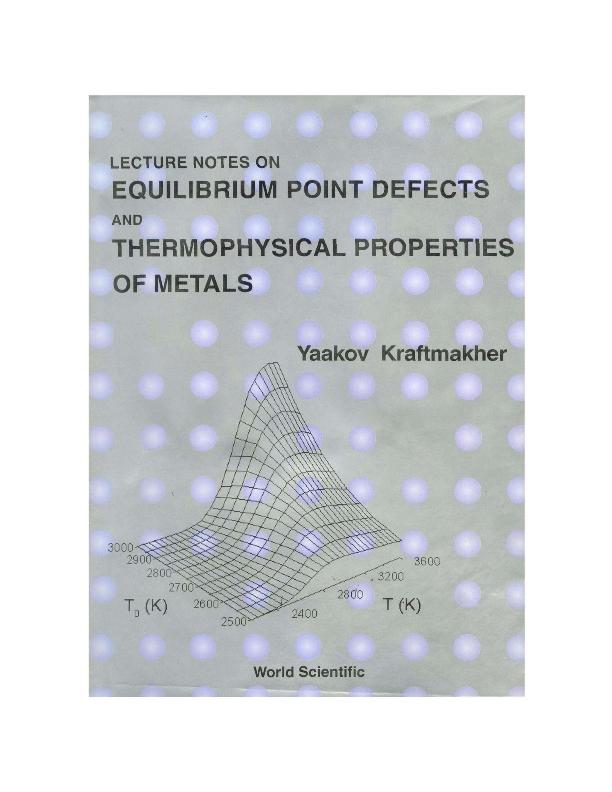
Despite the significant progress in the study of point defects in metals, some important problems still do not have unambiguous solutions. One of the most practically important questions relates to equilibrium defect concentrations. There exist two opposite viewpoints: (1) defect contributions to physical properties of metals at high temperatures are small and cannot be separated from the effects of anharmonicity; the equilibrium defect concentrations at the melting points are in the range of 10-4 to 10-3; (2) in many cases, defect contributions to the specific heat of metals are much larger than nonlinear effects of anharmonicity and can be separated without crucial errors; the equilibrium concentrations at the melting points are of the order of 10-3 in low-melting-point metals and 10-2 in high-melting-point metals.This book discusses the experimental results and theoretical considerations favoring each claim. At present, the majority of the scientific community hold the first viewpoint. Regrettably, the data supporting the second viewpoint have never been displayed and discussed together, and the criticism of this viewpoint has never included a detailed analysis. Important arguments supporting this viewpoint have appeared in the last decade. It may turn out that just calorimetric determinations provide the most reliable values of equilibrium defect concentrations in metals. In this book, the main attention is paid to equilibrium point defects in metals and their relation to thermophysical properties of metals. Along with a discussion on experimental data and theoretical estimates now available, some approaches are proposed that seem to be most suitable for settling the question.
Zahle einfach mit Karte, Klarna, Apple Pay oder Google Pay. Nicht zufrieden? Du hast immer ein 14-tägiges Widerrufsrecht. Lies mehr in unseren AGB. Hast du Fragen, schreib uns eine E-Mail an hello@memmo.org.
Memmo macht das Lernen einfacher – wo auch immer du bist. Bei uns findest du deine Kursbücher und smarte Lerntools an einem Ort: Zusammenfassungen, Quizzes, Podcasts und Lernkarten. Und Ted, dein Lernbuddy, beantwortet alles, was du wissen möchtest. Über 50.000 Studierende lernen bereits hier – gemacht, damit du schneller lernst und weniger Stress hast.
Das könnte dir auch gefallen
Buch kaufen0