
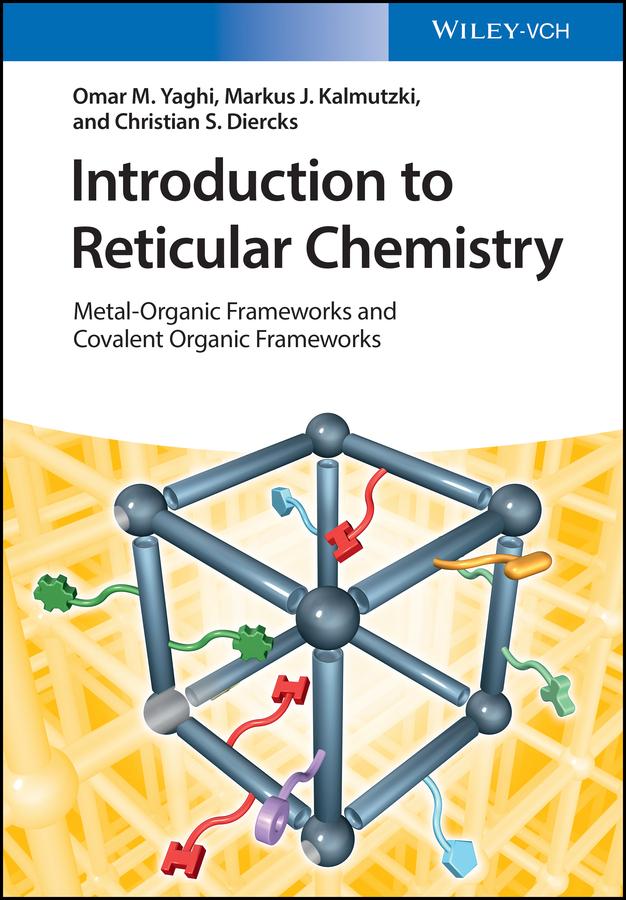
A concise introduction to the chemistry and design principles behind important metal-organic frameworks and related porous materials
Reticular chemistry has been applied to synthesize new classes of porous materials that are successfully used for myraid applications in areas such as gas separation, catalysis, energy, and electronics. Introduction to Reticular Chemistry gives an unique overview of the principles of the chemistry behind metal-organic frameworks (MOFs), covalent organic frameworks (COFs), and zeolitic imidazolate frameworks (ZIFs). Written by one of the pioneers in the field, this book covers all important aspects of reticular chemistry, including design and synthesis, properties and characterization, as well as current and future applications
Designed to be an accessible resource, the book is written in an easy-to-understand style. It includes an extensive bibliography, and offers figures and videos of crystal structures that are available as an electronic supplement. Introduction to Reticular Chemistry:
-Describes the underlying principles and design elements for the synthesis of important metal-organic frameworks (MOFs) and related materials
-Discusses both real-life and future applications in various fields, such as clean energy and water adsorption
-Offers all graphic material on a companion website
-Provides first-hand knowledge by Omar Yaghi, one of the pioneers in the field, and his team.
Aimed at graduate students in chemistry, structural chemists, inorganic chemists, organic chemists, catalytic chemists, and others, Introduction to Reticular Chemistry is a groundbreaking book that explores the chemistry principles and applications of MOFs, COFs, and ZIFs.
Reticular chemistry has been applied to synthesize new classes of porous materials that are successfully used for myraid applications in areas such as gas separation, catalysis, energy, and electronics. Introduction to Reticular Chemistry gives an unique overview of the principles of the chemistry behind metal-organic frameworks (MOFs), covalent organic frameworks (COFs), and zeolitic imidazolate frameworks (ZIFs). Written by one of the pioneers in the field, this book covers all important aspects of reticular chemistry, including design and synthesis, properties and characterization, as well as current and future applications
Designed to be an accessible resource, the book is written in an easy-to-understand style. It includes an extensive bibliography, and offers figures and videos of crystal structures that are available as an electronic supplement. Introduction to Reticular Chemistry:
-Describes the underlying principles and design elements for the synthesis of important metal-organic frameworks (MOFs) and related materials
-Discusses both real-life and future applications in various fields, such as clean energy and water adsorption
-Offers all graphic material on a companion website
-Provides first-hand knowledge by Omar Yaghi, one of the pioneers in the field, and his team.
Aimed at graduate students in chemistry, structural chemists, inorganic chemists, organic chemists, catalytic chemists, and others, Introduction to Reticular Chemistry is a groundbreaking book that explores the chemistry principles and applications of MOFs, COFs, and ZIFs.
Zahle einfach mit Karte, Klarna, Apple Pay oder Google Pay. Nicht zufrieden? Du hast immer ein 14-tägiges Widerrufsrecht. Lies mehr in unseren AGB. Hast du Fragen, schreib uns eine E-Mail an hello@memmo.org.
Memmo macht das Lernen einfacher – wo auch immer du bist. Bei uns findest du deine Kursbücher und smarte Lerntools an einem Ort: Zusammenfassungen, Quizzes, Podcasts und Lernkarten. Und Ted, dein Lernbuddy, beantwortet alles, was du wissen möchtest. Über 50.000 Studierende lernen bereits hier – gemacht, damit du schneller lernst und weniger Stress hast.