
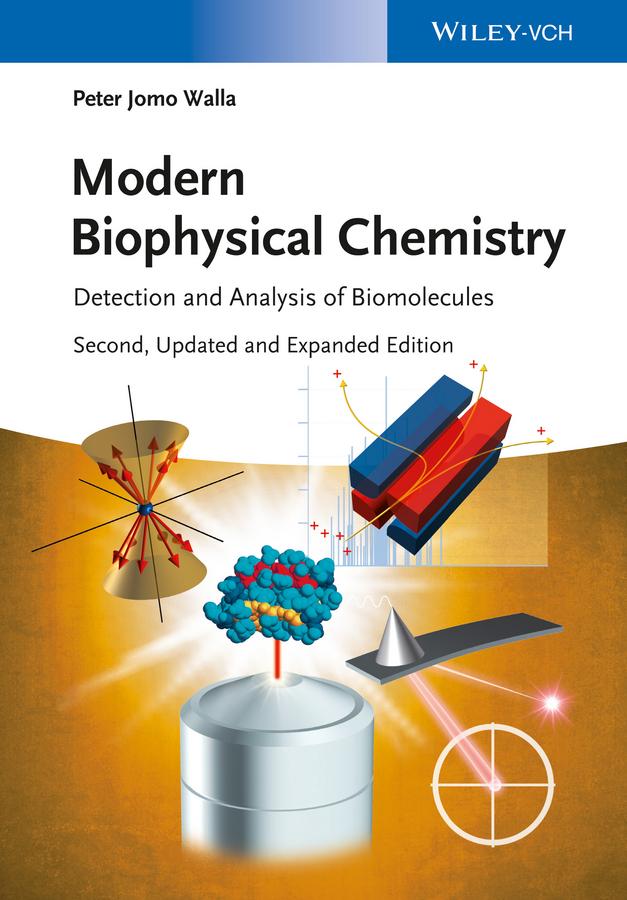
This updated and up-to-date version of the first edition continues with the really interesting stuff to spice up a standard biophysics and biophysical chemistry course. All relevant methods used in current cutting edge research including such recent developments as super-resolution microscopy and next-generation DNA sequencing techniques, as well as industrial applications, are explained. The text has been developed from a graduate course taught by the author for several years, and by presenting a mix of basic theory and real-life examples, he closes the gap between theory and experiment.
The first part, on basic biophysical chemistry, surveys fundamental and spectroscopic techniques as well as biomolecular properties that represent the modern standard and are also the basis for the more sophisticated technologies discussed later in the book. The second part covers the latest bioanalytical techniques such as the mentioned super-resolution and next generation sequencing methods, confocal fluorescence microscopy, light sheet microscopy, two-photon microscopy and ultrafast spectroscopy, single molecule optical, electrical and force measurements, fluorescence correlation spectroscopy, optical tweezers, quantum dots and DNA origami techniques. Both the text and illustrations have been prepared in a clear and accessible style, with extended and updated exercises (and their solutions) accompanying each chapter.
Readers with a basic understanding of biochemistry and/or biophysics will quickly gain an overview of cutting edge technology for the biophysical analysis of proteins, nucleic acids and other biomolecules and their interactions. Equally, any student contemplating a career in the chemical, pharmaceutical or bio-industry will greatly benefit from the technological knowledge presented. Questions of differing complexity testing the reader's understanding can be found at the end of each chapter with clearly described solutions available on the Wiley-VCH textbook homepage under: www.wiley-vch.de/textbooks
The first part, on basic biophysical chemistry, surveys fundamental and spectroscopic techniques as well as biomolecular properties that represent the modern standard and are also the basis for the more sophisticated technologies discussed later in the book. The second part covers the latest bioanalytical techniques such as the mentioned super-resolution and next generation sequencing methods, confocal fluorescence microscopy, light sheet microscopy, two-photon microscopy and ultrafast spectroscopy, single molecule optical, electrical and force measurements, fluorescence correlation spectroscopy, optical tweezers, quantum dots and DNA origami techniques. Both the text and illustrations have been prepared in a clear and accessible style, with extended and updated exercises (and their solutions) accompanying each chapter.
Readers with a basic understanding of biochemistry and/or biophysics will quickly gain an overview of cutting edge technology for the biophysical analysis of proteins, nucleic acids and other biomolecules and their interactions. Equally, any student contemplating a career in the chemical, pharmaceutical or bio-industry will greatly benefit from the technological knowledge presented. Questions of differing complexity testing the reader's understanding can be found at the end of each chapter with clearly described solutions available on the Wiley-VCH textbook homepage under: www.wiley-vch.de/textbooks
Zahle einfach mit Karte, Klarna, Apple Pay oder Google Pay. Nicht zufrieden? Du hast immer ein 14-tägiges Widerrufsrecht. Lies mehr in unseren AGB. Hast du Fragen, schreib uns eine E-Mail an hello@memmo.org.
Memmo macht das Lernen einfacher – wo auch immer du bist. Bei uns findest du deine Kursbücher und smarte Lerntools an einem Ort: Zusammenfassungen, Quizzes, Podcasts und Lernkarten. Und Ted, dein Lernbuddy, beantwortet alles, was du wissen möchtest. Über 50.000 Studierende lernen bereits hier – gemacht, damit du schneller lernst und weniger Stress hast.