
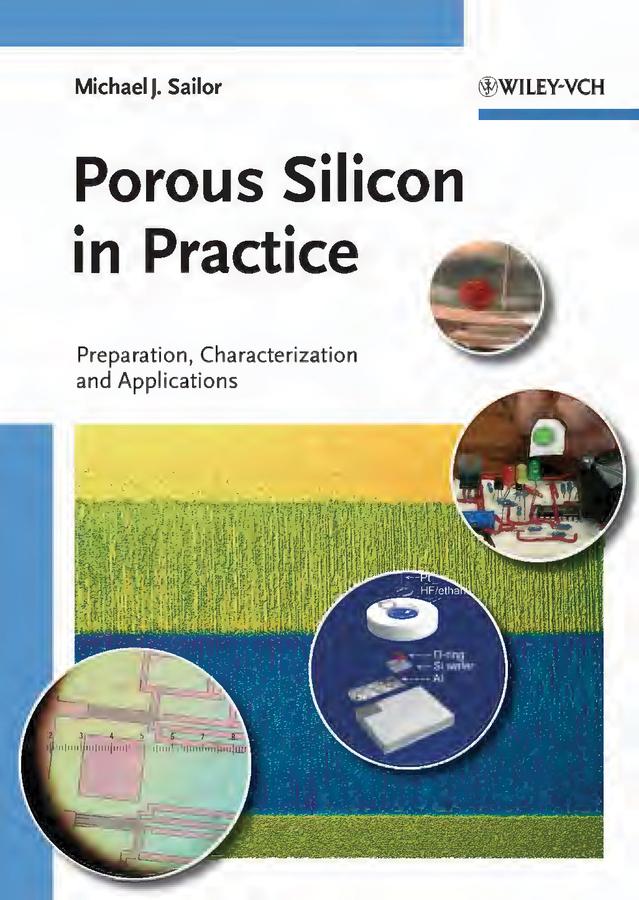
By means of electrochemical treatment, crystalline silicon can be permeated with tiny, nanostructured pores that entirely change the characteristics and properties of the material. One prominent example of this can be seen in the interaction of porous silicon with living cells,
which can be totally unwilling to settle on smooth silicon surfaces but readily adhere to porous silicon, giving rise to great hopes for such
future applications as programmable drug delivery or advanced, braincontrolled prosthetics. Porous silicon research is active in the fields
of sensors, tissue engineering, medical therapeutics and diagnostics, photovoltaics, rechargeable batteries, energetic materials, photonics,
and MEMS (Micro Electro Mechanical Systems).
Written by an outstanding, well-recognized expert in the field, this book provides detailed, step-by-step instructions to prepare and characterize the major types of porous silicon. It is intended for those new to the fi eld. Sampling of topics covered:
* Principles of Etching Porous Silicon
* Etch Cell Construction and Considerations
* Photonic Crystals, Microcavities, and Bragg Stacks Etched in Silicon
* Preparation of Free-standing Films and Particles of Porous Silicon
* Preparation of Photoluminescent Nanoparticles from Porous Silicon
* Preparation of Silicon Nanowires by Electrochemical Etch of Silicon
* Surface Modifi cation Chemistry and Biochemistry
* Measurement of Optical Properties
* Measurement of Pore Size, Porosity, Thickness, Surface Area
The whole is backed by a generous use of color photographs to illustrate the described procedures in detail, plus a bibliography of further
literature pertinent to a wide range of application fi elds. For materials scientists, chemists, physicists, optical physicists, biomaterials
scientists, neurobiologists, bioengineers, and graduate students in those fields, as well as those working in the semiconductor industry.
which can be totally unwilling to settle on smooth silicon surfaces but readily adhere to porous silicon, giving rise to great hopes for such
future applications as programmable drug delivery or advanced, braincontrolled prosthetics. Porous silicon research is active in the fields
of sensors, tissue engineering, medical therapeutics and diagnostics, photovoltaics, rechargeable batteries, energetic materials, photonics,
and MEMS (Micro Electro Mechanical Systems).
Written by an outstanding, well-recognized expert in the field, this book provides detailed, step-by-step instructions to prepare and characterize the major types of porous silicon. It is intended for those new to the fi eld. Sampling of topics covered:
* Principles of Etching Porous Silicon
* Etch Cell Construction and Considerations
* Photonic Crystals, Microcavities, and Bragg Stacks Etched in Silicon
* Preparation of Free-standing Films and Particles of Porous Silicon
* Preparation of Photoluminescent Nanoparticles from Porous Silicon
* Preparation of Silicon Nanowires by Electrochemical Etch of Silicon
* Surface Modifi cation Chemistry and Biochemistry
* Measurement of Optical Properties
* Measurement of Pore Size, Porosity, Thickness, Surface Area
The whole is backed by a generous use of color photographs to illustrate the described procedures in detail, plus a bibliography of further
literature pertinent to a wide range of application fi elds. For materials scientists, chemists, physicists, optical physicists, biomaterials
scientists, neurobiologists, bioengineers, and graduate students in those fields, as well as those working in the semiconductor industry.
Zahle einfach mit Karte, Klarna, Apple Pay oder Google Pay. Nicht zufrieden? Du hast immer ein 14-tägiges Widerrufsrecht. Lies mehr in unseren AGB. Hast du Fragen, schreib uns eine E-Mail an hello@memmo.org.
Memmo macht das Lernen einfacher – wo auch immer du bist. Bei uns findest du deine Kursbücher und smarte Lerntools an einem Ort: Zusammenfassungen, Quizzes, Podcasts und Lernkarten. Und Ted, dein Lernbuddy, beantwortet alles, was du wissen möchtest. Über 50.000 Studierende lernen bereits hier – gemacht, damit du schneller lernst und weniger Stress hast.