
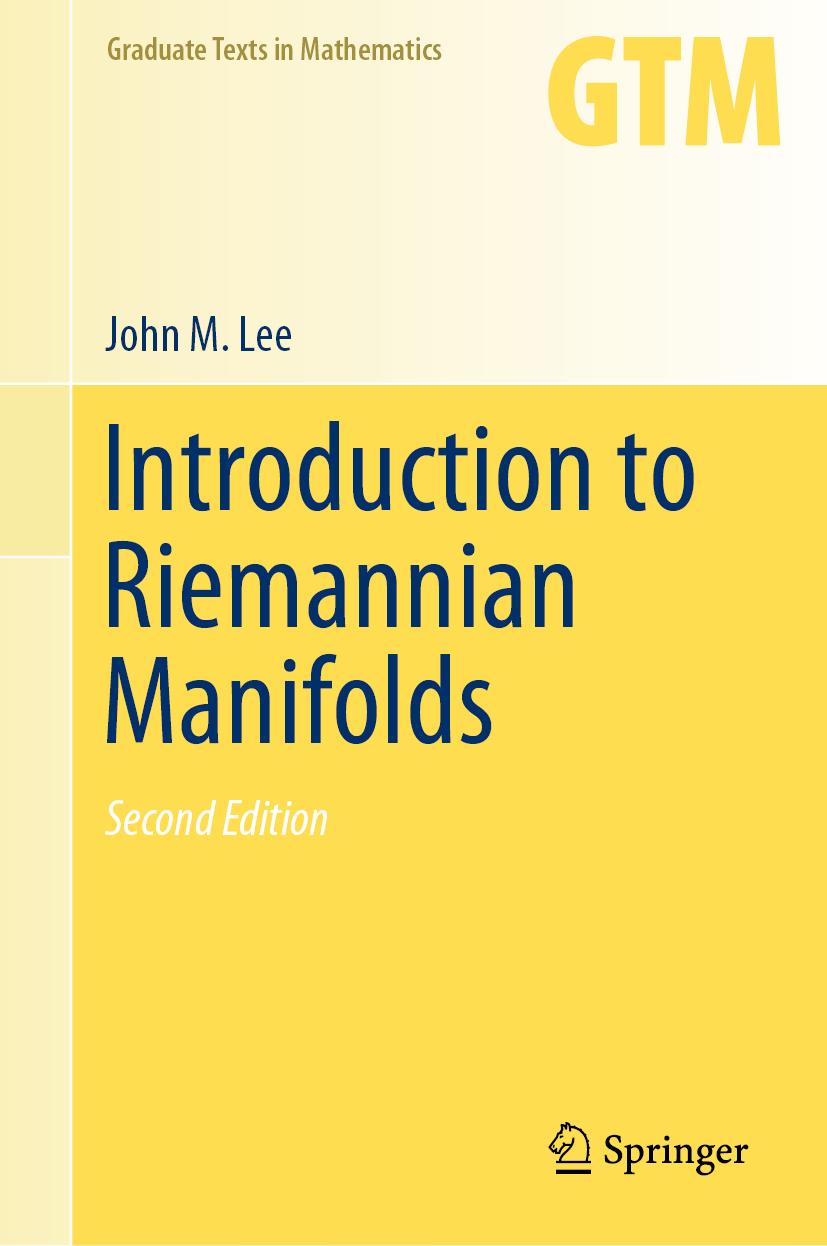
This textbook is designed for a one or two semester graduate course on Riemannian geometry for students who are familiar with topological and differentiable manifolds. The second edition has been adapted, expanded, and aptly retitled from Lee’s earlier book, Riemannian Manifolds: An Introduction to Curvature. Numerous exercises and problem sets provide the student with opportunities to practice and develop skills; appendices contain a brief review of essential background material.
While demonstrating the uses of most of the main technical tools needed for a careful study of Riemannian manifolds, this text focuses on ensuring that the student develops an intimate acquaintance with the geometric meaning of curvature. The reasonably broad coverage begins with a treatment of indispensable tools for working with Riemannian metrics such as connections and geodesics. Several topics have been added, including an expanded treatment of pseudo-Riemannianmetrics, a more detailed treatment of homogeneous spaces and invariant metrics, a completely revamped treatment of comparison theory based on Riccati equations, and a handful of new local-to-global theorems, to name just a few highlights.
Reviews of the first edition:
Arguments and proofs are written down precisely and clearly. The expertise of the author is reflected in many valuable comments and remarks on the recent developments of the subjects. Serious readers would have the challenges of solving the exercises and problems. The book is probably one of the most easily accessible introductions to Riemannian geometry. (M.C. Leung, MathReview)
The book’s aim is to develop tools and intuition for studying the central unifying theme in Riemannian geometry, which is the notion of curvature and its relation with topology. The main ideas of the subject, motivated as in the original papers, are introduced here in an intuitive and accessible way…The book is an excellent introduction designed for a one-semester graduate course, containing exercises and problems which encourage students to practice working with the new notions and develop skills for later use. By citing suitable references for detailed study, the reader is stimulated to inquire into further research. (C.-L. Bejan, zBMATH)
Zahle einfach mit Karte, Klarna, Apple Pay oder Google Pay. Nicht zufrieden? Du hast immer ein 14-tägiges Widerrufsrecht. Lies mehr in unseren AGB. Hast du Fragen, schreib uns eine E-Mail an hello@memmo.org.
Memmo macht das Lernen einfacher – wo auch immer du bist. Bei uns findest du deine Kursbücher und smarte Lerntools an einem Ort: Zusammenfassungen, Quizzes, Podcasts und Lernkarten. Und Ted, dein Lernbuddy, beantwortet alles, was du wissen möchtest. Über 50.000 Studierende lernen bereits hier – gemacht, damit du schneller lernst und weniger Stress hast.