
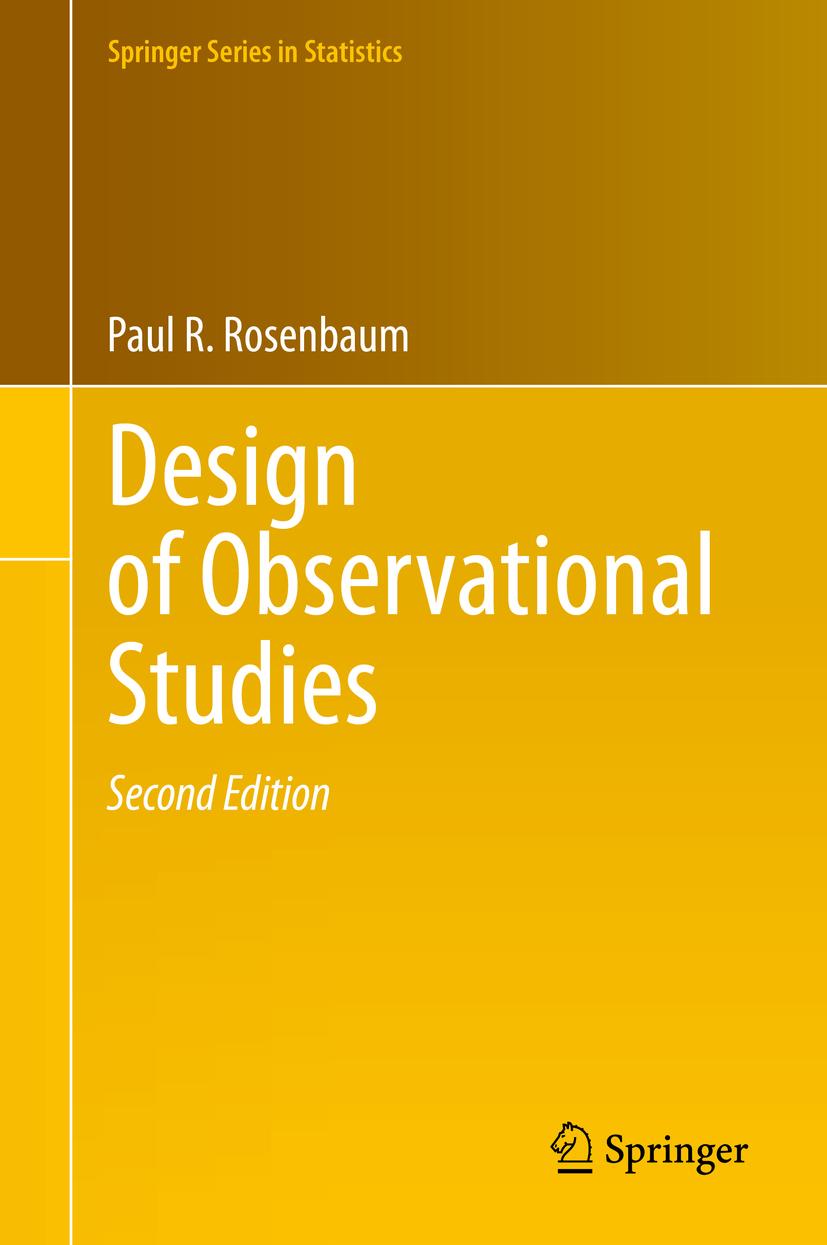
This second edition of Design of Observational Studies is both an introduction to statistical inference in observational studies and a detailed discussion of the principles that guide the design of observational studies. An observational study is an empiric investigation of effects caused by treatments when randomized experimentation is unethical or infeasible. Observational studies are common in most fields that study the effects of treatments on people, including medicine, economics, epidemiology, education, psychology, political science and sociology. The quality and strength of evidence provided by an observational study is determined largely by its design.
Design of Observational Studies is organized into five parts. Chapters 2, 3, and 5 of Part I cover concisely many of the ideas discussed in Rosenbaum’s Observational Studies (also published by Springer) but in a less technical fashion. Part II discusses the practical aspects of using propensity scores and other tools to create a matched comparison that balances many covariates, and includes an updated chapter on matching in R. In Part III, the concept of design sensitivity is used to appraise the relative ability of competing designs to distinguish treatment effects from biases due to unmeasured covariates. Part IV is new to this edition; it discusses evidence factors and the computerized construction of more than one comparison group. Part V discusses planning the analysis of an observational study, with particular reference to Sir Ronald Fisher’s striking advice for observational studies: "make your theories elaborate."
This new edition features updated exploration of causal influence, with four new chapters, a new R package DOS2 designed as a companion for the book, and discussion of several of the latest matching packages for R. In particular, DOS2 allows readers to reproduce many analyses from Design of Observational Studies.Zahle einfach mit Karte, Klarna, Apple Pay oder Google Pay. Nicht zufrieden? Du hast immer ein 14-tägiges Widerrufsrecht. Lies mehr in unseren AGB. Hast du Fragen, schreib uns eine E-Mail an hello@memmo.org.
Memmo macht das Lernen einfacher – wo auch immer du bist. Bei uns findest du deine Kursbücher und smarte Lerntools an einem Ort: Zusammenfassungen, Quizzes, Podcasts und Lernkarten. Und Ted, dein Lernbuddy, beantwortet alles, was du wissen möchtest. Über 50.000 Studierende lernen bereits hier – gemacht, damit du schneller lernst und weniger Stress hast.