
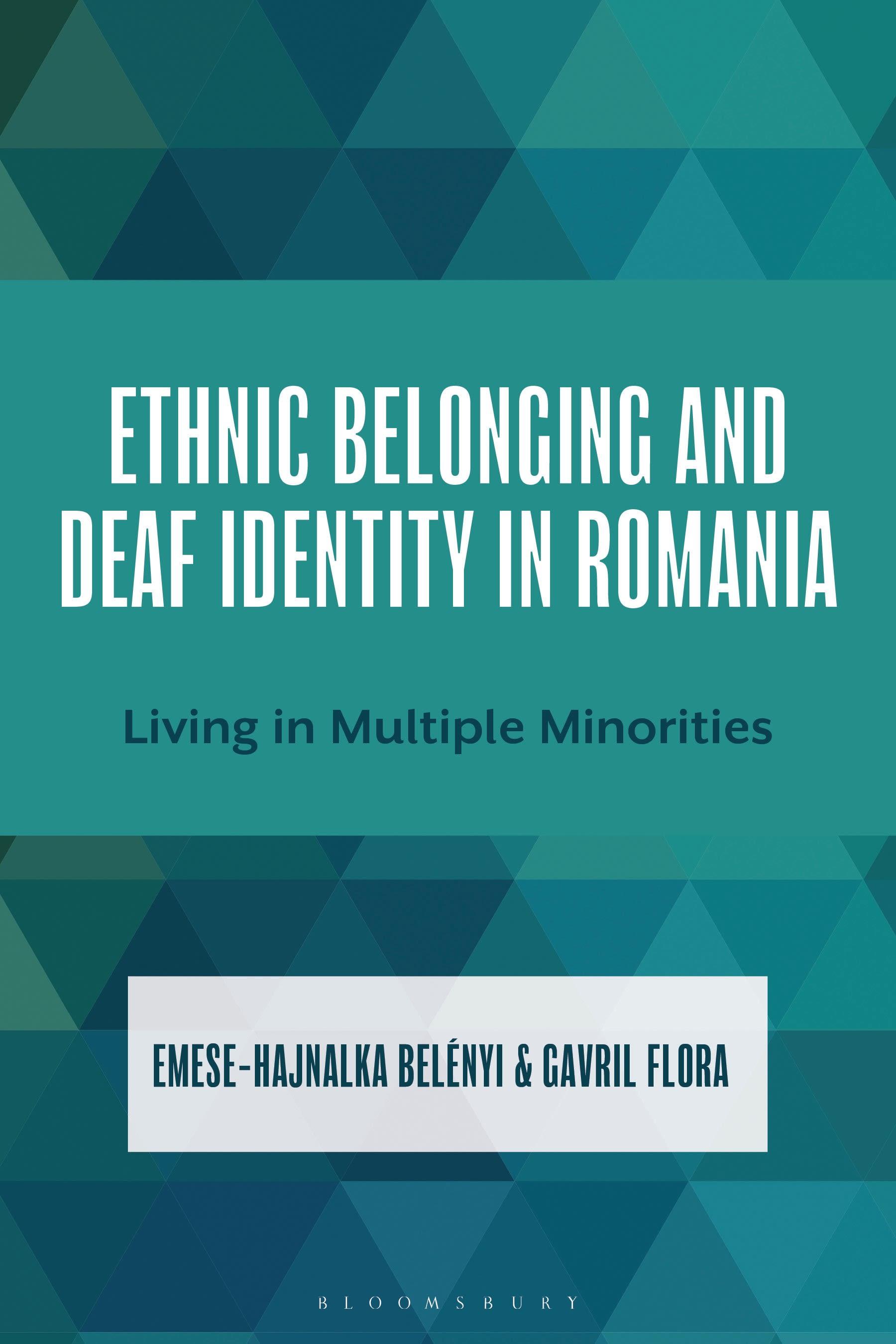
While Deafness can function as a cultural–linguistic identity with its own language and community norms, Deaf individuals may belong simultaneously to other social groups while sharing a Deaf identity.
Throughout this work, Belenyi and Flora interpret Deafness and ethnicity through the lens of Social Identity Theory (SIT), which posits that individuals derive part of their self-concept from membership in social groups and predicts that group memberships shape self-concept and self-esteem. While SIT has its limitations, newer adaptations, such as self-categorization theory and identity process theory, allow for more nuanced interpretations. With a focus on Hungarian ethnic-minority Deaf people in Romania-and their partners and communities-the authors examine these insights to understand how Deaf people in Romania balance their ethnic and Deaf identities.
Deaf people in East-Central Europe, especially in the multi-ethnic context of Romania, inhabit overlapping minority worlds. Although nation-building policies often emphasize linguistic and ethnic homogeneity, in practice Hungarian–Romanian relations within Deaf families and communities can reveal unexpected cultural bridges. This book combines a theoretical synthesis of Deaf identity, culture, and ethnicity with empirical life-course research to shed new light on how Deaf and ethnic identities intersect.
Throughout this work, Belenyi and Flora interpret Deafness and ethnicity through the lens of Social Identity Theory (SIT), which posits that individuals derive part of their self-concept from membership in social groups and predicts that group memberships shape self-concept and self-esteem. While SIT has its limitations, newer adaptations, such as self-categorization theory and identity process theory, allow for more nuanced interpretations. With a focus on Hungarian ethnic-minority Deaf people in Romania-and their partners and communities-the authors examine these insights to understand how Deaf people in Romania balance their ethnic and Deaf identities.
Deaf people in East-Central Europe, especially in the multi-ethnic context of Romania, inhabit overlapping minority worlds. Although nation-building policies often emphasize linguistic and ethnic homogeneity, in practice Hungarian–Romanian relations within Deaf families and communities can reveal unexpected cultural bridges. This book combines a theoretical synthesis of Deaf identity, culture, and ethnicity with empirical life-course research to shed new light on how Deaf and ethnic identities intersect.
Zahle einfach mit Karte, Klarna, Apple Pay oder Google Pay. Nicht zufrieden? Du hast immer ein 14-tägiges Widerrufsrecht. Lies mehr in unseren AGB. Hast du Fragen, schreib uns eine E-Mail an hello@memmo.org.
Memmo macht das Lernen einfacher – wo auch immer du bist. Bei uns findest du deine Kursbücher und smarte Lerntools an einem Ort: Zusammenfassungen, Quizzes, Podcasts und Lernkarten. Und Ted, dein Lernbuddy, beantwortet alles, was du wissen möchtest. Über 50.000 Studierende lernen bereits hier – gemacht, damit du schneller lernst und weniger Stress hast.