
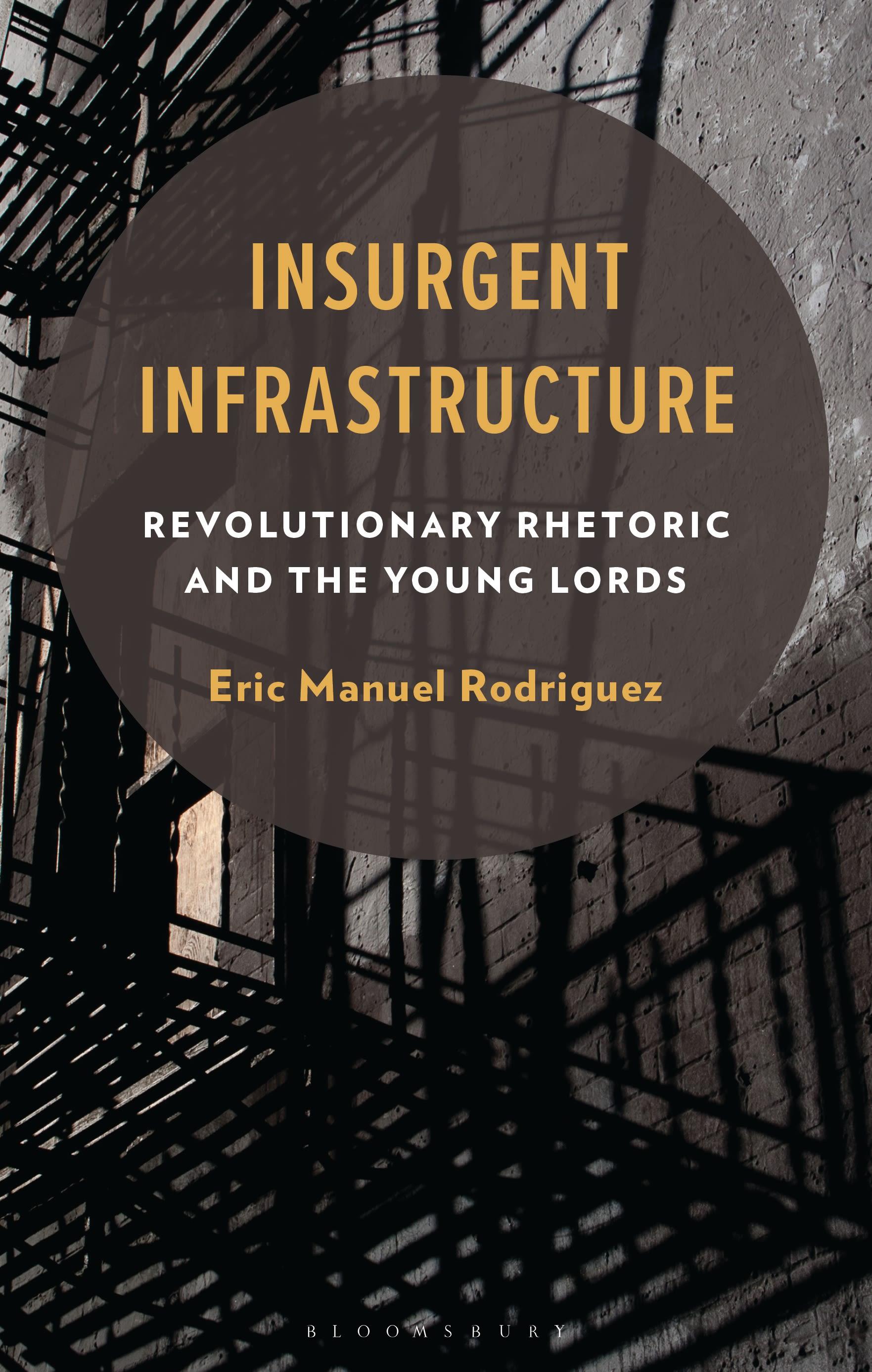
Eric Manuel Rodriguez argues that revolutionary rhetoric operates as insurgent infrastructure rather than symbolic performance.
Examining the Young Lords, a revolutionary nationalist organization forged from conditions of colonial displacement, racial capitalism, and urban neglect, this book argues that rhetorical studies requires recalibration to account for rhetoric's material dimensions and its capacity to coordinate collective survival. Through sustained analysis of the Young Lords' bilingual newspaper Palante, their 13-Point Program and Platform, Rules of Discipline, and the occupations, clinics, and educational programs that constituted their revolutionary praxis, Rodriguez demonstrates how rhetoric coordinated bodies, resources, and time under conditions of organized abandonment.
Drawing on decolonial theory, foquismo, and the concept of kairos, the study reframes rhetorical action as the construction of counter-institutions – free clinics, autonomous media, community defense, liberation schools – that sustained collective survival. Tracing the organization's rhetorical evolution from Chicago to New York and its eventual fracture, Eric Manuel Rodriguez reveals how print, pedagogy, and occupation functioned as logistical media for mobilization, and how the three principles – insurgent infrastructure, dialectical pedagogy, and collective logistics – connect the Young Lords' legacy to contemporary movements and abolitionist organizing.
Examining the Young Lords, a revolutionary nationalist organization forged from conditions of colonial displacement, racial capitalism, and urban neglect, this book argues that rhetorical studies requires recalibration to account for rhetoric's material dimensions and its capacity to coordinate collective survival. Through sustained analysis of the Young Lords' bilingual newspaper Palante, their 13-Point Program and Platform, Rules of Discipline, and the occupations, clinics, and educational programs that constituted their revolutionary praxis, Rodriguez demonstrates how rhetoric coordinated bodies, resources, and time under conditions of organized abandonment.
Drawing on decolonial theory, foquismo, and the concept of kairos, the study reframes rhetorical action as the construction of counter-institutions – free clinics, autonomous media, community defense, liberation schools – that sustained collective survival. Tracing the organization's rhetorical evolution from Chicago to New York and its eventual fracture, Eric Manuel Rodriguez reveals how print, pedagogy, and occupation functioned as logistical media for mobilization, and how the three principles – insurgent infrastructure, dialectical pedagogy, and collective logistics – connect the Young Lords' legacy to contemporary movements and abolitionist organizing.
Seiten: 192
Kategorie: Kultur-, Genus- & Postkoloniala studier
e-ISBN: 9781978769427
Versandgewicht: 1.2 kg
Versand in: 1-2 Tage
Zahle einfach mit Karte, Klarna, Apple Pay oder Google Pay. Nicht zufrieden? Du hast immer ein 14-tägiges Widerrufsrecht. Lies mehr in unseren AGB. Hast du Fragen, schreib uns eine E-Mail an hello@memmo.org.
Memmo macht das Lernen einfacher – wo auch immer du bist. Bei uns findest du deine Kursbücher und smarte Lerntools an einem Ort: Zusammenfassungen, Quizzes, Podcasts und Lernkarten. Und Ted, dein Lernbuddy, beantwortet alles, was du wissen möchtest. Über 50.000 Studierende lernen bereits hier – gemacht, damit du schneller lernst und weniger Stress hast.