
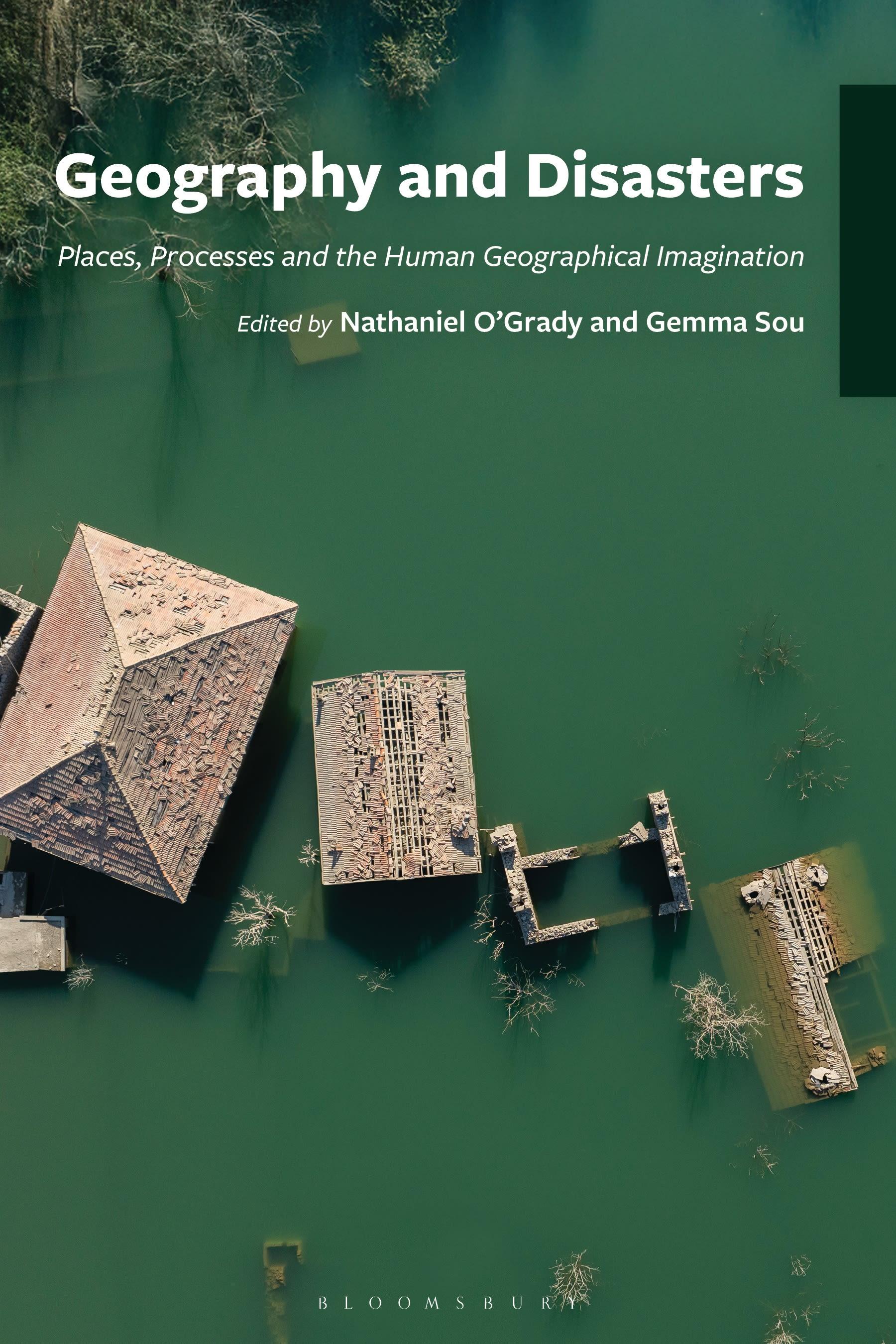
Drawing on global case studies, this is the first book to outline and elaborate on the ways that human geography has extended our understanding of disasters.
Every chapter analyses disasters through the lens of a different theoretical framework common to geography, including assemblage theory, post-colonialism, urban political ecology, governmentality, affect theory and scale. The case studies in the collection range from hurricane risk in the Caribbean and volcano eruptions in Chile to floods in India and many more. Thinking of them as processes rather than individual events, each contributor conceptualizes disasters as always-already entangled in the continual making and remaking of collective life.
Overall, the chapters present a “pluriversal” perspective that mirrors geography's methodological sensitivity to how disasters are shaped by the in-situ conditions in which they unfold. Following such a perspective, the volume both clarifies, and stays attuned to, the multiple, often cross-cutting, spatial and temporal registers upon which disasters are experienced. In doing so, the contributors also expand upon geography's appreciation for how disasters arise from, but also actively contribute to, the material configuration and reconfiguration of space over time. This emphasis allows each chapter to address the complicated ways in which different political issues underpin disasters in different ways. Providing inspiration for future scholars in geography and further afield, the collection is essential reading for those interested in developing more advanced understandings of disasters and how they continue to affect us today.
Every chapter analyses disasters through the lens of a different theoretical framework common to geography, including assemblage theory, post-colonialism, urban political ecology, governmentality, affect theory and scale. The case studies in the collection range from hurricane risk in the Caribbean and volcano eruptions in Chile to floods in India and many more. Thinking of them as processes rather than individual events, each contributor conceptualizes disasters as always-already entangled in the continual making and remaking of collective life.
Overall, the chapters present a “pluriversal” perspective that mirrors geography's methodological sensitivity to how disasters are shaped by the in-situ conditions in which they unfold. Following such a perspective, the volume both clarifies, and stays attuned to, the multiple, often cross-cutting, spatial and temporal registers upon which disasters are experienced. In doing so, the contributors also expand upon geography's appreciation for how disasters arise from, but also actively contribute to, the material configuration and reconfiguration of space over time. This emphasis allows each chapter to address the complicated ways in which different political issues underpin disasters in different ways. Providing inspiration for future scholars in geography and further afield, the collection is essential reading for those interested in developing more advanced understandings of disasters and how they continue to affect us today.
Zahle einfach mit Karte, Klarna, Apple Pay oder Google Pay. Nicht zufrieden? Du hast immer ein 14-tägiges Widerrufsrecht. Lies mehr in unseren AGB. Hast du Fragen, schreib uns eine E-Mail an hello@memmo.org.
Memmo macht das Lernen einfacher – wo auch immer du bist. Bei uns findest du deine Kursbücher und smarte Lerntools an einem Ort: Zusammenfassungen, Quizzes, Podcasts und Lernkarten. Und Ted, dein Lernbuddy, beantwortet alles, was du wissen möchtest. Über 50.000 Studierende lernen bereits hier – gemacht, damit du schneller lernst und weniger Stress hast.