
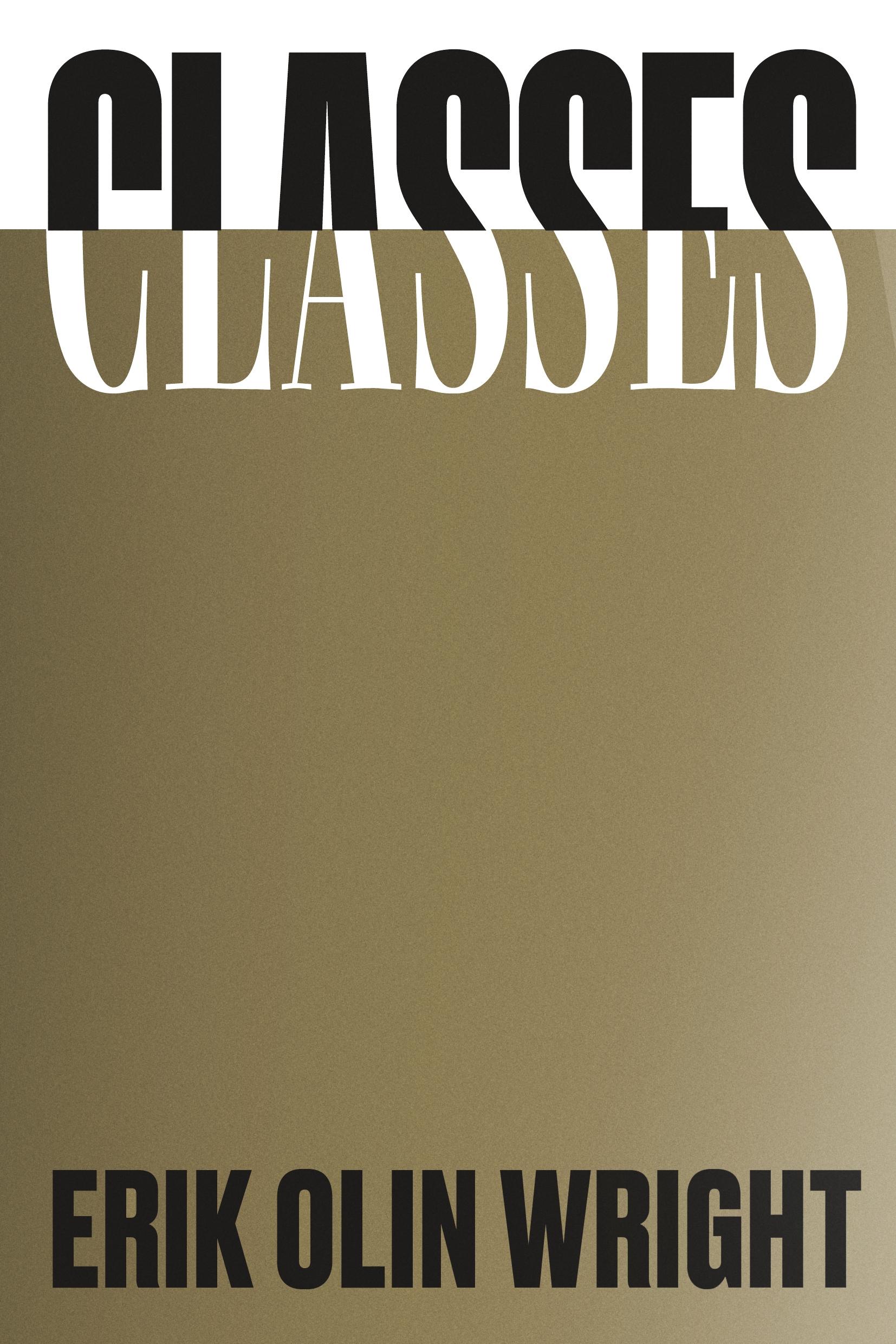
Questions of class, power and distribution have reemerged as central concerns in the public discourse. When we talk about class, we don't always know what is meant. Is class about income or affect or the ownership of the means of production? Perhaps it is about authority or autonomy? But what happens when, as is often the case in complex advanced economies, people can occupy social and economic roles that seem to indicate membership in more than one class? And what does this mean for the supposed relationship between class and potential political capacity and affinity?
In Classes, Erik Olin Wright, the greatest American Marxist sociologists, rises to the twofold challenge of both clarifying the abstract, structural account of class implicit in Marx, and of applying and refining the account in the light of contemporary developments in advanced capitalist societies. What Wright calls "contradictory class locations" can make the class landscape appear much more complex than the simple model presented in Marx. Despite this complexity, common interests and therefore political alliances can still be found. In a society, like the US, characterized by extreme inequality, Classes provides not just a useful descriptive account of the operation of class but also the tools to understand the interplay of class interests and political (re)alignment.
In Classes, Erik Olin Wright, the greatest American Marxist sociologists, rises to the twofold challenge of both clarifying the abstract, structural account of class implicit in Marx, and of applying and refining the account in the light of contemporary developments in advanced capitalist societies. What Wright calls "contradictory class locations" can make the class landscape appear much more complex than the simple model presented in Marx. Despite this complexity, common interests and therefore political alliances can still be found. In a society, like the US, characterized by extreme inequality, Classes provides not just a useful descriptive account of the operation of class but also the tools to understand the interplay of class interests and political (re)alignment.
Zahle einfach mit Karte, Klarna, Apple Pay oder Google Pay. Nicht zufrieden? Du hast immer ein 14-tägiges Widerrufsrecht. Lies mehr in unseren AGB. Hast du Fragen, schreib uns eine E-Mail an hello@memmo.org.
Memmo macht das Lernen einfacher – wo auch immer du bist. Bei uns findest du deine Kursbücher und smarte Lerntools an einem Ort: Zusammenfassungen, Quizzes, Podcasts und Lernkarten. Und Ted, dein Lernbuddy, beantwortet alles, was du wissen möchtest. Über 50.000 Studierende lernen bereits hier – gemacht, damit du schneller lernst und weniger Stress hast.
Das könnte dir auch gefallen
Buch kaufen0