
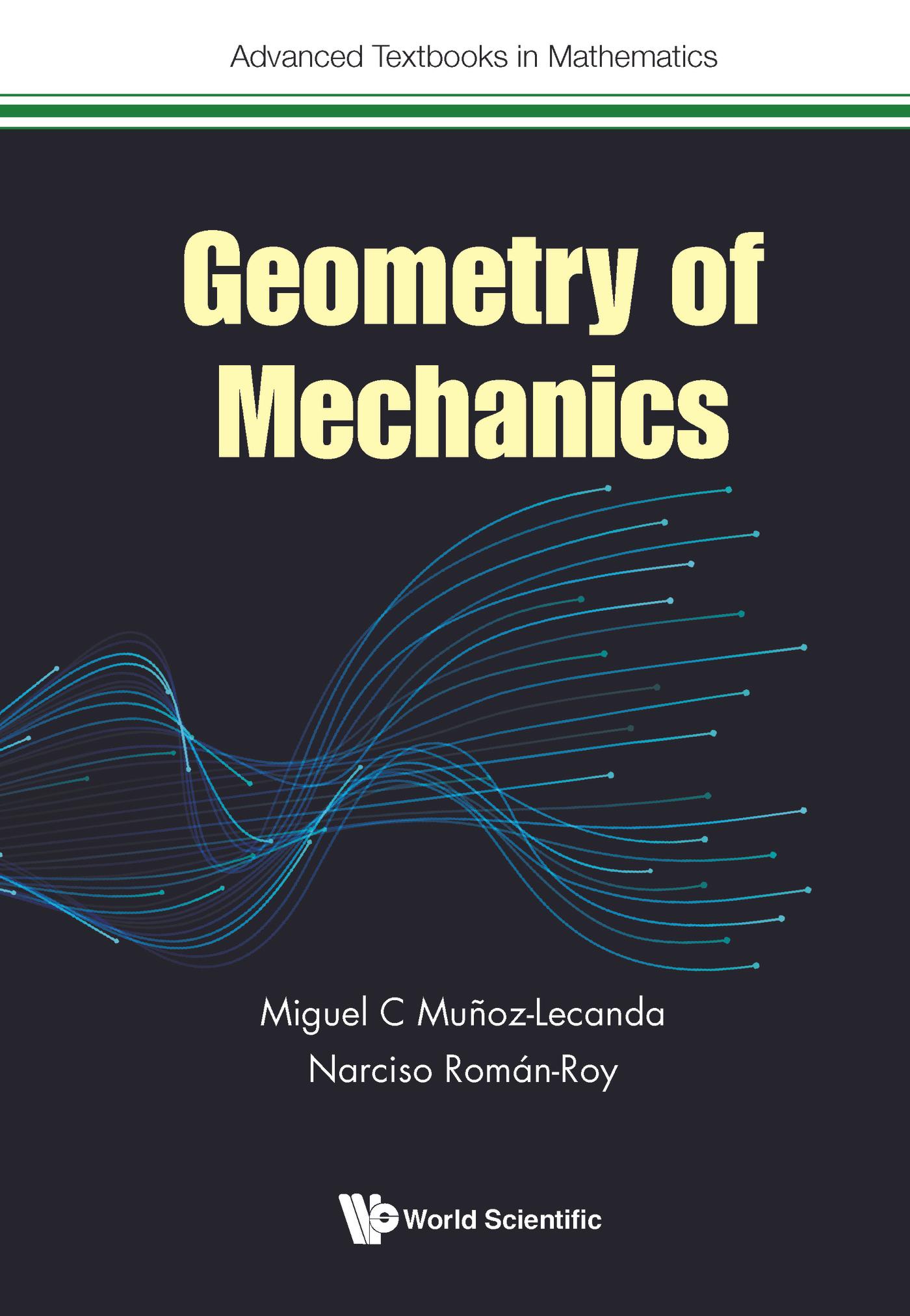
This book sets out to demonstrate, interpret, and analyse the geometrical structures underlying classical mechanics. Through exploring the applications of these structures in the context of dissipative, autonomous, and nonautonomous conservative dynamical systems, a series of insightful exercises are developed in order to both consolidate and clarify the theoretical concepts introduced.
Geometry of Mechanics provides an informative exploration of the classic geometrical structures, including the symplectic structure and its application for constructing Lagrangian and Hamiltonian formalisms of autonomous regular systems, the cosymplectic structure (and others) for nonautonomous (time-dependent) systems, and the Riemannian structure underlying systems of 'mechanical' type. Lesser-known frameworks are also investigated, such as the (Skinner–Rusk) unified Lagrangian–Hamiltonian formalism, a new geometric setting for the Hamilton–Jacobi equation, and the latest treatment of nonconservative systems by contact geometry. Although the main focus of this exposition is on the regular Lagrangian and Hamiltonian systems, singular systems are also briefly explained where applicable.
Each chapter concludes with a set of problems, some of which are intended to be solved solely by the application of results presented, while others contain instructive results complementary to those presented in the chapters, complete with comments, suggestions, and recommendations. Interested readers will also find an extensive and up-to-date bibliography, including a great number of works produced in recent decades related to all topics explored.
Contents:
- Introduction
- Symplectic Mechanics (I): Autonomous Hamiltonian Dynamical Systems
- Symplectic Mechanics (II): Autonomous Lagrangian Dynamical Systems
- Cosymplectic Mechanics: Nonautonomous Dynamical Systems
- Riemannian Mechanics: Newtonian Dynamical Systems
- An Introduction to Contact Mechanics and Dissipative Dynamical Systems
- Appendix A: Additional Contents
Readership: This book is intended for readers who have completed at least the first courses of a degree on mathematics or physics, and who have a basic training on differential geometry of smooth manifolds and analytical mechanics.
Zahle einfach mit Karte, Klarna, Apple Pay oder Google Pay. Nicht zufrieden? Du hast immer ein 14-tägiges Widerrufsrecht. Lies mehr in unseren AGB. Hast du Fragen, schreib uns eine E-Mail an hello@memmo.org.
Memmo macht das Lernen einfacher – wo auch immer du bist. Bei uns findest du deine Kursbücher und smarte Lerntools an einem Ort: Zusammenfassungen, Quizzes, Podcasts und Lernkarten. Und Ted, dein Lernbuddy, beantwortet alles, was du wissen möchtest. Über 50.000 Studierende lernen bereits hier – gemacht, damit du schneller lernst und weniger Stress hast.