
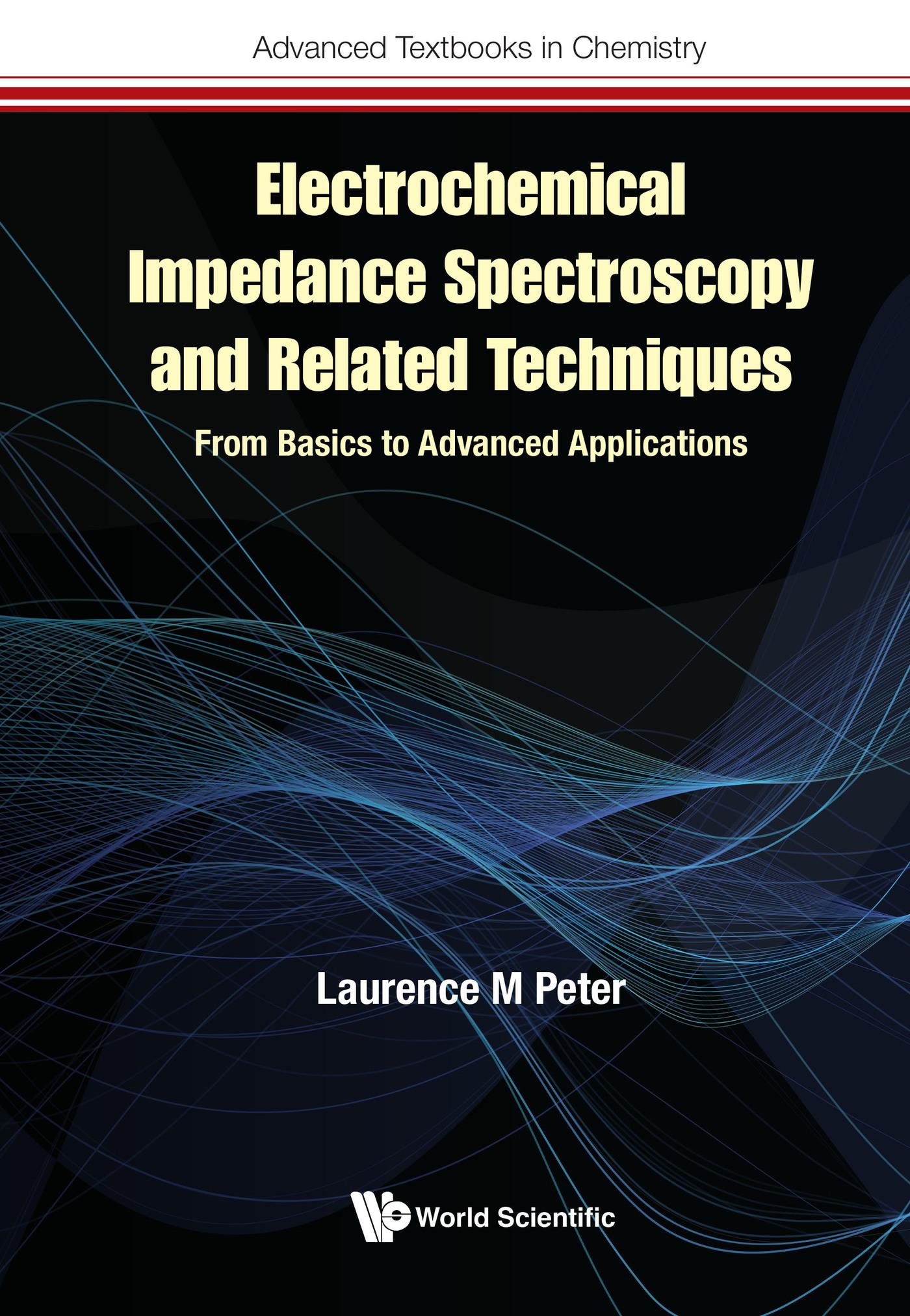
This book begins by introducing the basic concepts of impedance to non-specialist readers, who may have only an elementary knowledge of physics and mathematics. Mathematical concepts are explained clearly at appropriate points in a series of Theory Notes. Subsequent chapters cover RCL (resistor, capacitor, inductor) circuits before developing the key ideas behind the application of impedance spectroscopy to electrochemical systems. Circuit elements used to model electron transfer, double-layer charging and diffusion are described in detail, along with Kramers–Kronig testing of experimental data. The book explains how potentiostats and frequency-response analyzers work and evaluates a wealth of experimental data obtained either during the annual Bath impedance courses or in the laboratories of the author and his colleagues.
Topics covered include not only conventional electrochemical systems, such as the rotating disc electrode and ultramicroelectrodes, but also unconventional solar cells and the application of frequency-resolved techniques in spectroelectrochemistry. Finally, the last two chapters introduce techniques based on modulation of light intensity rather than voltage or current. The book concludes with worked answers to the problems set out in earlier chapters.
Contents:
- Getting Started
- Frequency-Response Analysis
- Putting the E in EIS: Frequency-Response Analysis of Electrochemical Systems
- Kramers–Kronig Testing of Impedance Data and Inductive Loops
- The Potentiostat and the Frequency-Response Analyzer: How Do They Work?
- Examples of Finite Diffusion Impedance: The Rotating Disc Electrode and the Ultramicroelectrode
- Photoelectrochemical Impedance Spectroscopy of Dye-Sensitized Solar Cells and Metal Halide Perovskite Cells
- Electrochromic Systems: Potential-Modulated Absorbance Spectroscopy of Polyaniline, and Light-Modulated Absorbance of Haematite
- Intensity-Modulated Techniques: Application of IMPS and IMVS to Characterize Unconventional Solar Cells
- Applications of IMPS and PEIS to Study Photoelectrode Kinetics
Readership: Postgraduate students and professionals in the industries of chemistry, physics, materials science. Adoption by Courses: EIS Course at Bath.
Key Features:
- This book gently guides the novice through the basic concepts behind electrochemical impedance spectroscopy (EIS) in a way that will appeal to a non-specialist who may be overawed by the jargon commonly used by experts in the field
- The text is based on an unprecedented and varied collection of real-life experimental data to illustrate the manifold applications of EIS and related techniques
- The treatment extends frequency-resolved methods beyond EIS to encompass innovative frequency-resolved methods involving, for example, modulation of light intensity rather than voltage or measurement of optical rather than electrical parameters
- No other book takes the reader from such humble beginnings to the forefront of modern research into topics such as solar cells and green hydrogen generation
Zahle einfach mit Karte, Klarna, Apple Pay oder Google Pay. Nicht zufrieden? Du hast immer ein 14-tägiges Widerrufsrecht. Lies mehr in unseren AGB. Hast du Fragen, schreib uns eine E-Mail an hello@memmo.org.
Memmo macht das Lernen einfacher – wo auch immer du bist. Bei uns findest du deine Kursbücher und smarte Lerntools an einem Ort: Zusammenfassungen, Quizzes, Podcasts und Lernkarten. Und Ted, dein Lernbuddy, beantwortet alles, was du wissen möchtest. Über 50.000 Studierende lernen bereits hier – gemacht, damit du schneller lernst und weniger Stress hast.