
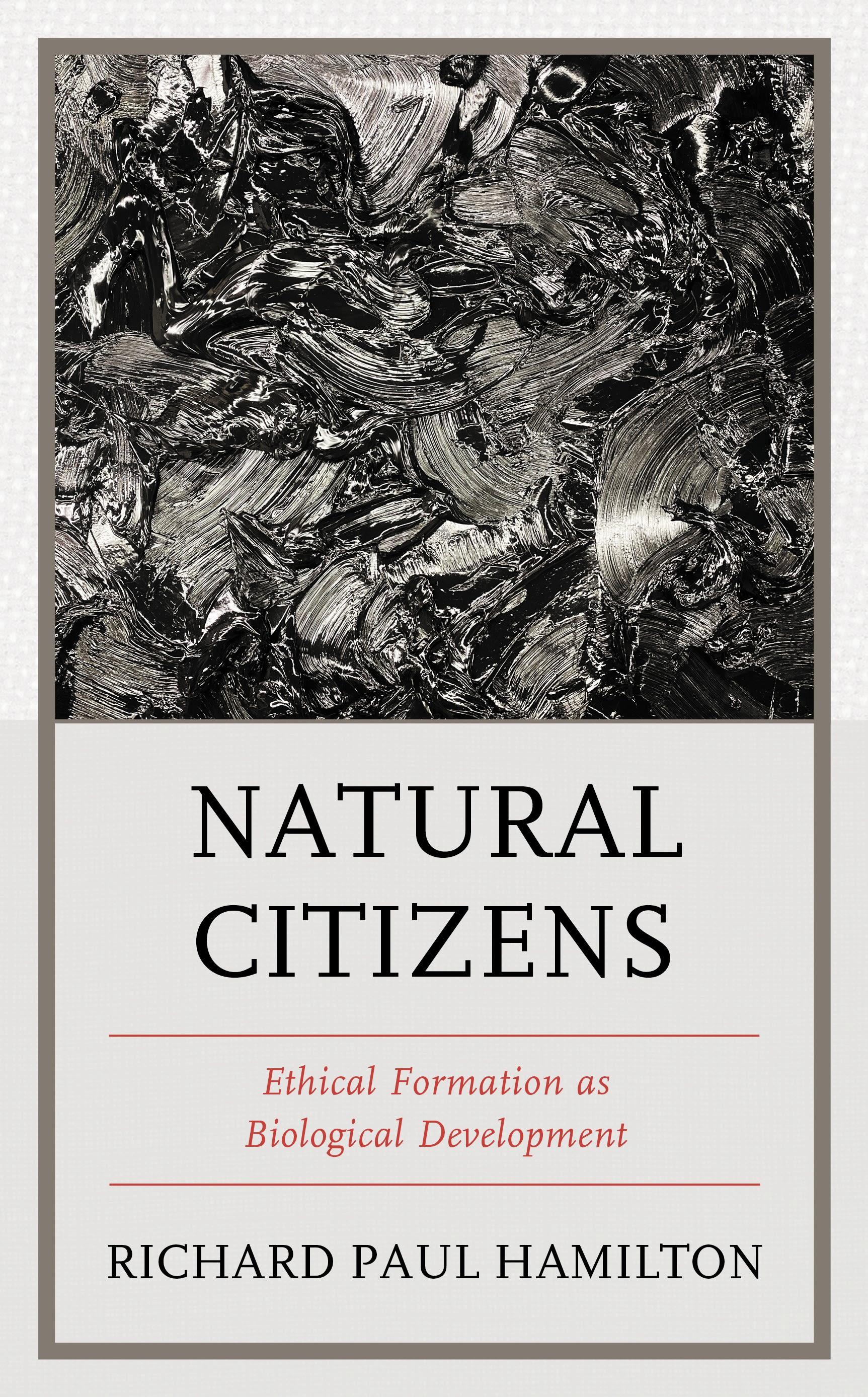
Natural Citizens: Ethical Formation as Biological Development presents a novel view, "naturalist humanism," that applies recent scientific work challenging dichotomous views of biological development. Rather than being a passive victim of its evolutionary fate, the developing organism is an active participant, partly constructing its own ecological niche from internal and external resources. The human developmental environment, our ecological niche, has a distinctive socio-cultural character. Richard Paul Hamilton proposes that we understand the development of moral character as an integral part of biological development with the virtues construed as refinements of mundane social intelligence.
Drawing on work in 4E Cognition, Hamilton revisits the traditional idea of ethical understanding as quasi-perceptual but argues that this can only be made intelligible by taking a non-representationalist view of perception. The virtuous person has learned how to focus her attention on what enables her to live a fully human life, individually and communally. Given that not all societies are equally conducive to fully human lives, the concluding sections explore how contemporary capitalist society distorts our attention and what obstacles it places in the way of virtue. Natural Citizens highlights the unsustainable state of current social and economic relations and the urgent need for radical alternatives.
Drawing on work in 4E Cognition, Hamilton revisits the traditional idea of ethical understanding as quasi-perceptual but argues that this can only be made intelligible by taking a non-representationalist view of perception. The virtuous person has learned how to focus her attention on what enables her to live a fully human life, individually and communally. Given that not all societies are equally conducive to fully human lives, the concluding sections explore how contemporary capitalist society distorts our attention and what obstacles it places in the way of virtue. Natural Citizens highlights the unsustainable state of current social and economic relations and the urgent need for radical alternatives.
Zahle einfach mit Karte, Klarna, Apple Pay oder Google Pay. Nicht zufrieden? Du hast immer ein 14-tägiges Widerrufsrecht. Lies mehr in unseren AGB. Hast du Fragen, schreib uns eine E-Mail an hello@memmo.org.
Memmo macht das Lernen einfacher – wo auch immer du bist. Bei uns findest du deine Kursbücher und smarte Lerntools an einem Ort: Zusammenfassungen, Quizzes, Podcasts und Lernkarten. Und Ted, dein Lernbuddy, beantwortet alles, was du wissen möchtest. Über 50.000 Studierende lernen bereits hier – gemacht, damit du schneller lernst und weniger Stress hast.