
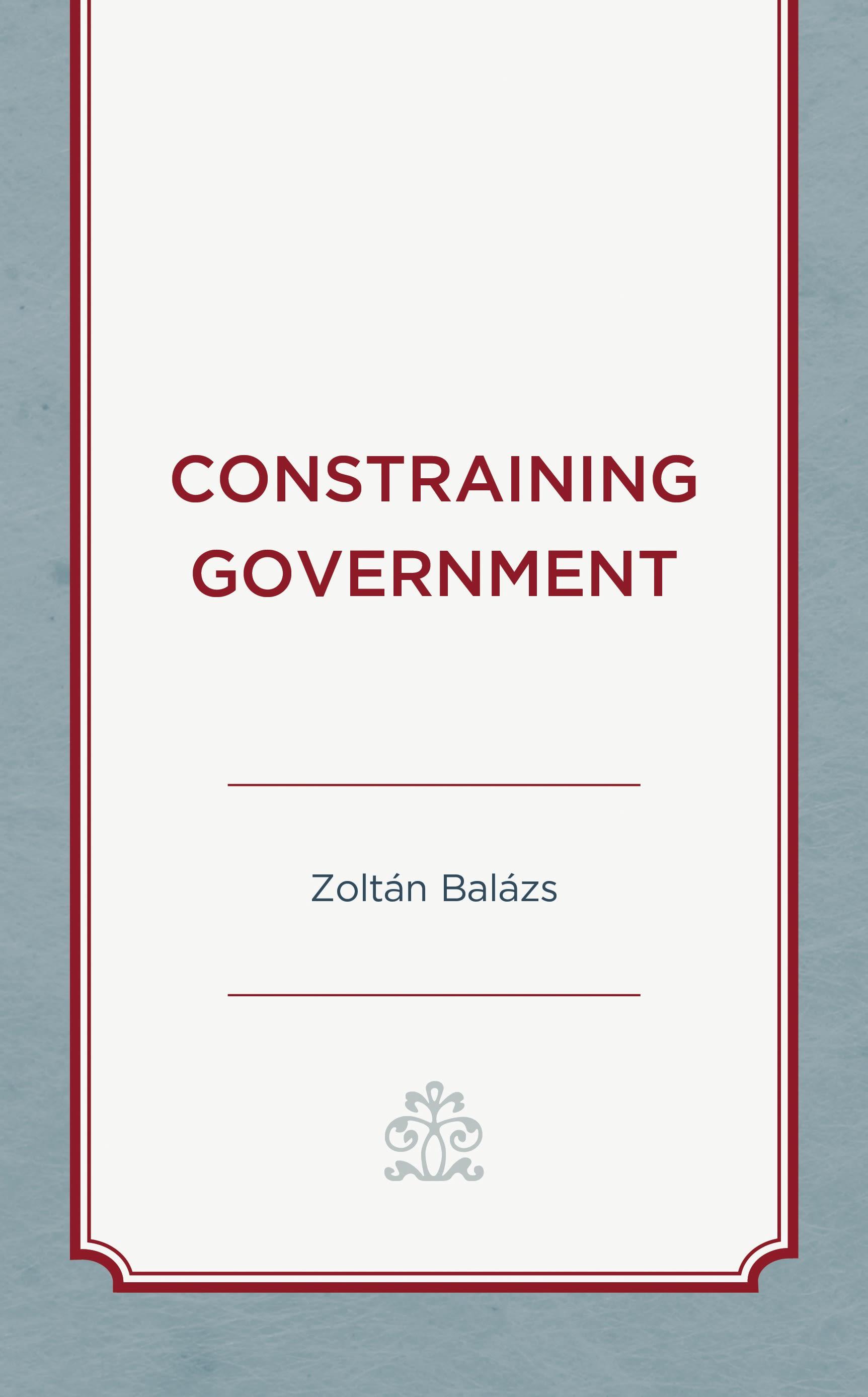
Moderate government is a time-honored and cherished doctrine. It has been considered the best solution of preventing tyranny and anarchy alike. However, expositions of the doctrine tend either to be entrenched by the technicalities of constitutional and public choice theory, or to remain largely exhortative. This book aims at providing a larger and more commonsensical defense of it. It addresses the issue of moderation but within a broader perspective of reflecting on how governments have developed with inherent constraints. This offers an analysis of the Antigone and Measure for Measure to discuss the necessary fall of tyranny, and the problems of how to distinguish between order and disorder. It is then argued that doing political theory is another important constraint on governments. Even conceptions that envision an unconstrained sort of government run into difficulties and as an unintended consequence, confirm the soundness of the idea that governing is an inherently constrained business. The book then takes issue with the recently growing awareness, associated with political realism, that governing is as much a personal as an institutional activity. In this context, the virtue of moderation will be discussed, and shown how it grows out of the experience of shame, whereby we are made conscious of our limitations of control over ourselves. Governing is to a large part about control, and as a personal activity it preserves the centrality of shame, and the insight that moderation is the best way to maintain effective control without pretending to have full control. Then, the book discusses three offices of government, traditionally considered to be the pivotal ones: the legislator, the chief executive, and the judge. Each will be analyzed by help of three fundamental distinctions: normal vs exceptional times, personal vs institutional aspects, and governing vs anti-governing. They highlight and confirm the inherent constraints of each office. Finally, three political conceptions of governing will be discussed, ending with a reflection on the principle of the separation of powers.
Seiten: 218
Kategorie: Statsvetenskap & Politik
e-ISBN: 9781793603814
Versandgewicht: 1.2 kg
Versand in: 1-2 Tage
Zahle einfach mit Karte, Klarna, Apple Pay oder Google Pay. Nicht zufrieden? Du hast immer ein 14-tägiges Widerrufsrecht. Lies mehr in unseren AGB. Hast du Fragen, schreib uns eine E-Mail an hello@memmo.org.
Memmo macht das Lernen einfacher – wo auch immer du bist. Bei uns findest du deine Kursbücher und smarte Lerntools an einem Ort: Zusammenfassungen, Quizzes, Podcasts und Lernkarten. Und Ted, dein Lernbuddy, beantwortet alles, was du wissen möchtest. Über 50.000 Studierende lernen bereits hier – gemacht, damit du schneller lernst und weniger Stress hast.