
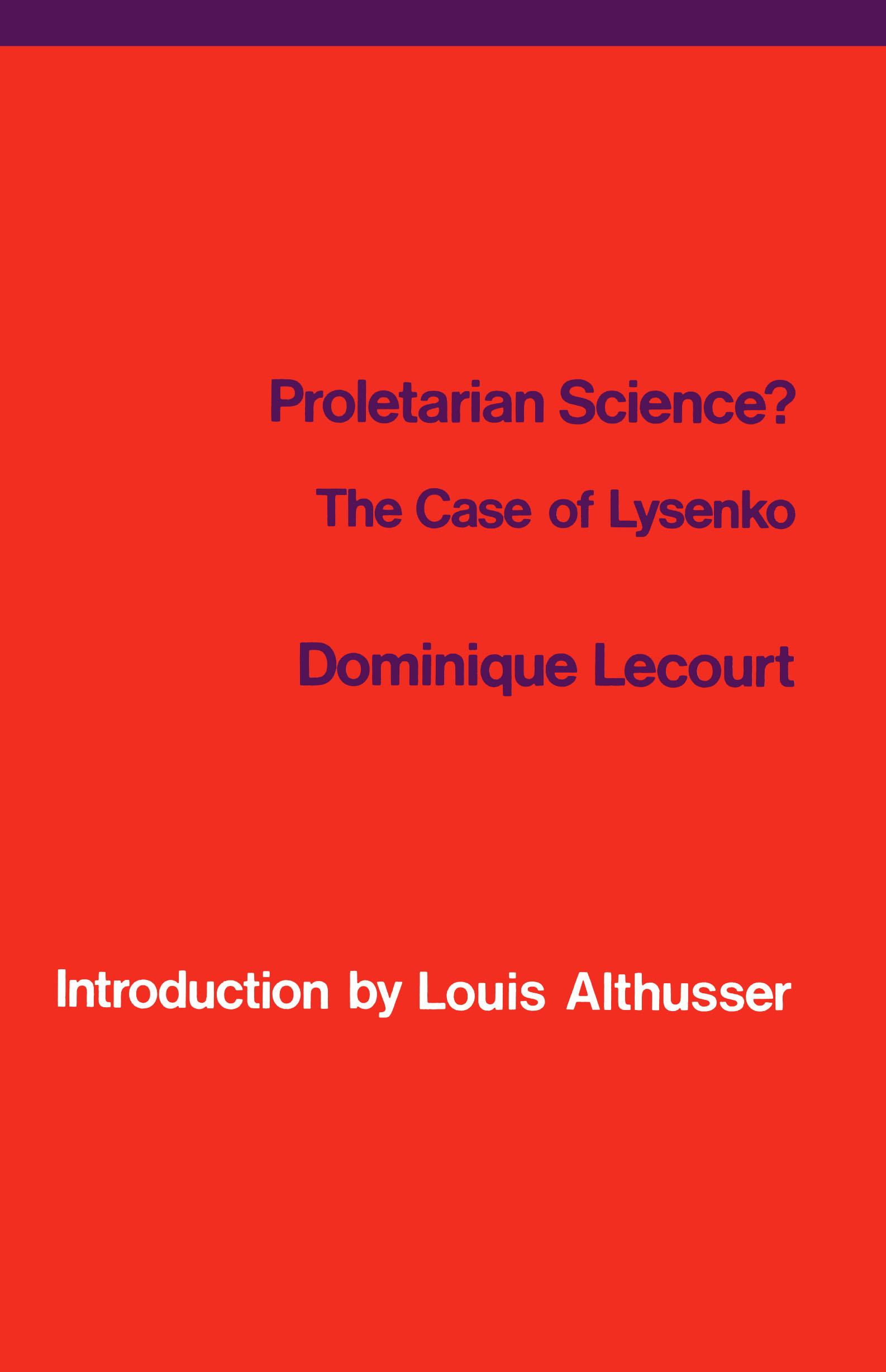
The Soviet agronomist Trofim Lysenko, who died in 1976, symbolizes one of the most notorious yet obscure episodes in the history of the Soviet Union. Emerging from provincial shadows in the Ukraine during the twenties, Lysenko achieved a meteoric career under Stalin's dictatorship, when ever greater claims were officially made for his 'environmentalism'. Overlord and autocrat of all Soviet biology after the Second World War, Lysenko's doctrines were promulgated throughout the international communist movement - from Britain to Japan - as a specifically 'proletarian' science, as opposed to mere bourgeois science. After Stalin's death, Lysenko soon plunged into discredit - although his agricultural recipes were to be approved again by Khruschev.
Dominique Lecourt - author of the highly successful study Marxism and Epistemology - poses the question: what was the historical meaning of Lysenko? Was Lysenko no more than a brutal charlatan? Or did his ideas correspond - not to any canon of science - but to wider social forces at work in the USSR? Lecourt's sardonic and perceptive study provides a definitive critique of the follies of 'anti-Mendelian' biology, and a materialist account of the reasons for its triumph in Russia during the rule of Stalin. An important afterword traces the original idea of a proletarian science to its source in Bogdanov.
In a major introductory essay, Louis Althusser poses the acute political problems which the history of Lysenko still represents for Communists everywhere, and for the first time directly indicts political repression in the USSR today.
Dominique Lecourt - author of the highly successful study Marxism and Epistemology - poses the question: what was the historical meaning of Lysenko? Was Lysenko no more than a brutal charlatan? Or did his ideas correspond - not to any canon of science - but to wider social forces at work in the USSR? Lecourt's sardonic and perceptive study provides a definitive critique of the follies of 'anti-Mendelian' biology, and a materialist account of the reasons for its triumph in Russia during the rule of Stalin. An important afterword traces the original idea of a proletarian science to its source in Bogdanov.
In a major introductory essay, Louis Althusser poses the acute political problems which the history of Lysenko still represents for Communists everywhere, and for the first time directly indicts political repression in the USSR today.
Zahle einfach mit Karte, Klarna, Apple Pay oder Google Pay. Nicht zufrieden? Du hast immer ein 14-tägiges Widerrufsrecht. Lies mehr in unseren AGB. Hast du Fragen, schreib uns eine E-Mail an hello@memmo.org.
Memmo macht das Lernen einfacher – wo auch immer du bist. Bei uns findest du deine Kursbücher und smarte Lerntools an einem Ort: Zusammenfassungen, Quizzes, Podcasts und Lernkarten. Und Ted, dein Lernbuddy, beantwortet alles, was du wissen möchtest. Über 50.000 Studierende lernen bereits hier – gemacht, damit du schneller lernst und weniger Stress hast.
Das könnte dir auch gefallen
Buch kaufen0