
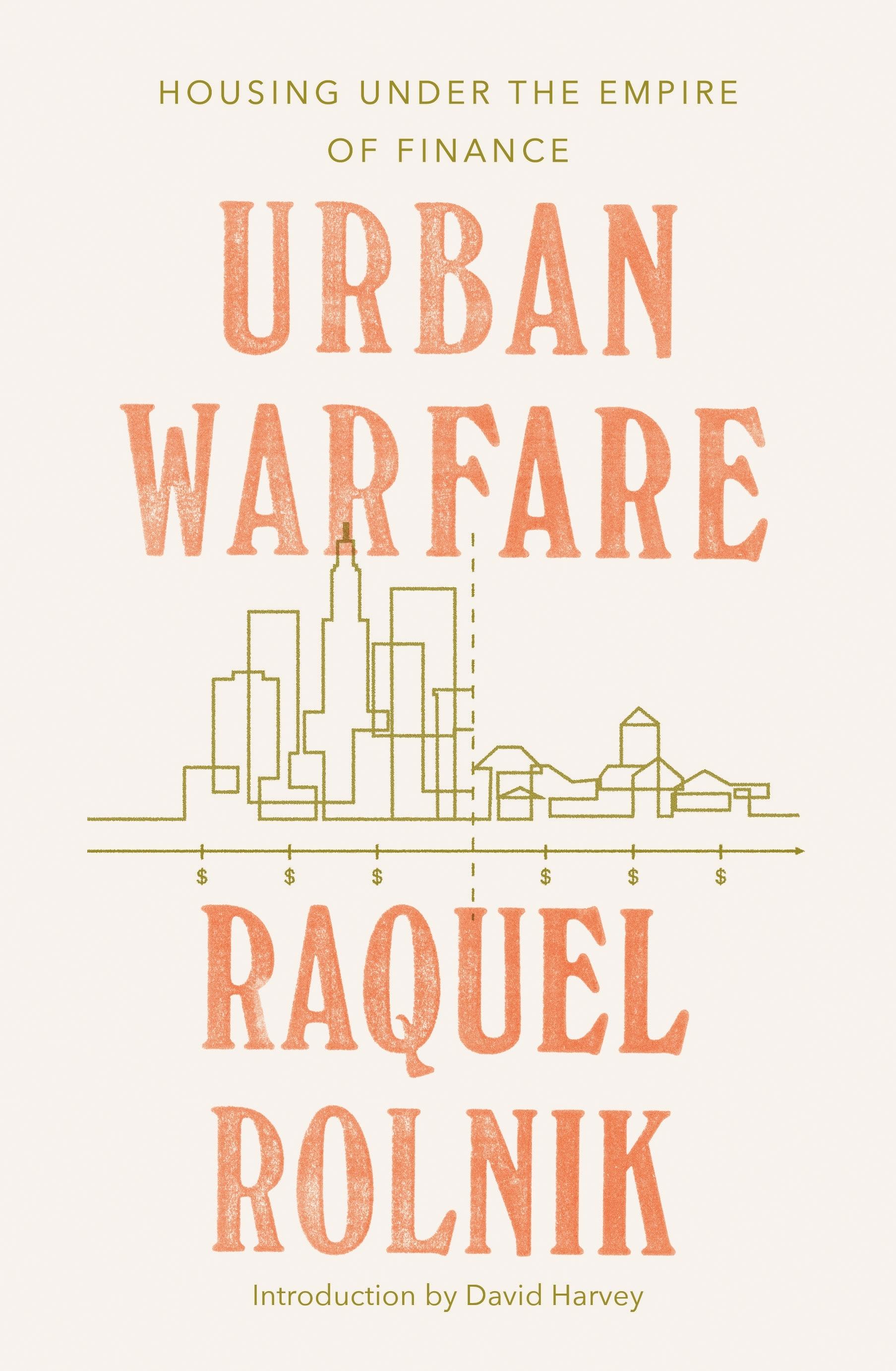
In Urban Warfare, Rolnik charts how the financialisation of housing has become a global crisis, as models of home ownership, originating in the US and UK, are being exported around the world. These developments were largely organised by htosw who benefit the most: construction companies and banks, supported by government-facilitated schemes, such as 'the right to buy', subsidies, and micro-financing.
Using examples ranging from Kazakhstan, Indonesia, Chile, Israel, Haiti, the UK and especially Brazil, Rolnik shows how our homes and neighbourhoods have effectively become the "last subprime frontiers of capitalism". This neoliberal colonialism is experienced on the scale of the city but also within our everyday lives. Yet since the financial crisis and wider urban politics that have left millions homeless, forced from their homes because of urban development politics, and mega-events such as the Rio World Cup in 2013. These narratives are weaved together with theoretical reflections and empirical evidence to explain the crisis in depth. In response, Rolnik restates the political need for activism and resistance. Examining in detail the June Days protests in Rio, 2013-14, she shows that housing remains an essential, and global, struggle.
Using examples ranging from Kazakhstan, Indonesia, Chile, Israel, Haiti, the UK and especially Brazil, Rolnik shows how our homes and neighbourhoods have effectively become the "last subprime frontiers of capitalism". This neoliberal colonialism is experienced on the scale of the city but also within our everyday lives. Yet since the financial crisis and wider urban politics that have left millions homeless, forced from their homes because of urban development politics, and mega-events such as the Rio World Cup in 2013. These narratives are weaved together with theoretical reflections and empirical evidence to explain the crisis in depth. In response, Rolnik restates the political need for activism and resistance. Examining in detail the June Days protests in Rio, 2013-14, she shows that housing remains an essential, and global, struggle.
Zahle einfach mit Karte, Klarna, Apple Pay oder Google Pay. Nicht zufrieden? Du hast immer ein 14-tägiges Widerrufsrecht. Lies mehr in unseren AGB. Hast du Fragen, schreib uns eine E-Mail an hello@memmo.org.
Memmo macht das Lernen einfacher – wo auch immer du bist. Bei uns findest du deine Kursbücher und smarte Lerntools an einem Ort: Zusammenfassungen, Quizzes, Podcasts und Lernkarten. Und Ted, dein Lernbuddy, beantwortet alles, was du wissen möchtest. Über 50.000 Studierende lernen bereits hier – gemacht, damit du schneller lernst und weniger Stress hast.
Das könnte dir auch gefallen
Buch kaufen0