
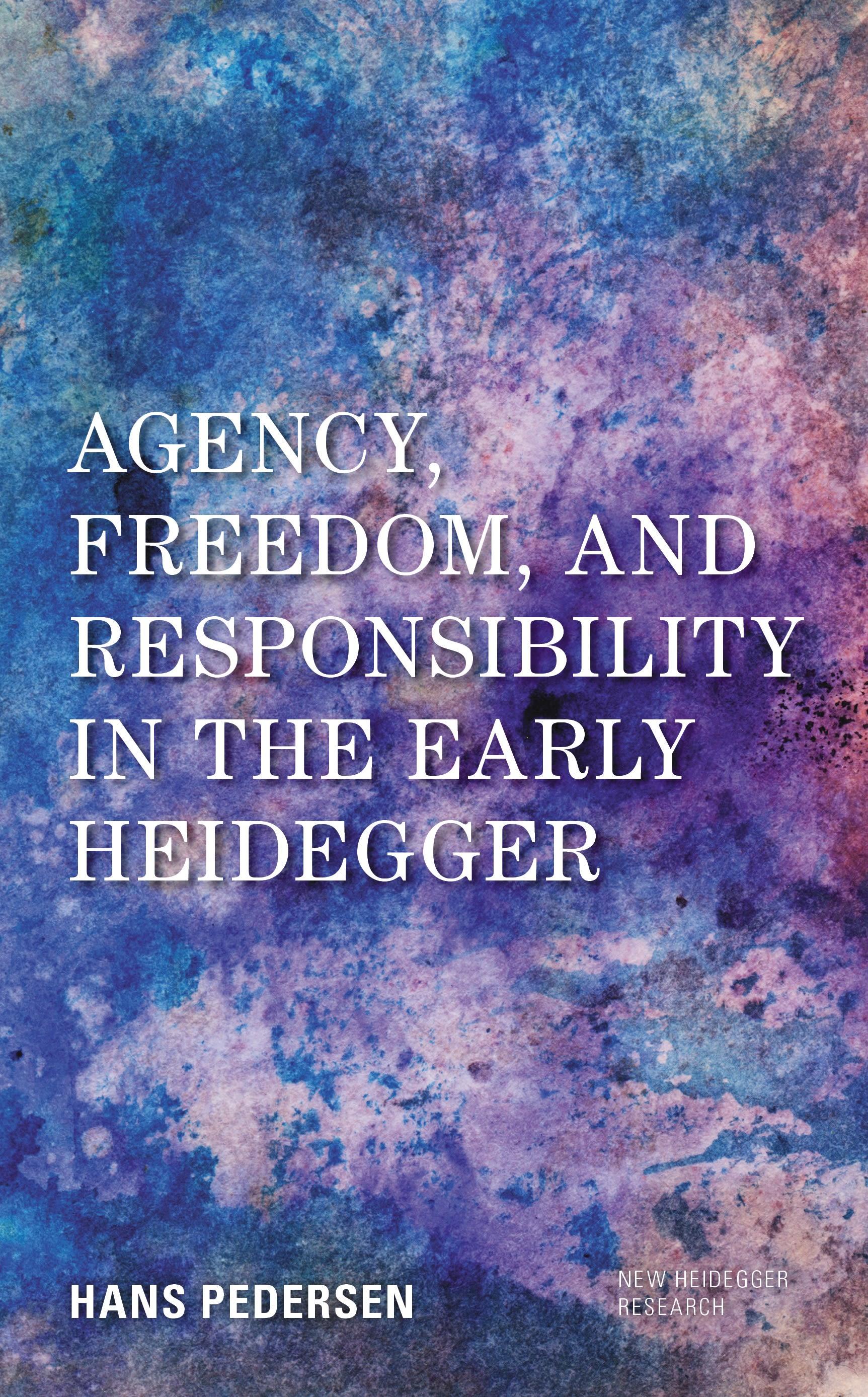
This book employs Heidegger’s work of the 1920s and early 1930s to develop distinctively Heideggerian accounts of agency, freedom, and responsibility, making the case that Heidegger’s thought provides a compelling alternative to the mainstream philosophical accounts of these concepts.
Hans Pedersen demonstrates that Heidegger’s thought can be fruitfully used to develop a plausible alternative understanding of agency that avoids the metaphysical commitments that give rise to the standard free-will debate. The first several chapters are devoted to working out an account of the ontological structure of human agency, specifically focusing on the Heideggerian understanding of the role of mental states, causal explanations, and deliberation in human agency, arguing that action need not be understood in terms of the causal efficacy of mental states. In the following chapters, building on the prior account of agency, Pedersen develops Heideggerian accounts of freedom and responsibility. Having shown that action need not be understood causally, the Heideggerian view thereby avoids the conflict between free will and determinism that gives rise to the problem of free will and the correlative problem of responsibility.
Hans Pedersen demonstrates that Heidegger’s thought can be fruitfully used to develop a plausible alternative understanding of agency that avoids the metaphysical commitments that give rise to the standard free-will debate. The first several chapters are devoted to working out an account of the ontological structure of human agency, specifically focusing on the Heideggerian understanding of the role of mental states, causal explanations, and deliberation in human agency, arguing that action need not be understood in terms of the causal efficacy of mental states. In the following chapters, building on the prior account of agency, Pedersen develops Heideggerian accounts of freedom and responsibility. Having shown that action need not be understood causally, the Heideggerian view thereby avoids the conflict between free will and determinism that gives rise to the problem of free will and the correlative problem of responsibility.
Zahle einfach mit Karte, Klarna, Apple Pay oder Google Pay. Nicht zufrieden? Du hast immer ein 14-tägiges Widerrufsrecht. Lies mehr in unseren AGB. Hast du Fragen, schreib uns eine E-Mail an hello@memmo.org.
Memmo macht das Lernen einfacher – wo auch immer du bist. Bei uns findest du deine Kursbücher und smarte Lerntools an einem Ort: Zusammenfassungen, Quizzes, Podcasts und Lernkarten. Und Ted, dein Lernbuddy, beantwortet alles, was du wissen möchtest. Über 50.000 Studierende lernen bereits hier – gemacht, damit du schneller lernst und weniger Stress hast.