
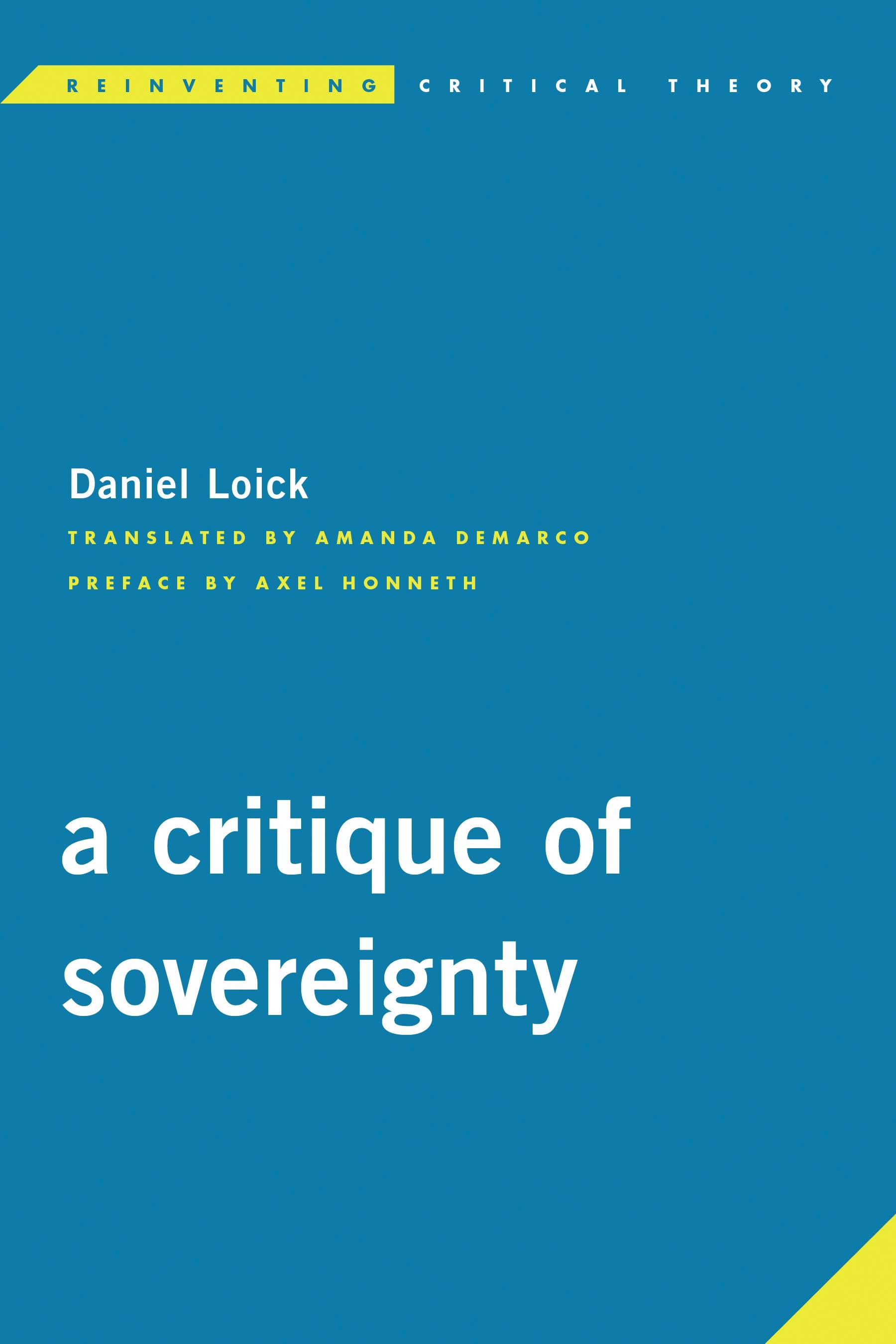
In this important new book, Daniel Loick argues that in order to become sensible to the violence imbedded in our political routines, philosophy must question the current forms of political community – the ways in which it organizes and executes its decisions, in which it creates and interprets its laws – much more radically than before. It must become a critical theory of sovereignty and in doing so eliminate coercion from the law.
The book opens with a historical reconstruction of the concept of sovereignty in Bodin, Hobbes, Rousseau, and Kant. Loick applies Adorno and Horkheimer’s notion of a ‘dialectic of Enlightenment’ to the political sphere, demonstrating that whenever humanity deemed itself progressing from chaos and despotism, it at the same time prolonged exactly the violent forms of interaction it wanted to rid itself from. He goes on to assemble critical theories of sovereignty, using Walter Benjamin’s distinction between ‘law-positing’ and ‘law-preserving’ violence as a terminological source, engaging with Marx, Arendt, Foucault, Agamben and Derrida, and adding several other dimensions of violence in order to draw a more complete picture. Finally, Loick proposes the idea of non-coercive law as a consequence of a critical theory of sovereignty.
The translation of this work was funded by Geisteswissenschaften International – Translation Funding for Humanities and Social Sciences from Germany, a joint initiative of the Fritz Thyssen Foundation, the German Federal Foreign Office, the collecting society VG WORT and the Börsenverein des Deutschen Buchhandels (German Publisher & Booksellers Association)
The book opens with a historical reconstruction of the concept of sovereignty in Bodin, Hobbes, Rousseau, and Kant. Loick applies Adorno and Horkheimer’s notion of a ‘dialectic of Enlightenment’ to the political sphere, demonstrating that whenever humanity deemed itself progressing from chaos and despotism, it at the same time prolonged exactly the violent forms of interaction it wanted to rid itself from. He goes on to assemble critical theories of sovereignty, using Walter Benjamin’s distinction between ‘law-positing’ and ‘law-preserving’ violence as a terminological source, engaging with Marx, Arendt, Foucault, Agamben and Derrida, and adding several other dimensions of violence in order to draw a more complete picture. Finally, Loick proposes the idea of non-coercive law as a consequence of a critical theory of sovereignty.
The translation of this work was funded by Geisteswissenschaften International – Translation Funding for Humanities and Social Sciences from Germany, a joint initiative of the Fritz Thyssen Foundation, the German Federal Foreign Office, the collecting society VG WORT and the Börsenverein des Deutschen Buchhandels (German Publisher & Booksellers Association)
Zahle einfach mit Karte, Klarna, Apple Pay oder Google Pay. Nicht zufrieden? Du hast immer ein 14-tägiges Widerrufsrecht. Lies mehr in unseren AGB. Hast du Fragen, schreib uns eine E-Mail an hello@memmo.org.
Memmo macht das Lernen einfacher – wo auch immer du bist. Bei uns findest du deine Kursbücher und smarte Lerntools an einem Ort: Zusammenfassungen, Quizzes, Podcasts und Lernkarten. Und Ted, dein Lernbuddy, beantwortet alles, was du wissen möchtest. Über 50.000 Studierende lernen bereits hier – gemacht, damit du schneller lernst und weniger Stress hast.