
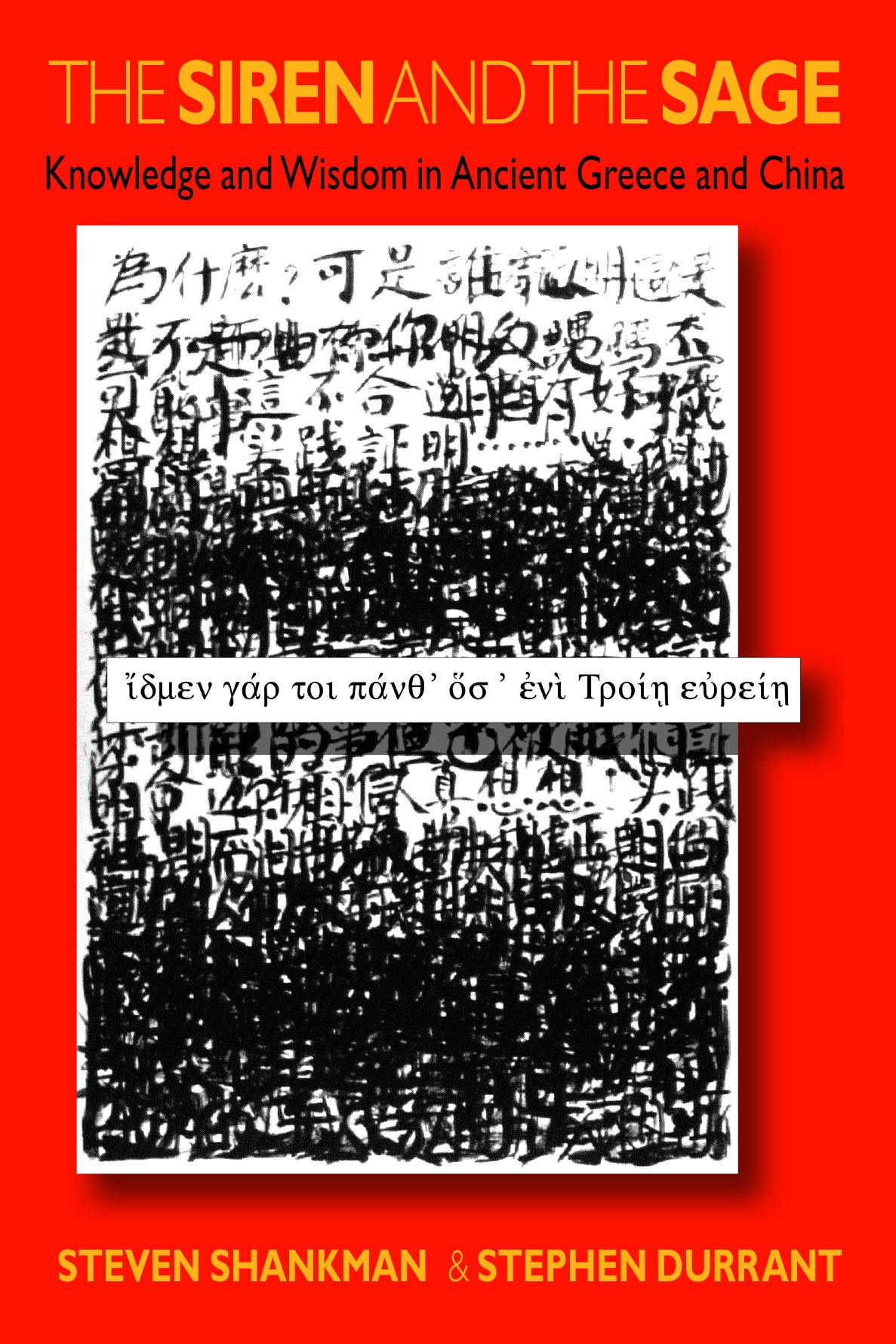
The cultures of ancient China and ancient Greece have exerted immeasurable influence on later civilizations. The texts and cultural values of classical China spread throughout East Asia and became the foundation of learning in Korea, Japan and Vietnam. Greek learning and culture receive credit for many of the intellectual paradigms of the West. Probably the one which is most distinctly Western is the tradition of logical proof and the related assumption that, as Aristotle put it in 'Metaphysics' 980, 'we all desire to know.' In contrast, the Chinese tradition, as exemplified by Laozi's 'Dao de jing,' cautions that through our desire to know we may forfeit wisdom, thus engendering a split between knowledge and wisdom.
'The Siren and the Sage' is a comparative study of what some of the most influential writers of ancient China and ancient Greece thought it meant to know and whether they distinguished knowledge from wisdom. It surveys selected works of poetry, history and philosophy from roughly the eighth through the second centuries BCE, focusing on the 'Odyssey,' the ancient Chinese 'Classic of Poetry,' Thucydides' 'History of the Peloponnesian War,' Sima Qian's 'Records of the Historian,' Plato's 'Symposium,' Laozi's 'Dao de jing' and the writings of Zhuangzi. The intention, through such juxtaposition, is to introduce foundational texts of each tradition, texts which continue to influence most of the world's peoples.
It is intriguing to ask what awareness, if any, these distinctive cultures had of each other. A considerable body of scholarship comparing ancient Greece and ancient China now exists. Scholars are presenting evidence that the two cultures may actually have been aware of each other's presence, even though that awareness was presumably indirect, perhaps mediated by the nomadic peoples of Central Asia. While not directly contributing evidence, the authors argue that comparing the cultures of Greece and China will continue to be an irresistible and important scholarly debate. The book offers a provocative study which is accessible to students and general readers and at the same time contributes to the debate.
Zahle einfach mit Karte, Klarna, Apple Pay oder Google Pay. Nicht zufrieden? Du hast immer ein 14-tägiges Widerrufsrecht. Lies mehr in unseren AGB. Hast du Fragen, schreib uns eine E-Mail an hello@memmo.org.
Memmo macht das Lernen einfacher – wo auch immer du bist. Bei uns findest du deine Kursbücher und smarte Lerntools an einem Ort: Zusammenfassungen, Quizzes, Podcasts und Lernkarten. Und Ted, dein Lernbuddy, beantwortet alles, was du wissen möchtest. Über 50.000 Studierende lernen bereits hier – gemacht, damit du schneller lernst und weniger Stress hast.
Das könnte dir auch gefallen
Buch kaufen0