
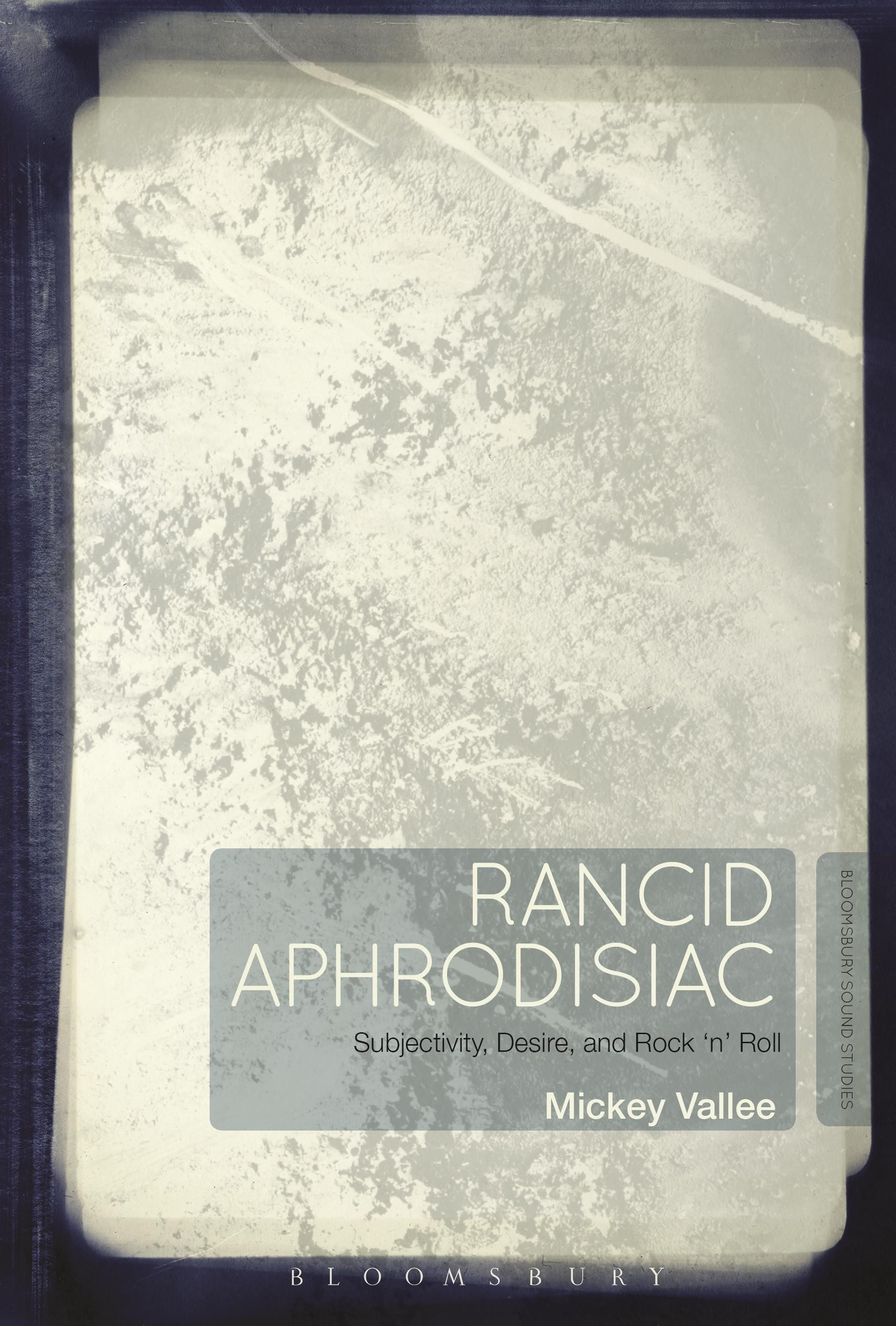
It has been sixty years since Rock 'n' Roll exploded into the mainstream, yet we remain limited in our understanding of how its bawdy excesses absorbed into the annals of mass popularity in such a short amount of time. Mickey Vallee asks: what if the Rock 'n' Roll eruption was nothing less than postwar consumer capitalism at its very best, precisely because it was taken as its very worst?
Vallee explores the emergence of Rock 'n' Roll's from an entirely new theoretical disposition in order to answer this question, drawing mainly from Lacanian cultural psychoanalysis to reveal that Rock 'n' Roll was far more conformist than we are generally led to believe; namely, that it was conformist with emerging liberal principles of freedom from the tyranny of the state. Vallee supports this proposition with detailed analyses of familiar (and not-so-familiar) characters and texts in Rock 'n' Roll to suggest that the disruption of our symbolic economy was symptomatic of a new cultural logic of economic freedom.
While not denying Rock 'n' Roll's role in the pre-civil rights movement, Vallee refuses the possibility to deny that Rock 'n' Roll's symbolic efficacy ultimately coordinated a neoliberal foundation to the ideology of individualism in its rhythm, instrumentation, lyrics, and vocals, where its power was at its most effective and affective.
Vallee explores the emergence of Rock 'n' Roll's from an entirely new theoretical disposition in order to answer this question, drawing mainly from Lacanian cultural psychoanalysis to reveal that Rock 'n' Roll was far more conformist than we are generally led to believe; namely, that it was conformist with emerging liberal principles of freedom from the tyranny of the state. Vallee supports this proposition with detailed analyses of familiar (and not-so-familiar) characters and texts in Rock 'n' Roll to suggest that the disruption of our symbolic economy was symptomatic of a new cultural logic of economic freedom.
While not denying Rock 'n' Roll's role in the pre-civil rights movement, Vallee refuses the possibility to deny that Rock 'n' Roll's symbolic efficacy ultimately coordinated a neoliberal foundation to the ideology of individualism in its rhythm, instrumentation, lyrics, and vocals, where its power was at its most effective and affective.
Seiten: 160
Kategorie: Film- & Medievetenskap
e-ISBN: 9781623560140
Versandgewicht: 1.2 kg
Versand in: 1-2 Tage
Zahle einfach mit Karte, Klarna, Apple Pay oder Google Pay. Nicht zufrieden? Du hast immer ein 14-tägiges Widerrufsrecht. Lies mehr in unseren AGB. Hast du Fragen, schreib uns eine E-Mail an hello@memmo.org.
Memmo macht das Lernen einfacher – wo auch immer du bist. Bei uns findest du deine Kursbücher und smarte Lerntools an einem Ort: Zusammenfassungen, Quizzes, Podcasts und Lernkarten. Und Ted, dein Lernbuddy, beantwortet alles, was du wissen möchtest. Über 50.000 Studierende lernen bereits hier – gemacht, damit du schneller lernst und weniger Stress hast.