
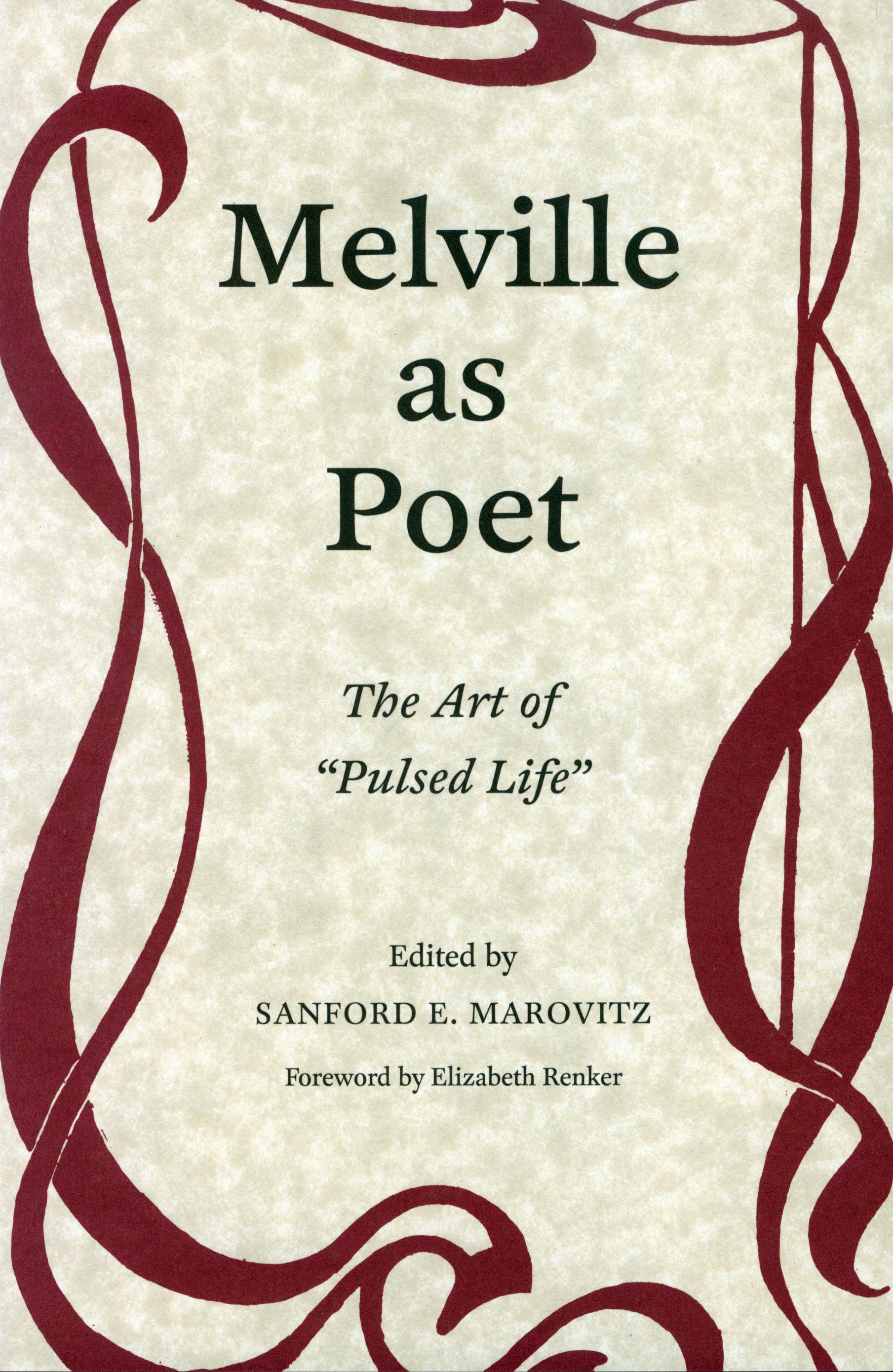
Herman Melville’s literary reputation is based chiefly on his fiction, especially Moby-Dick and Billy Budd. Yet he was a gifted poet, as evidenced by his collection of Civil War poems, Battle-Pieces and Aspects of the War (1866), and by his epic-length poem, Clarel (1876), a symbolic rendering of his pilgrimage of 1856–57 to the Holy Land, as well as the two small volumes of poems he published before his death in 1891. Melville as Poet: The Art of “Pulsed Life” opens with an introduction by Sanford E. Marovitz and the late Douglas Robillard on Melville’s conception of poetry as a literary form. The essays begin with Dennis Berthold’s study of how Melville’s observations of art at New York’s National Academy of Design in 1865 are reflected in Battle-Pieces, and Mary K. Bercaw Edwards follows, describing how the nautical combat of the ironclads Monitor and Merrimack became a subject of wide contemporary interest in popular culture. The next three essays focus on Clarel. Peter Riley explains how Melville’s familiarity with the congestion of Lower Manhattan as a customs inspector influenced his descriptions of Jerusalem. Gordon M. Poole then discusses notable subtleties in Ruggero Bianchi’s Italian translation of the poem, and Robert R. Wallace reveals how selected Biblical prints and other graphics familiar to Melville affected the poet’s descriptions in Clarel. Melville’s John Marr and Other Sailors (1888) is then examined by A. Robert Lee, who emphasizes the themes of memory and death in that small volume, and Sanford E. Marovitz illuminates Melville’s method of unifying Timoleon, Etc. by using contrast to bind, not separate. Vernon Shetley compares Melville’s “Pausilippo” thematically with Shelley’s “Julian and Maddalo,” and Michael Jonik explores “The Archipelago” for insights into Melville’s experimentation with imagery and form. Finally, Wyn Kelley, Clark Davis, and Robert Sandberg imaginatively examine and reassess poems Melville left unpublished at his death. Melville as Poet is a valuable collection of new and critical scholarship that aims to encourage more and deeper study of Melville’s art of poetry.
Zahle einfach mit Karte, Klarna, Apple Pay oder Google Pay. Nicht zufrieden? Du hast immer ein 14-tägiges Widerrufsrecht. Lies mehr in unseren AGB. Hast du Fragen, schreib uns eine E-Mail an hello@memmo.org.
Memmo macht das Lernen einfacher – wo auch immer du bist. Bei uns findest du deine Kursbücher und smarte Lerntools an einem Ort: Zusammenfassungen, Quizzes, Podcasts und Lernkarten. Und Ted, dein Lernbuddy, beantwortet alles, was du wissen möchtest. Über 50.000 Studierende lernen bereits hier – gemacht, damit du schneller lernst und weniger Stress hast.
Das könnte dir auch gefallen
Buch kaufen0