
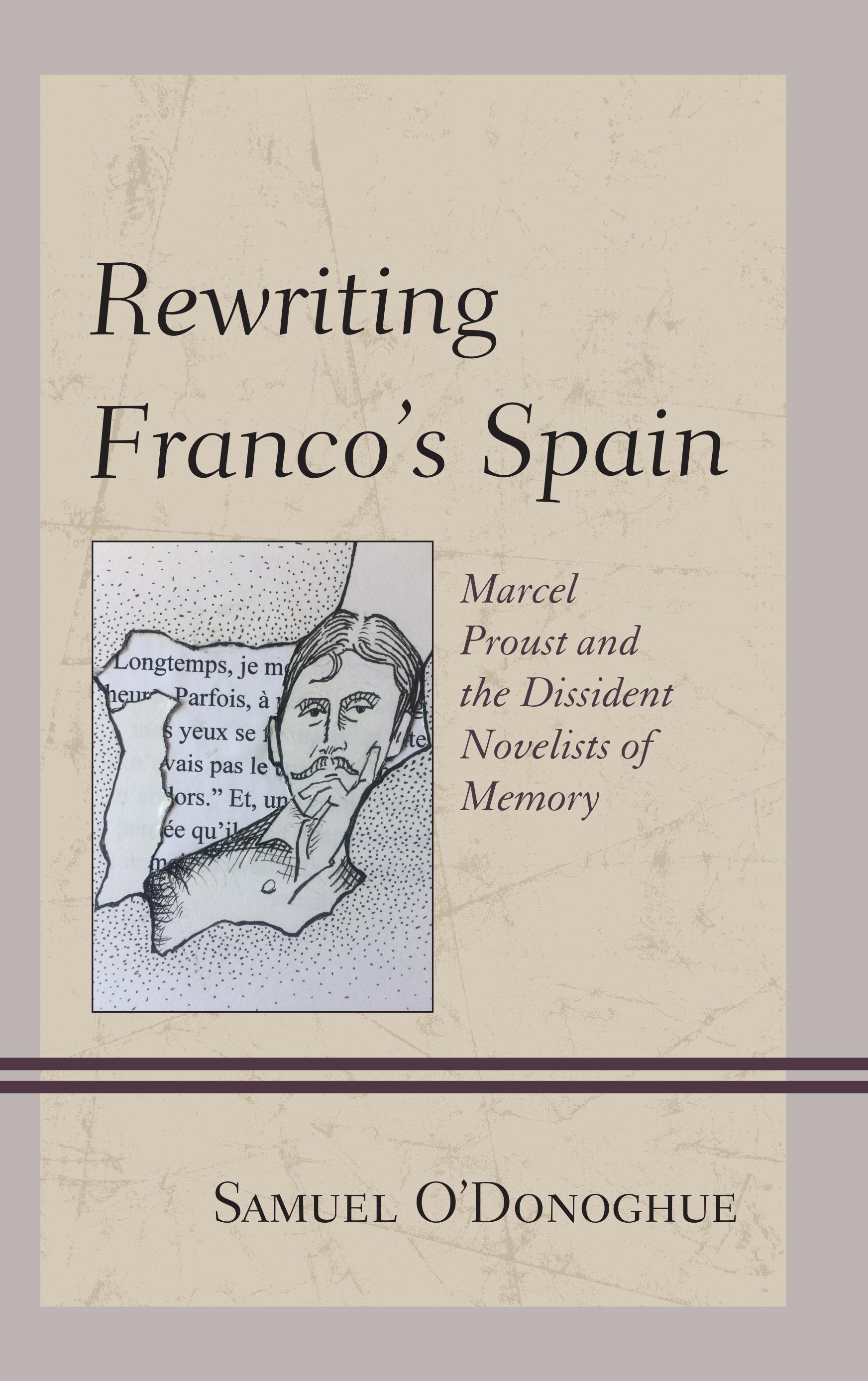
Rewriting Franco’s Spain: Marcel Proust and the Dissident Novelists of Memory proposes a new reading of some of the most culturally significant and closely studied works of Spanish memory fiction from the past seventy years. It examines the influence of French writer Marcel Proust on fiction concerning the Spanish Civil War and Franco’s dictatorship by Carmen Laforet, Juan Goytisolo, Juan Benet, Carmen Martín Gaite, Jorge Semprún, and Javier Marías. It explores the ways in which À la recherche du temps perdu has been instrumental in these authors’ works, galvanizing their creative impetus, shaping their imaginative act, and guiding their adversarial stance toward Franco’s regime. This book illustrates how these writers use Proustian themes and techniques and thereby enhances our understanding of the function of memory and fictional creation in some of the most important milestones in contemporary Spanish literature.
Rewriting Franco’s Spain argues that an appreciation of Proust’s pervasive influence on Spanish memory writing obliges us to reconsider the notion that Franco’s regime maintained a rigid stranglehold on imported culture. Capturing the richness of Spanish novelists’ contact with literature produced outside of Spain, it challenges the prevailing scholarly tendency to focus on the novelists’ immediate sociopolitical concerns. There is more to these texts than a simple testimony of the brutality and hardship of the civil war and life under Franco. By illuminating the subversive nature of Spanish novelists’ use of a Proust-inspired practice of self-writing, Rewriting Franco’s Spain seeks to readjust some of the ways we view the role of novelists living during the regime and in its wake. It advocates a conception of novelists as dissidents, teasing out the seditious undercurrent of their cultivation of self-writing and examining how they disputed the regime’s ideas about what culture should look like. The preconception that the development of Spanish literature under Franco was stunted because Spaniards were prevented from reading works considered an affront to National-Catholic sensibilities is cast aside, as is the notion that Spain was isolated from narrative developments elsewhere. Rewriting Franco’s Spain ultimately reveals the centrality of Proust’s monumental novel in the evolution of contemporary Spanish literature.
Rewriting Franco’s Spain argues that an appreciation of Proust’s pervasive influence on Spanish memory writing obliges us to reconsider the notion that Franco’s regime maintained a rigid stranglehold on imported culture. Capturing the richness of Spanish novelists’ contact with literature produced outside of Spain, it challenges the prevailing scholarly tendency to focus on the novelists’ immediate sociopolitical concerns. There is more to these texts than a simple testimony of the brutality and hardship of the civil war and life under Franco. By illuminating the subversive nature of Spanish novelists’ use of a Proust-inspired practice of self-writing, Rewriting Franco’s Spain seeks to readjust some of the ways we view the role of novelists living during the regime and in its wake. It advocates a conception of novelists as dissidents, teasing out the seditious undercurrent of their cultivation of self-writing and examining how they disputed the regime’s ideas about what culture should look like. The preconception that the development of Spanish literature under Franco was stunted because Spaniards were prevented from reading works considered an affront to National-Catholic sensibilities is cast aside, as is the notion that Spain was isolated from narrative developments elsewhere. Rewriting Franco’s Spain ultimately reveals the centrality of Proust’s monumental novel in the evolution of contemporary Spanish literature.
Seiten: 244
Kategorie: Litteraturvetenskap & Teori
e-ISBN: 9781611488616
Versandgewicht: 1.2 kg
Versand in: 1-2 Tage
Zahle einfach mit Karte, Klarna, Apple Pay oder Google Pay. Nicht zufrieden? Du hast immer ein 14-tägiges Widerrufsrecht. Lies mehr in unseren AGB. Hast du Fragen, schreib uns eine E-Mail an hello@memmo.org.
Memmo macht das Lernen einfacher – wo auch immer du bist. Bei uns findest du deine Kursbücher und smarte Lerntools an einem Ort: Zusammenfassungen, Quizzes, Podcasts und Lernkarten. Und Ted, dein Lernbuddy, beantwortet alles, was du wissen möchtest. Über 50.000 Studierende lernen bereits hier – gemacht, damit du schneller lernst und weniger Stress hast.