
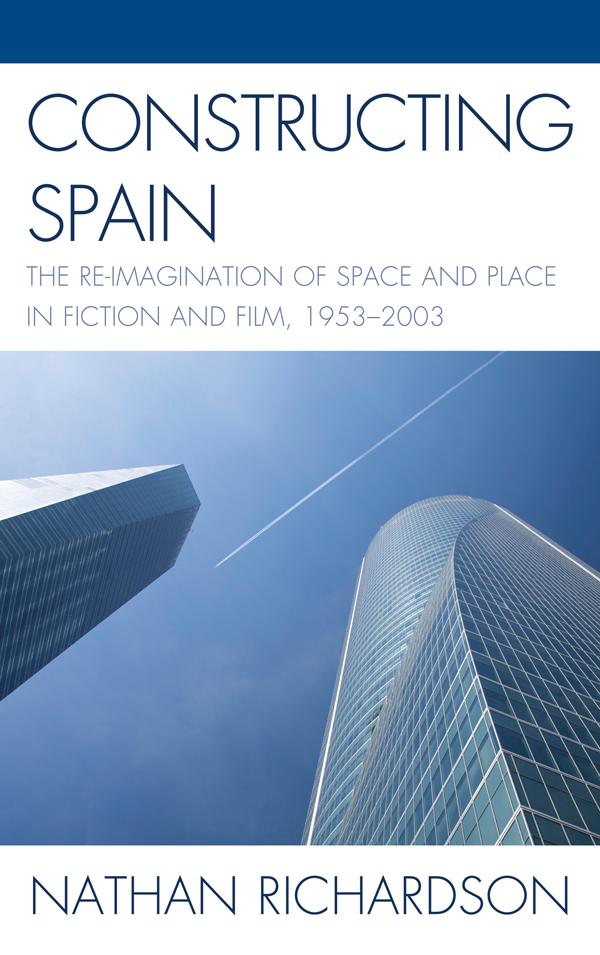
Does fiction do more than just represent space? Can our experiences with fictional storytelling be in themselves spatial? In Constructing Spain: The Re-imagination of Space and Place in Fiction and Film, Nathan Richardson explores relations between cultural representation and spatial transformation across fifty years of Spanish culture. Beginning in 1953, the year Spanish space was officially reopened to Western thought and capital, and culminating in 2003, the year of Aznar’s unpopular involvement of his country in the second Iraq War, Richardson traces in popular and critically acclaimed fiction and film an evolution in Spanish storytelling that, while initially representative in nature, increasingly engages its audience in spatial practices that go beyond mere perception or conception of local material geographies.
In original readings of films by Luis Berlanga, Luis Buñuel, Alex de la Iglesia, Alejandro Amenábar, and Julio Medem, and novels by Juan Goytisolo, Antonio Muñoz Molina, and Javier Marías, Richardson shows this formal evolution as a necessary response to developments, restorations, and transformations of local landscapes that resulted during these years from various human migrations, tourist-invasions, urban development plans, resurgent nationalisms, and finally globalization. As these changes occur, Richardson traces a shift in the works studied from mere representation of spatial change toward actual engagement with shifting physical and social geographies, as they inch ever closer toward the production of an actual spatial experience for their audiences. In the final chapters of this book, Richardson offers in-depth and highly original readings of the storytelling projects of Medem and Marías in particular, showing how these two artists invite readers to not only reconceive hegemonic notions of space and place, but to practice alternative notions of being-in-place. In these final readings, Constructing Spain, points to the newest developments in contemporary Spanish narrative and film, a rise of new grammars of creation to challenge the ongoing capital-driven creative destruction of globalized Spanish geography.
In original readings of films by Luis Berlanga, Luis Buñuel, Alex de la Iglesia, Alejandro Amenábar, and Julio Medem, and novels by Juan Goytisolo, Antonio Muñoz Molina, and Javier Marías, Richardson shows this formal evolution as a necessary response to developments, restorations, and transformations of local landscapes that resulted during these years from various human migrations, tourist-invasions, urban development plans, resurgent nationalisms, and finally globalization. As these changes occur, Richardson traces a shift in the works studied from mere representation of spatial change toward actual engagement with shifting physical and social geographies, as they inch ever closer toward the production of an actual spatial experience for their audiences. In the final chapters of this book, Richardson offers in-depth and highly original readings of the storytelling projects of Medem and Marías in particular, showing how these two artists invite readers to not only reconceive hegemonic notions of space and place, but to practice alternative notions of being-in-place. In these final readings, Constructing Spain, points to the newest developments in contemporary Spanish narrative and film, a rise of new grammars of creation to challenge the ongoing capital-driven creative destruction of globalized Spanish geography.
Seiten: 352
Kategorie: Litteraturvetenskap & Teori
e-ISBN: 9781611483970
Versandgewicht: 1.2 kg
Versand in: 1-2 Tage
Zahle einfach mit Karte, Klarna, Apple Pay oder Google Pay. Nicht zufrieden? Du hast immer ein 14-tägiges Widerrufsrecht. Lies mehr in unseren AGB. Hast du Fragen, schreib uns eine E-Mail an hello@memmo.org.
Memmo macht das Lernen einfacher – wo auch immer du bist. Bei uns findest du deine Kursbücher und smarte Lerntools an einem Ort: Zusammenfassungen, Quizzes, Podcasts und Lernkarten. Und Ted, dein Lernbuddy, beantwortet alles, was du wissen möchtest. Über 50.000 Studierende lernen bereits hier – gemacht, damit du schneller lernst und weniger Stress hast.