
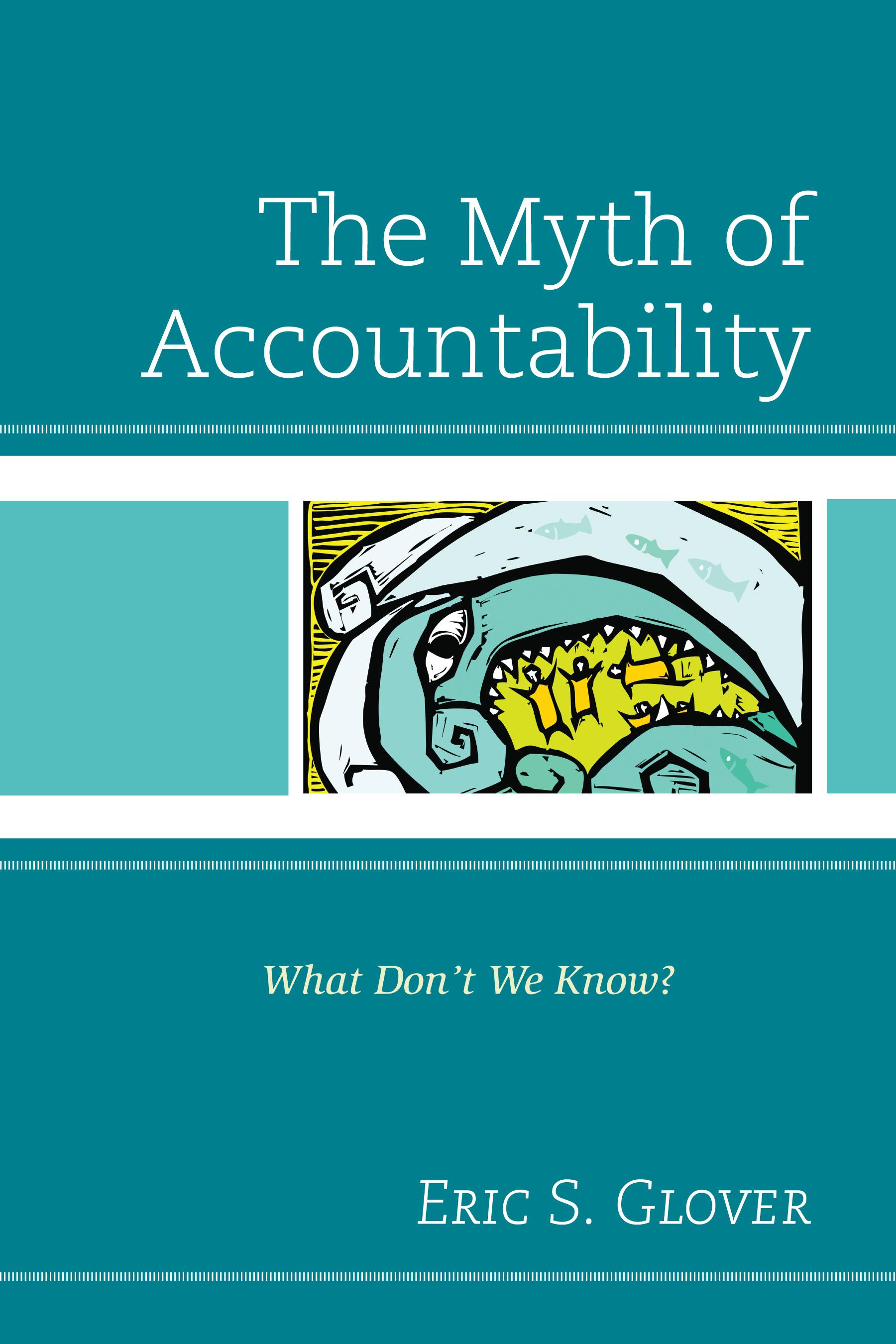
School improvement that is reliant on accountability is a myth based upon falsehoods and wrong assumptions. Public educations’ increased dependence on this foundation for school reform and change has failed both students and teachers. The fact remains that people who create education policy do not understand what is best for individual students and classrooms. Their devised curriculum standards are, in actuality, curriculum limits that prevent students from creating successful personal and academic futures because they thwart any natural learning exploration. As such, these market-inspired, externally-motivated standards limit higher-level learning. Instead of treating students and teachers as subjects to be actively engaged in learning, accountability systems treat students and teachers like objects to be manipulated by training.
By presenting the lead-teach-learn triad, Eric Glover’s The Myth of Accountability discusses the pitfalls of accountability systems in schools, while also investigating how schools have somehow managed to improve in spite of their negative influences. In order to evolve school reform, Glover introduces the concept of developmental empowerment in order to frame how school participants must view themselves as perpetually changing learners and systematically update school reform. Through open inquiry, Glover encourages educators to challenge the standardization and accountability practices that limit children’s futures.
By presenting the lead-teach-learn triad, Eric Glover’s The Myth of Accountability discusses the pitfalls of accountability systems in schools, while also investigating how schools have somehow managed to improve in spite of their negative influences. In order to evolve school reform, Glover introduces the concept of developmental empowerment in order to frame how school participants must view themselves as perpetually changing learners and systematically update school reform. Through open inquiry, Glover encourages educators to challenge the standardization and accountability practices that limit children’s futures.
Zahle einfach mit Karte, Klarna, Apple Pay oder Google Pay. Nicht zufrieden? Du hast immer ein 14-tägiges Widerrufsrecht. Lies mehr in unseren AGB. Hast du Fragen, schreib uns eine E-Mail an hello@memmo.org.
Memmo macht das Lernen einfacher – wo auch immer du bist. Bei uns findest du deine Kursbücher und smarte Lerntools an einem Ort: Zusammenfassungen, Quizzes, Podcasts und Lernkarten. Und Ted, dein Lernbuddy, beantwortet alles, was du wissen möchtest. Über 50.000 Studierende lernen bereits hier – gemacht, damit du schneller lernst und weniger Stress hast.