
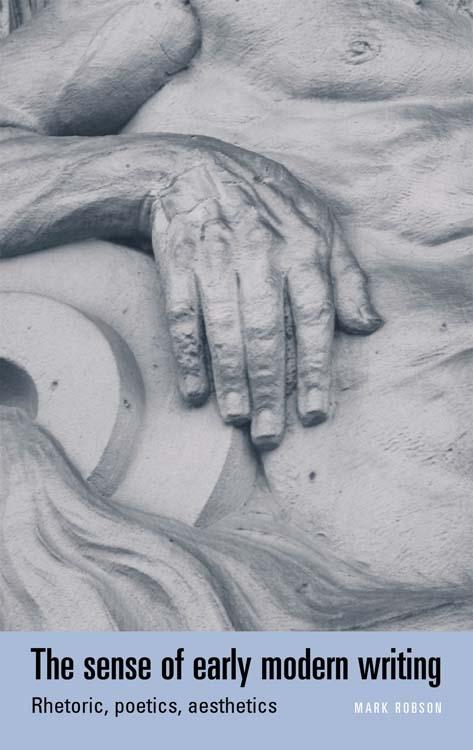
In The sense of Early Modern writing, Mark Robson pursues the relation between the concept of the ‘early modern’ and modernity, tracing the complex interactions of post-Romantic, philosophical aesthetics and early modern rhetoric and poetics. The book therefore questions the status of what we now think of as literary texts in a period prior to the emergence of literature as a category. In this way, Robson argues for an attention to the classical notion of aisthesis, that is, for the crucial dimension of perception and response in reading and thinking -- and its rhetorical determination -- to be taken into account. Robson’s theoretically-informed approach, drawing in particular on the work of Jacques Derrida and Paul de Man, fundamentally challenges the idea that critical theory is of little relevance in the reading of early modern texts.
The sense of Early Modern writing includes readings of both familiar and unfamiliar texts by Shakespeare, Sidney, Jonson, Hester Pulter and others, and considers topics such as ears, eyes, tongues, hands and voices, in order to ask: How should we read early modern texts? The book will therefore be of interest to all students and researchers in early modern or Renaissance studies, as well as to those thinking through the theories and histories of literature, aesthetics and rhetoric.
Zahle einfach mit Karte, Klarna, Apple Pay oder Google Pay. Nicht zufrieden? Du hast immer ein 14-tägiges Widerrufsrecht. Lies mehr in unseren AGB. Hast du Fragen, schreib uns eine E-Mail an hello@memmo.org.
Memmo macht das Lernen einfacher – wo auch immer du bist. Bei uns findest du deine Kursbücher und smarte Lerntools an einem Ort: Zusammenfassungen, Quizzes, Podcasts und Lernkarten. Und Ted, dein Lernbuddy, beantwortet alles, was du wissen möchtest. Über 50.000 Studierende lernen bereits hier – gemacht, damit du schneller lernst und weniger Stress hast.