
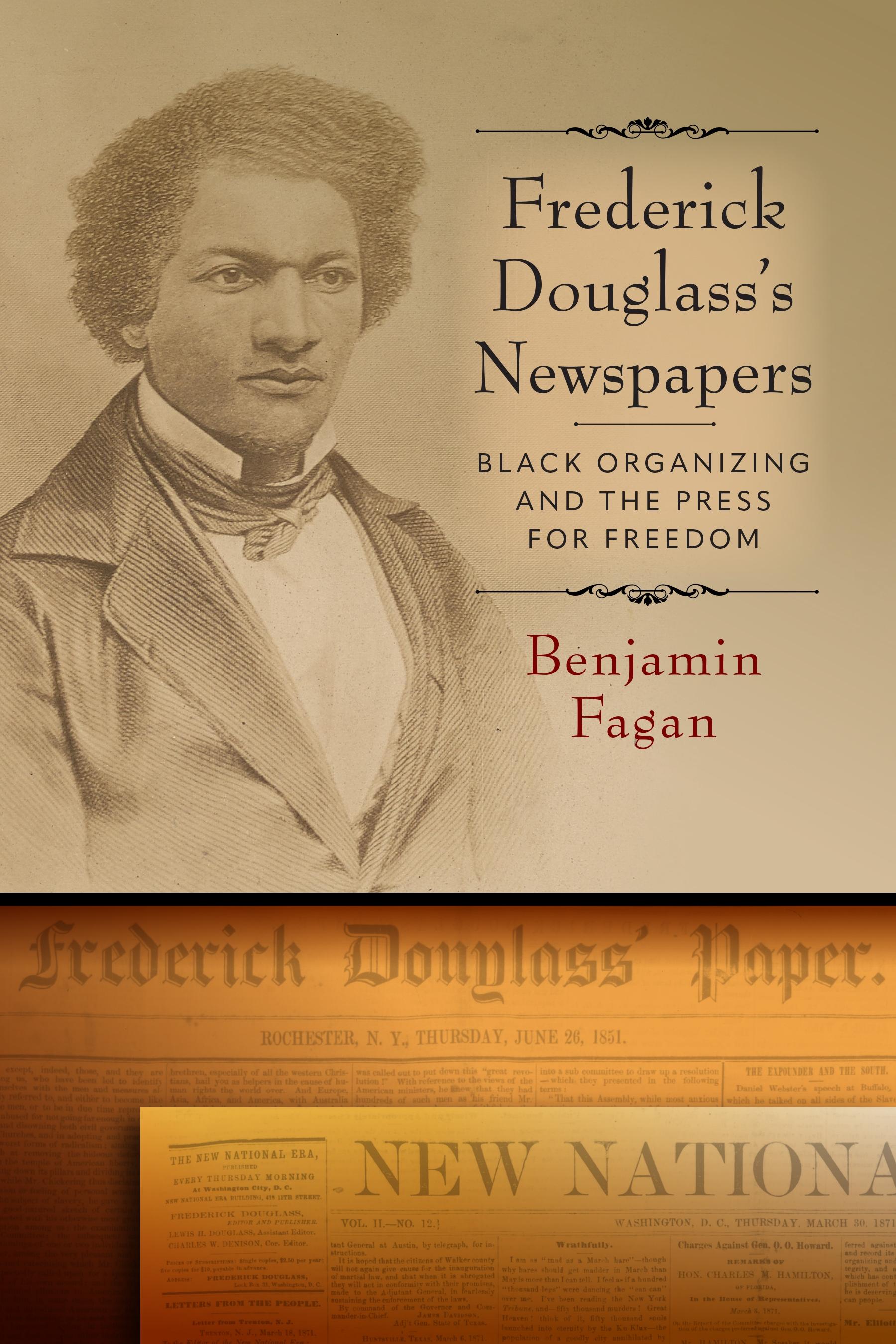
The first book to focus on the newspapers edited by Frederick Douglass and their impact on Black organizing
A robust body of work has established the importance of print in general, and newspapers in particular, to African American culture in the 1800s. Such work regularly acknowledges Frederick Douglass (1818–1895) as one of the most influential newspaper editors of the nineteenth century, a judgment that Douglass and many of his contemporaries shared. But while recent scholarship has continued to expand our understanding of Douglass’s life and work, his newspapers remain largely understudied. Frederick Douglass’s Newspapers is the first book that explores the full range of Douglass’s periodicals.
Benjamin Fagan traces the making and impact of the four newspapers edited by Douglass: the North Star (1847–1851), Frederick Douglass’ Paper (1851–1860), Douglass’ Monthly (1858–1863), and the New National Era (1870–1874). Fagan highlights how Douglass and his co-workers—which included Martin R. Delany, James McCune Smith, William C. Neil, and Douglass’s daughter Rosetta Douglass, among others—practiced versions of Black organizing as they made his newspapers. By teasing out the inner workings of Douglass’s newspapers, Fagan explores the complex and often messy practices of Black organizing that made these publications possible.
In doing so, this book places Douglass’s newspapers at the center of the story of Black organizing in the nineteenth century. Douglass’s newspapers not only offered examples of how to organize for Black readers across the country, but he and his co-workers also participated in a variety of other kinds of Black organizations. Writers for Douglass’s papers put such experiences into print, and stories and lessons of Black organizing filled the pages of Douglass’s newspapers. They covered a variety of issues: abolitionism, school integration, politics both domestic and international, the Civil War, and the burgeoning Black labor movement, among others. Fagan’s close examination of the making of Douglass’s newspapers as well as what appeared in their pages chronicles how his publications were simultaneously examples and archives of Black organizing.
Zahle einfach mit Karte, Klarna, Apple Pay oder Google Pay. Nicht zufrieden? Du hast immer ein 14-tägiges Widerrufsrecht. Lies mehr in unseren AGB. Hast du Fragen, schreib uns eine E-Mail an hello@memmo.org.
Memmo macht das Lernen einfacher – wo auch immer du bist. Bei uns findest du deine Kursbücher und smarte Lerntools an einem Ort: Zusammenfassungen, Quizzes, Podcasts und Lernkarten. Und Ted, dein Lernbuddy, beantwortet alles, was du wissen möchtest. Über 50.000 Studierende lernen bereits hier – gemacht, damit du schneller lernst und weniger Stress hast.