
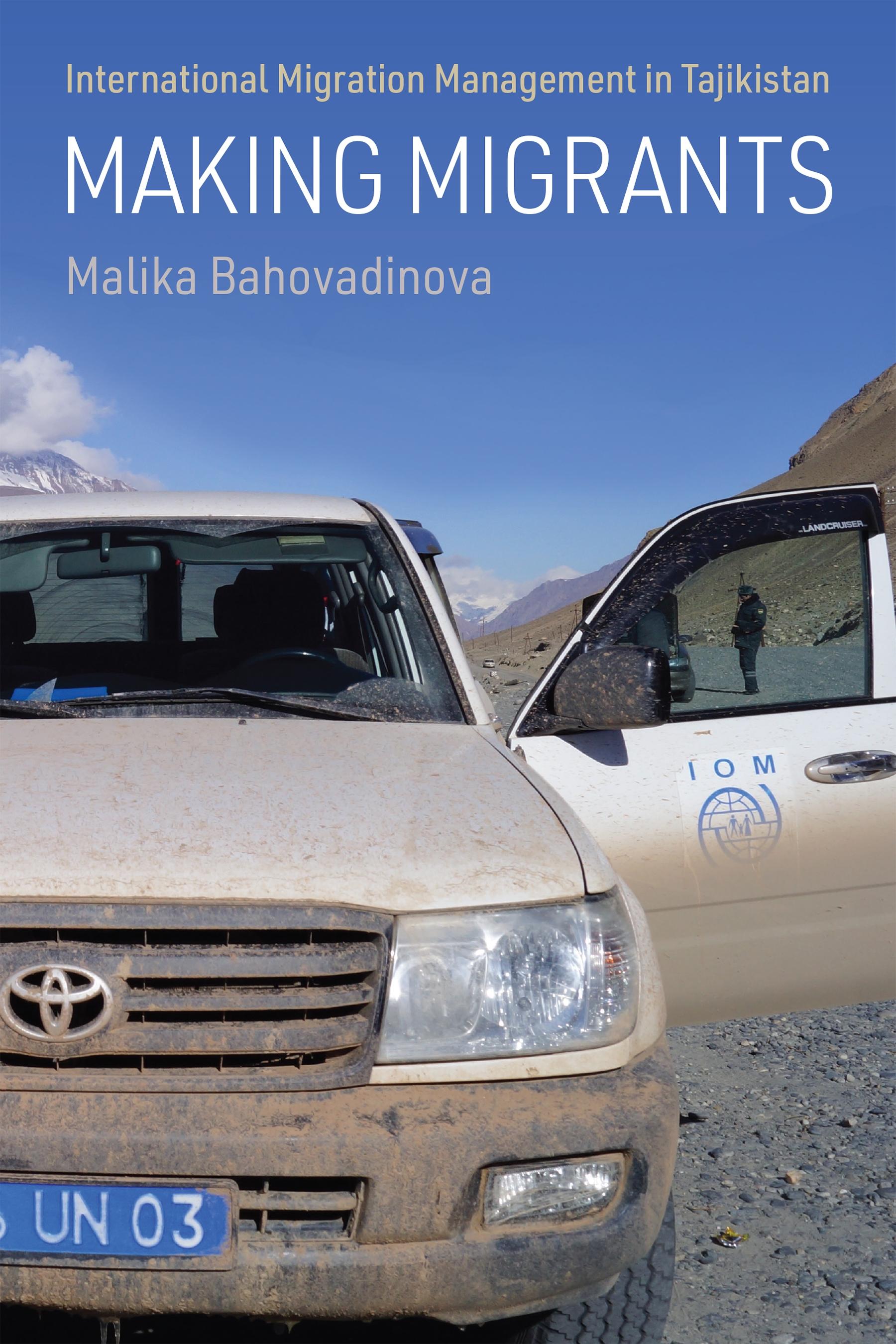
How officials in bureaucratic institutions in Tajikistan, though well-meaning, create a postcolonial, problematic “migrant”
Making Migrants explores the postcolonial life of institutions and law in Tajikistan, finding that bureaucratic spaces render people who seek to work abroad into the subjective construct of a “migrant.” Anthropologist Malika Bahovadinova argues that this category describes not an individual, but a broader process of government regulation and control. Both structural and literal violence is entrenched in the bureaucratic process, which, in our increasingly mobile world, unfolds in a hostile global context where nation-states seek to make the figure of the “migrant” an “illegal” one.
Through an examination of migration officials’ day-to-day work facilitating migration from Tajikistan to Russia, Bahovadinova reveals how 10 percent of Tajikistan’s population has moved to Russia in search of stronger economic opportunities. She finds that officials face steep challenges in this work as they grapple with deeply unequal and asymmetrical relationships with Russia, donor states, and international experts, while coming face-to-face with postcolonial legacies from the Soviet past. By exploring relationships between history, pedagogy, and law in migration bureaucracy, Bahovadinova highlights the limited possibilities available to officials in global migration management, asks how governmental ideas and practices develop, and uncovers the challenges that transnational citizens face when they leave their countries to work without forfeiting their original citizenship.
This case shows how postcolonial countries that export workers introduce and replicate colonial rationalities that understand laborers as “migrants” or “illegals” in receiving states. By attaching the term “illegal” to people from a former colony, Russia shapes representations of Tajikistan’s citizens as inherently potentially criminal and dangerous “others,” while benefitting from their temporary labor. Ultimately, Making Migrants uncovers how introducing and performing “migration management” in a postcolonial environment aligns with and reinforces colonial rationalities about people, labor, economic opportunity, and bureaucratic authority.
Zahle einfach mit Karte, Klarna, Apple Pay oder Google Pay. Nicht zufrieden? Du hast immer ein 14-tägiges Widerrufsrecht. Lies mehr in unseren AGB. Hast du Fragen, schreib uns eine E-Mail an hello@memmo.org.
Memmo macht das Lernen einfacher – wo auch immer du bist. Bei uns findest du deine Kursbücher und smarte Lerntools an einem Ort: Zusammenfassungen, Quizzes, Podcasts und Lernkarten. Und Ted, dein Lernbuddy, beantwortet alles, was du wissen möchtest. Über 50.000 Studierende lernen bereits hier – gemacht, damit du schneller lernst und weniger Stress hast.