
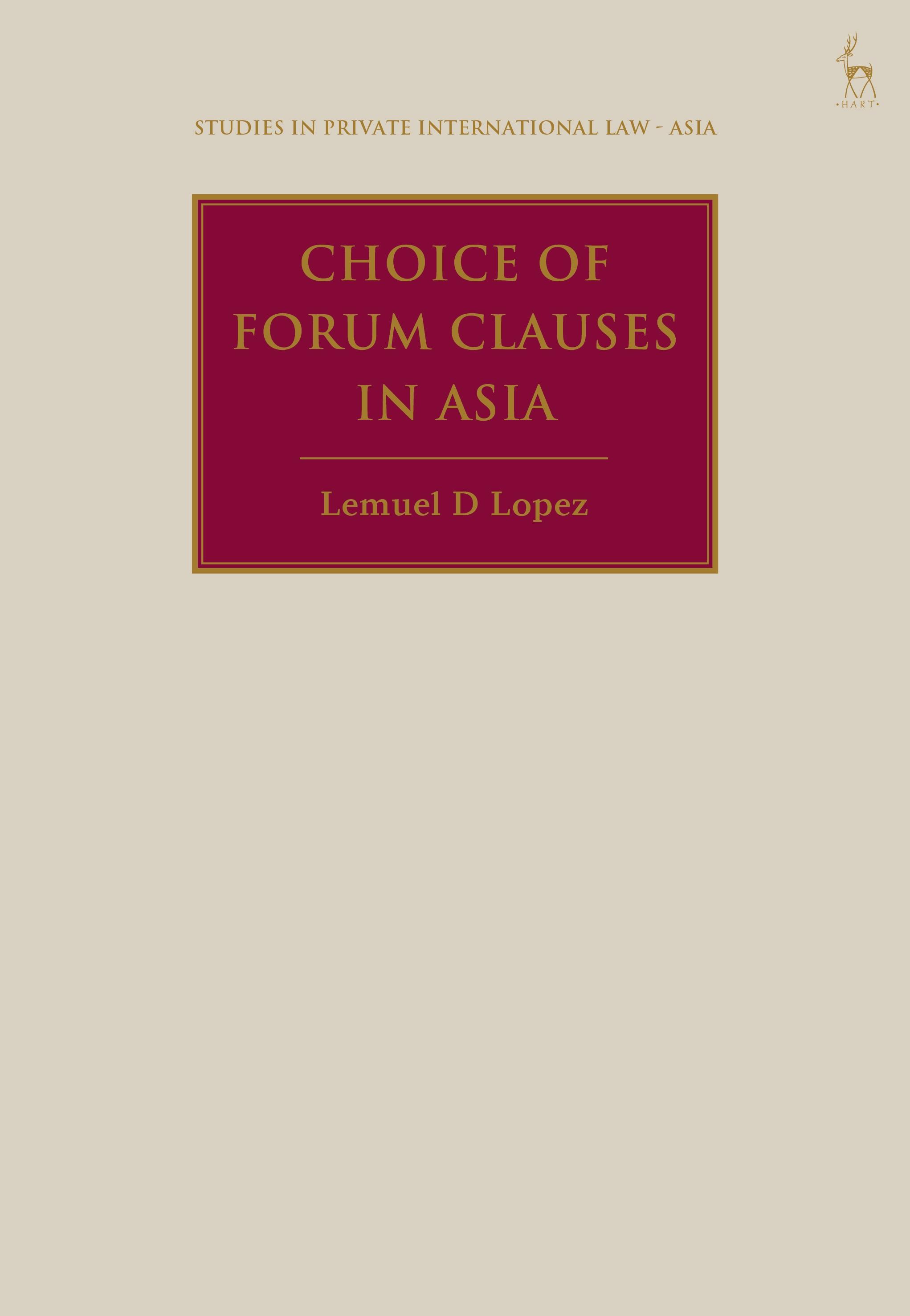
This book compares and explains the approaches taken by Asian courts when choice of forum clauses in international commercial contracts are challenged in litigation.
It examines key common law jurisdictions (Singapore, Hong Kong and Malaysia), civil law jurisdictions (China, Japan, and Indonesia), and hybrid jurisdictions (the Philippines).
With Asia's ascent in cross-border trade and investment, alongside a corresponding increase in cross-border litigation, understanding how Asian courts address choice of forum clauses in international commercial contracts has never been more critical. Employing a comparative law method, the book identifies and explains the relief and remedies used by Asian courts in enforcing choice of forum clauses, analysing how their classification as either contractual or procedural in nature shapes judicial approaches. It further distinguishes choice of forum clauses from arbitration agreements and explores their interaction with other contractual provisions. Party autonomy – as the parties' freedom to determine the contents of the choice of forum clause and the freedom to control the flow of litigation – is also critically scrutinised.
Furthermore, the book investigates the factors courts consider in resolving key choice of forum clause issues (ie, enforceability; specific relief to be granted; existence, validity, interpretation of choice of forum clauses; role of mandatory rules, public policy, and international interests) and explores the prospects for future development of this area of law in Asia.
Crucially, the book highlights the unique approaches of Asian courts, while underscoring the differences and similarities among common law, civil law, and hybrid jurisdictions.
It examines key common law jurisdictions (Singapore, Hong Kong and Malaysia), civil law jurisdictions (China, Japan, and Indonesia), and hybrid jurisdictions (the Philippines).
With Asia's ascent in cross-border trade and investment, alongside a corresponding increase in cross-border litigation, understanding how Asian courts address choice of forum clauses in international commercial contracts has never been more critical. Employing a comparative law method, the book identifies and explains the relief and remedies used by Asian courts in enforcing choice of forum clauses, analysing how their classification as either contractual or procedural in nature shapes judicial approaches. It further distinguishes choice of forum clauses from arbitration agreements and explores their interaction with other contractual provisions. Party autonomy – as the parties' freedom to determine the contents of the choice of forum clause and the freedom to control the flow of litigation – is also critically scrutinised.
Furthermore, the book investigates the factors courts consider in resolving key choice of forum clause issues (ie, enforceability; specific relief to be granted; existence, validity, interpretation of choice of forum clauses; role of mandatory rules, public policy, and international interests) and explores the prospects for future development of this area of law in Asia.
Crucially, the book highlights the unique approaches of Asian courts, while underscoring the differences and similarities among common law, civil law, and hybrid jurisdictions.
Zahle einfach mit Karte, Klarna, Apple Pay oder Google Pay. Nicht zufrieden? Du hast immer ein 14-tägiges Widerrufsrecht. Lies mehr in unseren AGB. Hast du Fragen, schreib uns eine E-Mail an hello@memmo.org.
Memmo macht das Lernen einfacher – wo auch immer du bist. Bei uns findest du deine Kursbücher und smarte Lerntools an einem Ort: Zusammenfassungen, Quizzes, Podcasts und Lernkarten. Und Ted, dein Lernbuddy, beantwortet alles, was du wissen möchtest. Über 50.000 Studierende lernen bereits hier – gemacht, damit du schneller lernst und weniger Stress hast.