
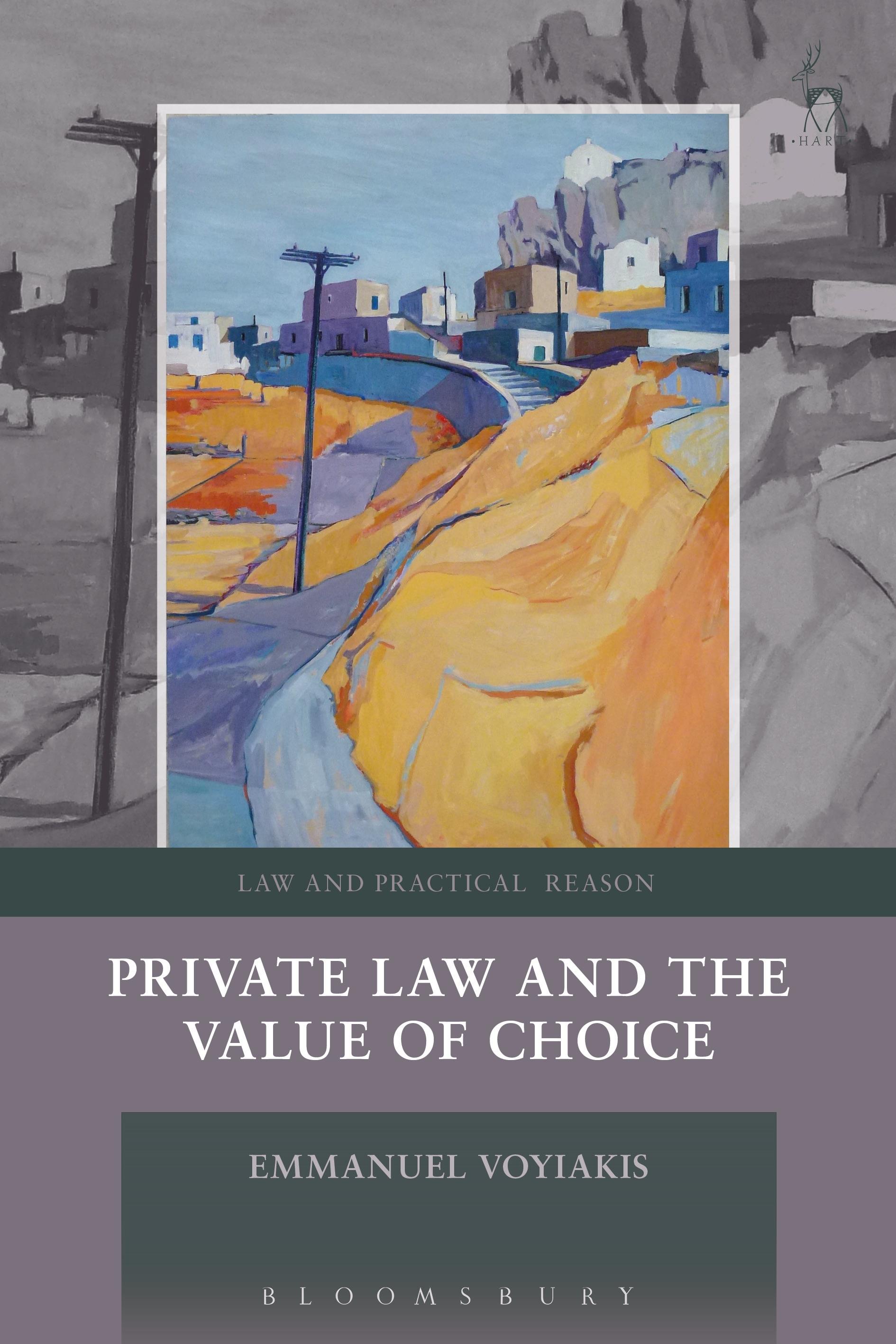
Some say that private law ought to correct wrongs or to protect rights. Others say that private law ought to maximise social welfare or to minimise social cost.
In this book, Emmanuel Voyiakis claims that private law ought to make our responsibilities to others depend on the opportunities we have to affect how things will go for us. Drawing on the work of HLA Hart and TM Scanlon, he argues that private law principles that require us to bear certain practical burdens in our relations with others are justified as long as those principles provide us with certain opportunities to choose what will happen to us, and having those opportunities is something we have reason to value.
The book contrasts this 'value-of-choice' account with its wrong- and social cost-based rivals, and applies it to familiar problems of contract and tort law, including whether liability should be negligence-based or stricter; whether insurance should matter in the allocation of the burden of repair; how far private law should make allowance for persons of limited capacities; when a contract term counts as 'unconscionable' or 'unfair'; and when tort law should hold a person vicariously liable for another's mistakes.
In this book, Emmanuel Voyiakis claims that private law ought to make our responsibilities to others depend on the opportunities we have to affect how things will go for us. Drawing on the work of HLA Hart and TM Scanlon, he argues that private law principles that require us to bear certain practical burdens in our relations with others are justified as long as those principles provide us with certain opportunities to choose what will happen to us, and having those opportunities is something we have reason to value.
The book contrasts this 'value-of-choice' account with its wrong- and social cost-based rivals, and applies it to familiar problems of contract and tort law, including whether liability should be negligence-based or stricter; whether insurance should matter in the allocation of the burden of repair; how far private law should make allowance for persons of limited capacities; when a contract term counts as 'unconscionable' or 'unfair'; and when tort law should hold a person vicariously liable for another's mistakes.
Zahle einfach mit Karte, Klarna, Apple Pay oder Google Pay. Nicht zufrieden? Du hast immer ein 14-tägiges Widerrufsrecht. Lies mehr in unseren AGB. Hast du Fragen, schreib uns eine E-Mail an hello@memmo.org.
Memmo macht das Lernen einfacher – wo auch immer du bist. Bei uns findest du deine Kursbücher und smarte Lerntools an einem Ort: Zusammenfassungen, Quizzes, Podcasts und Lernkarten. Und Ted, dein Lernbuddy, beantwortet alles, was du wissen möchtest. Über 50.000 Studierende lernen bereits hier – gemacht, damit du schneller lernst und weniger Stress hast.