
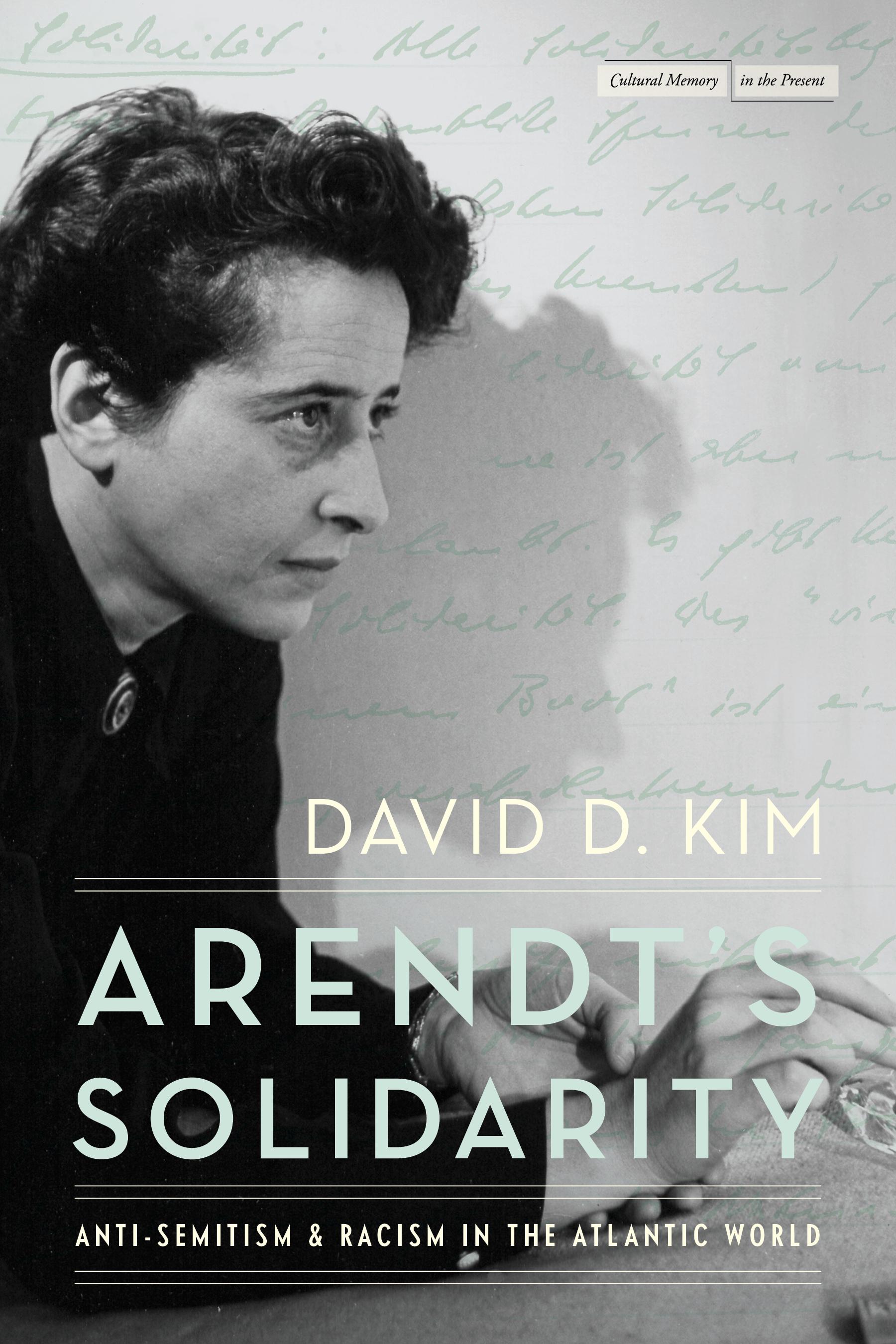
Hannah Arendt's work inspires many to stand in solidarity against authoritarianism, racial or gender-based violence, climate change, and right-wing populism. But what if a careful analysis of her oeuvre reveals a darker side to this intellectual legacy? What if solidarity, as she conceives of it, is not oriented toward equality, freedom, or justice for all, but creates a barrier to intersectional coalition building?
In Arendt's Solidarity, David D. Kim illuminates Arendt's lifelong struggle with this deceptively straightforward yet divisive concept. Drawing upon her publications, unpublished documents, private letters, radio and television interviews, newspaper clippings, and archival marginalia, Kim examines how Arendt refutes solidarity as an effective political force against anti-Semitism, racial injustice, or social inequality. As Kim reveals, this conceptual conundrum follows the arc of Arendt's forced migration across the Atlantic and is directly related to every major concern of hers: Christian neighborly love, friendship, Jewish assimilation, Zionism, National Socialism, the American republic, Black Power, revolution, violence, and the human world. Kim places these thoughts in dialogue with dissenting voices, such as Thomas Mann, Gershom Scholem, Jean-Paul Sartre, James Baldwin, Frantz Fanon, James Forman, and Ralph Ellison. The result is a full-scale reinterpretation of Arendt's oeuvre.
Zahle einfach mit Karte, Klarna, Apple Pay oder Google Pay. Nicht zufrieden? Du hast immer ein 14-tägiges Widerrufsrecht. Lies mehr in unseren AGB. Hast du Fragen, schreib uns eine E-Mail an hello@memmo.org.
Memmo macht das Lernen einfacher – wo auch immer du bist. Bei uns findest du deine Kursbücher und smarte Lerntools an einem Ort: Zusammenfassungen, Quizzes, Podcasts und Lernkarten. Und Ted, dein Lernbuddy, beantwortet alles, was du wissen möchtest. Über 50.000 Studierende lernen bereits hier – gemacht, damit du schneller lernst und weniger Stress hast.