
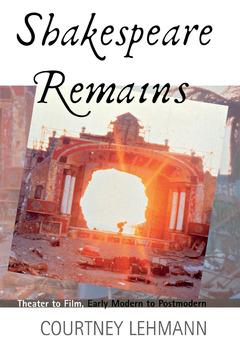
No literary figure has proved so elusive as Shakespeare. How, Courtney Lehmann asks, can the controversies surrounding the Bard's authorship be resolved when his works precede the historical birth of that modern concept? And how is it that Shakespeare remains such a powerful presence today, years after poststructuralists hailed the "death of the author"? In her cogent book, Lehmann reexamines these issues through a new lens: film theory.
An alternative to literary models that either minimize or exalt the writer's creative role, film theory, in Lehmann's view, perceives authorship as a site of constitutive conflict, generating in the process the notion of the auteur. From this perspective, she offers close readings of Romeo and Juliet, A Midsummer Night's Dream, and Hamlet, of film adaptations by Kenneth Branagh, Baz Luhrmann, and Michael Almereyda, and of John Madden's Shakespeare in Love. In their respective historical contexts, these plays and films emerge as allegories of authorship, exploiting such strategies as appropriation, adaptation, projection, and montage. Lehmann explores the significance of this struggle for agency, both in Shakespeare's time and in the present day, in the cultures of early and late capitalism.
By projecting film theory from the postmodern to the early modern and back again, Lehmann demonstrates the ways in which Shakespeare emerges as a special effect—indeed, as an auteur—in two cultures wherein authors fear to tread.
Zahle einfach mit Karte, Klarna, Apple Pay oder Google Pay. Nicht zufrieden? Du hast immer ein 14-tägiges Widerrufsrecht. Lies mehr in unseren AGB. Hast du Fragen, schreib uns eine E-Mail an hello@memmo.org.
Memmo macht das Lernen einfacher – wo auch immer du bist. Bei uns findest du deine Kursbücher und smarte Lerntools an einem Ort: Zusammenfassungen, Quizzes, Podcasts und Lernkarten. Und Ted, dein Lernbuddy, beantwortet alles, was du wissen möchtest. Über 50.000 Studierende lernen bereits hier – gemacht, damit du schneller lernst und weniger Stress hast.