
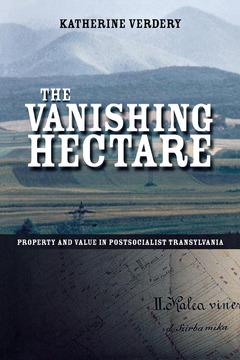
In most countries in Eastern Europe and the former Soviet Union, the fall of communism opened up the possibility for individuals to acquire land. Based on Katherine Verdery's extensive fieldwork between 1990 and 2001, The Vanishing Hectare explores the importance of land and land ownership to the people of one Transylvanian community, Aurel Vlaicu. Verdery traces how collectivized land was transformed into private property, how land was valued, what the new owners were able to do with it, and what it signified to each of the different groups vying for land rights.
Verdery tells this story about transforming socialist property forms in a global context, showing the fruitfulness of conceptualizing property as a political symbol, as a complex of social relations among people and things, and as a process of assigning value. This book is a window on rural life after socialism but it also provides a framework for assessing the neo-liberal economic policies that have prevailed elsewhere, such as in Latin America. Verdery shows how the trajectory of property after socialism was deeply conditioned by the forms property took in socialism itself; this is in contrast to the image of a "tabula rasa" that governed much thinking about post-socialist property reform.
Zahle einfach mit Karte, Klarna, Apple Pay oder Google Pay. Nicht zufrieden? Du hast immer ein 14-tägiges Widerrufsrecht. Lies mehr in unseren AGB. Hast du Fragen, schreib uns eine E-Mail an hello@memmo.org.
Memmo macht das Lernen einfacher – wo auch immer du bist. Bei uns findest du deine Kursbücher und smarte Lerntools an einem Ort: Zusammenfassungen, Quizzes, Podcasts und Lernkarten. Und Ted, dein Lernbuddy, beantwortet alles, was du wissen möchtest. Über 50.000 Studierende lernen bereits hier – gemacht, damit du schneller lernst und weniger Stress hast.