
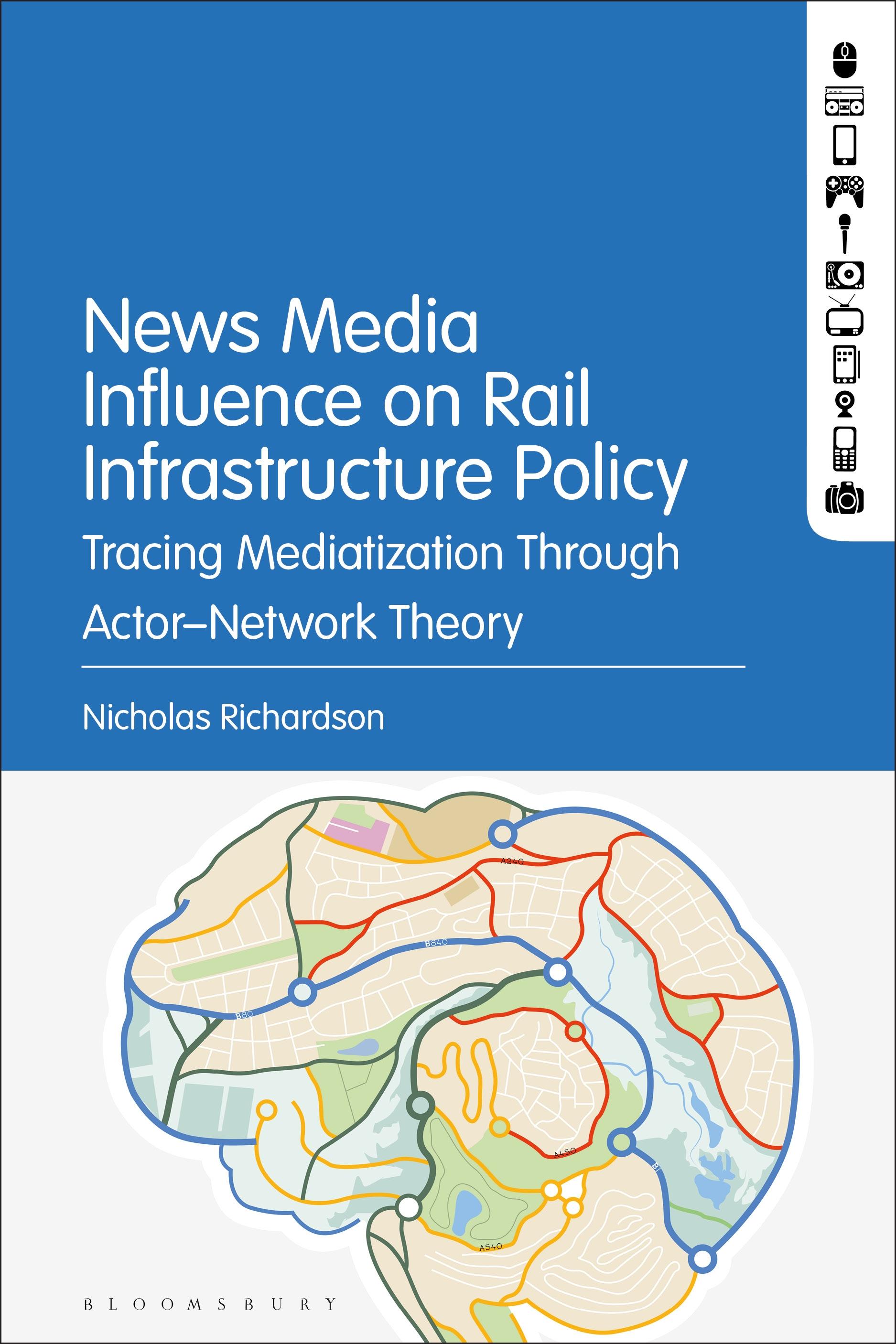
In this book, Richardson's research spans a decade and two cities - Sydney, Australia and Montreal, Canada - focusing on three metro-style rail infrastructure case study projects: one ongoing, one failed and one upgraded after reaching fifty years of age – to build an irrefutable case that the news media is highly influential to policy, and that these influences are complex, messy and changing.
News Media Influence on Rail Infrastructure Policy offers scholars and industry practitioners in the arenas of policy analysis, politics and media communications a method for astutely guiding large-scale projects through the complex and changing landscape of 24/7 news media. It is underpinned by empirical research that identifies and endeavors to close a considerable gap in current understanding and practice. This gap represents a failure to recognise and respect mediatization – the many powerful influences impacting a policy arena that has drawn the ire of the news media. The result of this failure is ineffective communication that does little to advance the policy piece and, in the worst instances, leads to policy immobilisation or poor policy decision-making.
Drawing significantly on Actor–Network Theory, Richardson identifies the influential actors and alliances at play when policy is subjected to media discourse, and he proposes a framework for tracing and managing them. In doing so, he demonstrates that such a framework is not only vital for the successful negotiation of policy and projects in the media, but also to an (r)evolutionary recasting of public, expert and media actors in the development and decision-making process.
News Media Influence on Rail Infrastructure Policy offers scholars and industry practitioners in the arenas of policy analysis, politics and media communications a method for astutely guiding large-scale projects through the complex and changing landscape of 24/7 news media. It is underpinned by empirical research that identifies and endeavors to close a considerable gap in current understanding and practice. This gap represents a failure to recognise and respect mediatization – the many powerful influences impacting a policy arena that has drawn the ire of the news media. The result of this failure is ineffective communication that does little to advance the policy piece and, in the worst instances, leads to policy immobilisation or poor policy decision-making.
Drawing significantly on Actor–Network Theory, Richardson identifies the influential actors and alliances at play when policy is subjected to media discourse, and he proposes a framework for tracing and managing them. In doing so, he demonstrates that such a framework is not only vital for the successful negotiation of policy and projects in the media, but also to an (r)evolutionary recasting of public, expert and media actors in the development and decision-making process.
Zahle einfach mit Karte, Klarna, Apple Pay oder Google Pay. Nicht zufrieden? Du hast immer ein 14-tägiges Widerrufsrecht. Lies mehr in unseren AGB. Hast du Fragen, schreib uns eine E-Mail an hello@memmo.org.
Memmo macht das Lernen einfacher – wo auch immer du bist. Bei uns findest du deine Kursbücher und smarte Lerntools an einem Ort: Zusammenfassungen, Quizzes, Podcasts und Lernkarten. Und Ted, dein Lernbuddy, beantwortet alles, was du wissen möchtest. Über 50.000 Studierende lernen bereits hier – gemacht, damit du schneller lernst und weniger Stress hast.