
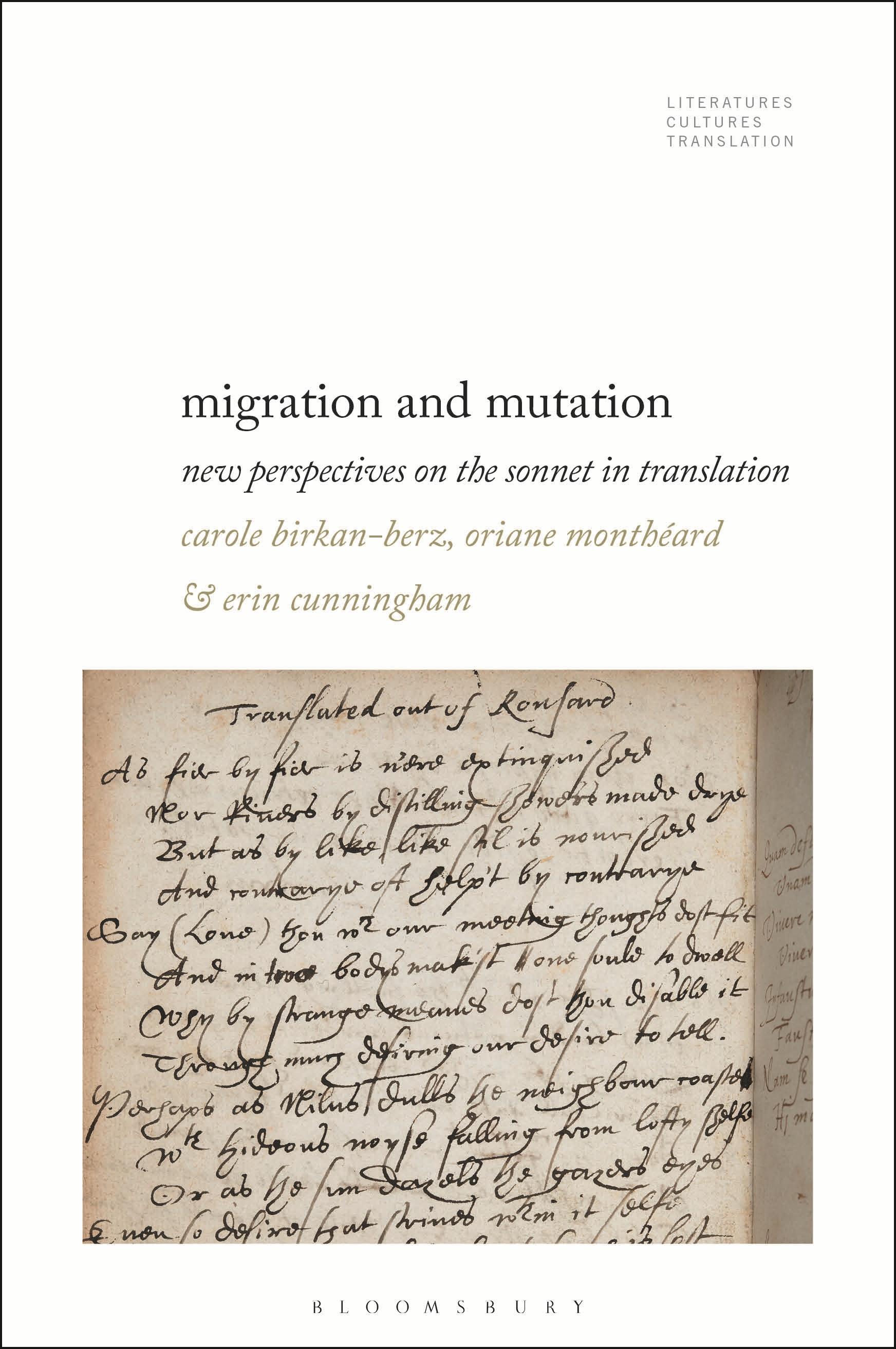
Spanning four centuries from the Renaissance to today's avant-garde, Migration and Mutation explores how the sonnet has evolved in and out of translation.
Contributors examine little-studied translation trajectories in the early modern period, such as the pivotal role of France between Italy and England or the first German sonnets and their Italian, French, Dutch and Scottish origins. Essays then shed new light on major European sonneteers In the 19th and 20th centuries, including Shakespeare, Keats, Yeats, Rilke and Pessoa, alongside lesser-known contemporaries and with novel approaches. And finally, contributors explore how translation and adaptation create metaphorical space in the 21st century.
Migration and Mutation also pays attention to the political or subversive dimension of the sonnet, with essays on women, gay or postcolonial reclaimings of the sonnet and recent experiments such as post-Soviet Sonnets on shirts by Genrikh Sagpir. It takes the sonnet out of the confines of enclosed national traditions bringing it into renewed contact with mostly European, but also other, cultures.
Contributors examine little-studied translation trajectories in the early modern period, such as the pivotal role of France between Italy and England or the first German sonnets and their Italian, French, Dutch and Scottish origins. Essays then shed new light on major European sonneteers In the 19th and 20th centuries, including Shakespeare, Keats, Yeats, Rilke and Pessoa, alongside lesser-known contemporaries and with novel approaches. And finally, contributors explore how translation and adaptation create metaphorical space in the 21st century.
Migration and Mutation also pays attention to the political or subversive dimension of the sonnet, with essays on women, gay or postcolonial reclaimings of the sonnet and recent experiments such as post-Soviet Sonnets on shirts by Genrikh Sagpir. It takes the sonnet out of the confines of enclosed national traditions bringing it into renewed contact with mostly European, but also other, cultures.
Zahle einfach mit Karte, Klarna, Apple Pay oder Google Pay. Nicht zufrieden? Du hast immer ein 14-tägiges Widerrufsrecht. Lies mehr in unseren AGB. Hast du Fragen, schreib uns eine E-Mail an hello@memmo.org.
Memmo macht das Lernen einfacher – wo auch immer du bist. Bei uns findest du deine Kursbücher und smarte Lerntools an einem Ort: Zusammenfassungen, Quizzes, Podcasts und Lernkarten. Und Ted, dein Lernbuddy, beantwortet alles, was du wissen möchtest. Über 50.000 Studierende lernen bereits hier – gemacht, damit du schneller lernst und weniger Stress hast.