
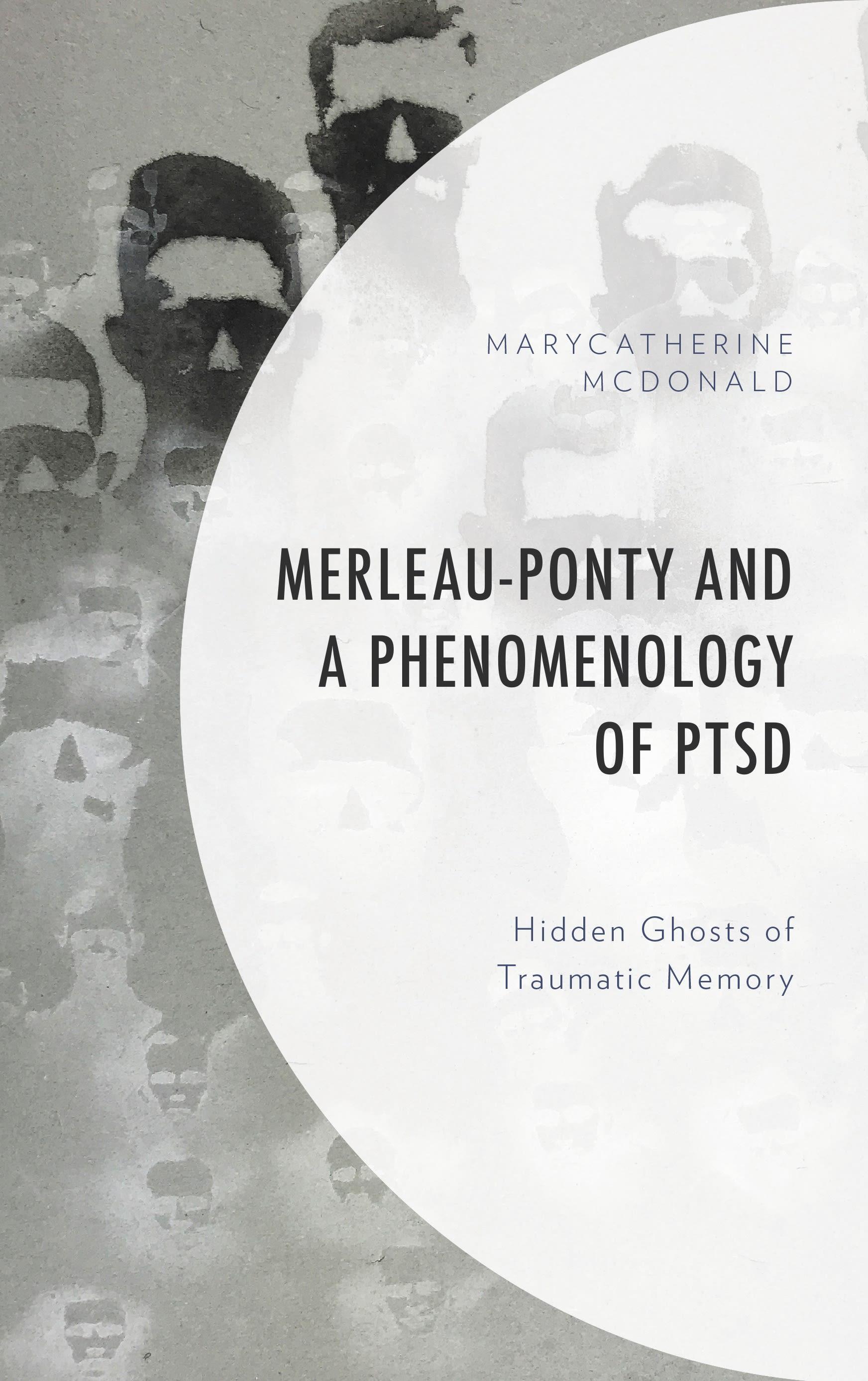
Despite the fact that we have been studying posttraumatic stress disorder (PTSD) since at least the late 1800s, it remains prevalent and, in many cases intractable. Merleau-Ponty and a Phenomenology of PTSD: Hidden Ghosts of Traumatic Memory begins with the assertion that we struggle to successfully treat PTSD because we simply do not understand it well enough.
Using the phenomenological approach of Maurice Merleau-Ponty – which focuses on the first-person, lived experience of the trauma victim – Merleau-Ponty and a Phenomenology of PTSD: Hidden Ghosts of Traumatic Memory focuses on reframing our understanding of combat trauma in two fundamental ways.
First, the concepts of embodiment and adaptation give us an understanding of the human being as fundamentally adaptive. This allows us to view traumatic responses as adaptive as well. When the roots of traumatic injury become reframed in this way, combat-related PTSD can be understood more accurately as a set of symptoms borne of strength and survival rather than weakness or disorder.
Second, phenomenology reveals that a different ghost haunts those who are afflicted by trauma. For the past century, trauma studies across disciplines have all assumed that the ghost of a singular traumatic event haunts the sufferer. While this is likely a part of the problem, further study shows that those who suffer from trauma are also haunted by the specter of a world without meaning. In other words, phenomenology reveals that what is injured in trauma is not just the mind or the body but the entire worldview of the individual. It is this aspect of the injury – the shattering loss of one’s blueprint of the world – that is missing from other accounts of trauma.
Rather than aim to upend previous research in the fields of psychology and neuroscience, Merleau-Ponty and a Phenomenology of PTSD: Hidden Ghosts of Traumatic Memory uses the phenomenological approach to bring them together and expand then. It is in this expansion that we are able to consider what we may have previously missed – which stands to improve our understanding and treatment of trauma in general.
Using the phenomenological approach of Maurice Merleau-Ponty – which focuses on the first-person, lived experience of the trauma victim – Merleau-Ponty and a Phenomenology of PTSD: Hidden Ghosts of Traumatic Memory focuses on reframing our understanding of combat trauma in two fundamental ways.
First, the concepts of embodiment and adaptation give us an understanding of the human being as fundamentally adaptive. This allows us to view traumatic responses as adaptive as well. When the roots of traumatic injury become reframed in this way, combat-related PTSD can be understood more accurately as a set of symptoms borne of strength and survival rather than weakness or disorder.
Second, phenomenology reveals that a different ghost haunts those who are afflicted by trauma. For the past century, trauma studies across disciplines have all assumed that the ghost of a singular traumatic event haunts the sufferer. While this is likely a part of the problem, further study shows that those who suffer from trauma are also haunted by the specter of a world without meaning. In other words, phenomenology reveals that what is injured in trauma is not just the mind or the body but the entire worldview of the individual. It is this aspect of the injury – the shattering loss of one’s blueprint of the world – that is missing from other accounts of trauma.
Rather than aim to upend previous research in the fields of psychology and neuroscience, Merleau-Ponty and a Phenomenology of PTSD: Hidden Ghosts of Traumatic Memory uses the phenomenological approach to bring them together and expand then. It is in this expansion that we are able to consider what we may have previously missed – which stands to improve our understanding and treatment of trauma in general.
Zahle einfach mit Karte, Klarna, Apple Pay oder Google Pay. Nicht zufrieden? Du hast immer ein 14-tägiges Widerrufsrecht. Lies mehr in unseren AGB. Hast du Fragen, schreib uns eine E-Mail an hello@memmo.org.
Memmo macht das Lernen einfacher – wo auch immer du bist. Bei uns findest du deine Kursbücher und smarte Lerntools an einem Ort: Zusammenfassungen, Quizzes, Podcasts und Lernkarten. Und Ted, dein Lernbuddy, beantwortet alles, was du wissen möchtest. Über 50.000 Studierende lernen bereits hier – gemacht, damit du schneller lernst und weniger Stress hast.