
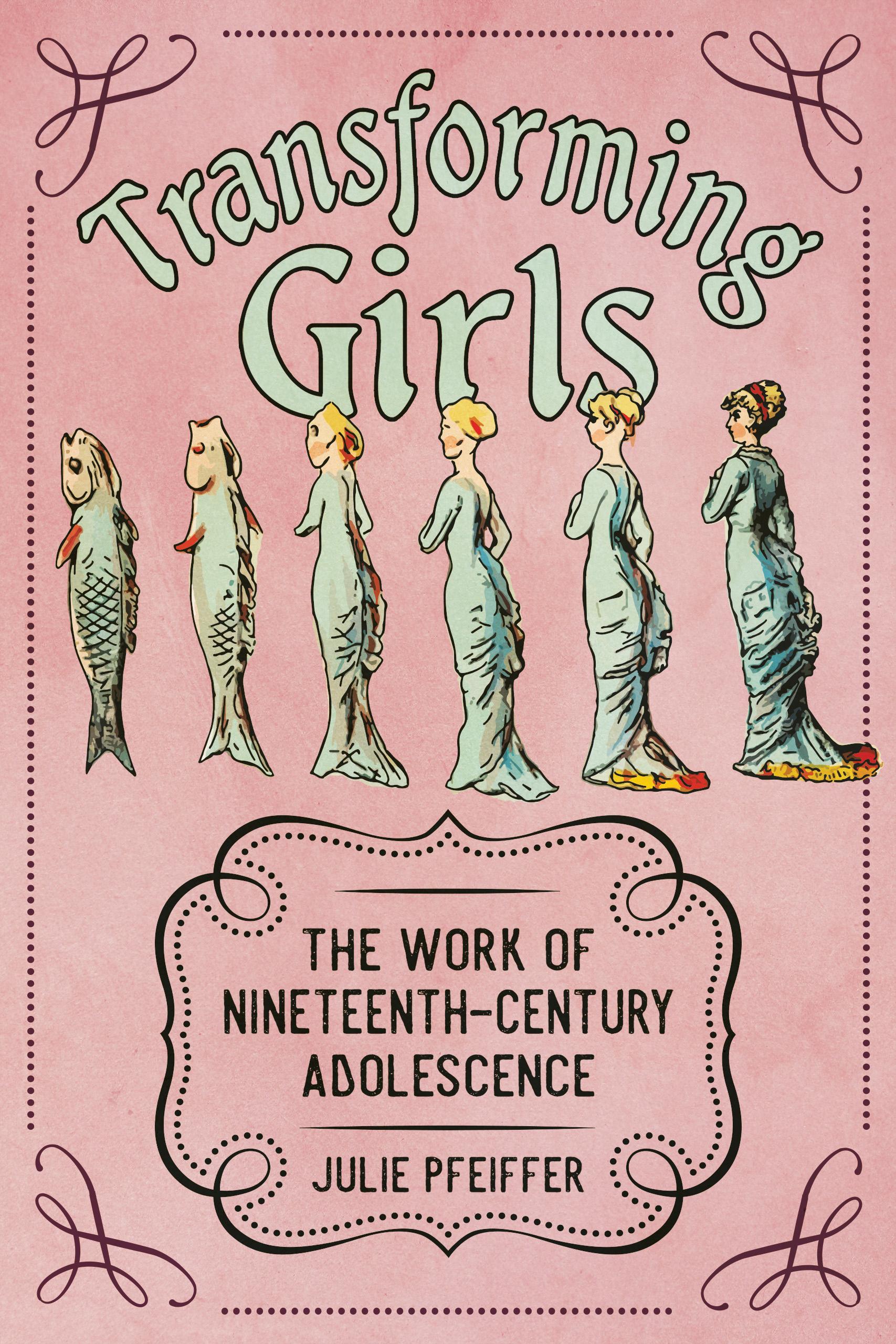
Transforming Girls: The Work of Nineteenth-Century Adolescence explores the paradox of the nineteenth-century girls’ book. On the one hand, early novels for adolescent girls rely on gender binaries and suggest that girls must accommodate and support a patriarchal framework to be happy. On the other, they provide access to imagined worlds in which teens are at the center. The early girls’ book frames female adolescence as an opportunity for productive investment in the self. This is a space where mentors who trust themselves, the education they provide, and the girl’s essentially good nature neutralize the girl’s own anxieties about maturity.
These mid-nineteenth-century novels focus on female adolescence as a social category in unexpected ways. They draw not on a twentieth-century model of the alienated adolescent, but on a model of collaborative growth. The purpose of these novels is to approach adolescence—a category that continues to engage and perplex us—from another perspective, one in which fluid identity and the deliberate construction of a self are celebrated. They provide alternatives to cultural beliefs about what it was like to be a white, middle-class girl in the nineteenth century and challenge the assumption that the evolution of the girls’ book is always a movement towards less sexist, less restrictive images of girls.
Drawing on forgotten bestsellers in the United States and Germany (where this genre is referred to as Backfischliteratur), Transforming Girls offers insightful readings that call scholars to reexamine the history of the girls’ book. It also outlines an alternate model for imagining adolescence and supporting adolescent girls. The awkward adolescent girl—so popular in mid-nineteenth-century fiction for girls—remains a valuable resource for understanding contemporary girls and stories about them.
These mid-nineteenth-century novels focus on female adolescence as a social category in unexpected ways. They draw not on a twentieth-century model of the alienated adolescent, but on a model of collaborative growth. The purpose of these novels is to approach adolescence—a category that continues to engage and perplex us—from another perspective, one in which fluid identity and the deliberate construction of a self are celebrated. They provide alternatives to cultural beliefs about what it was like to be a white, middle-class girl in the nineteenth century and challenge the assumption that the evolution of the girls’ book is always a movement towards less sexist, less restrictive images of girls.
Drawing on forgotten bestsellers in the United States and Germany (where this genre is referred to as Backfischliteratur), Transforming Girls offers insightful readings that call scholars to reexamine the history of the girls’ book. It also outlines an alternate model for imagining adolescence and supporting adolescent girls. The awkward adolescent girl—so popular in mid-nineteenth-century fiction for girls—remains a valuable resource for understanding contemporary girls and stories about them.
Zahle einfach mit Karte, Klarna, Apple Pay oder Google Pay. Nicht zufrieden? Du hast immer ein 14-tägiges Widerrufsrecht. Lies mehr in unseren AGB. Hast du Fragen, schreib uns eine E-Mail an hello@memmo.org.
Memmo macht das Lernen einfacher – wo auch immer du bist. Bei uns findest du deine Kursbücher und smarte Lerntools an einem Ort: Zusammenfassungen, Quizzes, Podcasts und Lernkarten. Und Ted, dein Lernbuddy, beantwortet alles, was du wissen möchtest. Über 50.000 Studierende lernen bereits hier – gemacht, damit du schneller lernst und weniger Stress hast.
Das könnte dir auch gefallen
Buch kaufen0