
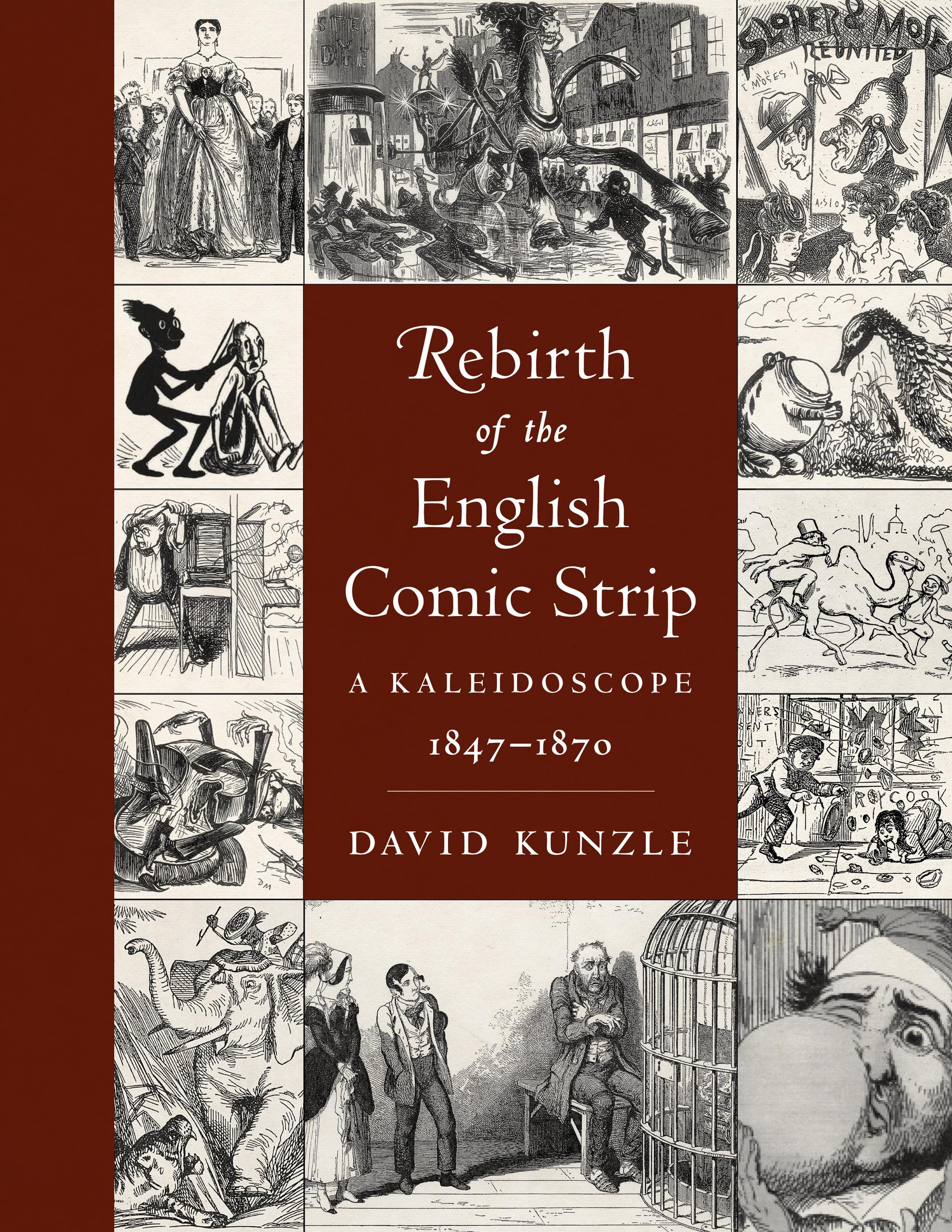
Rebirth of the English Comic Strip: A Kaleidoscope, 1847–1870 enters deep into an era of comic history that has been entirely neglected. This buried cache of mid-Victorian graphic humor is marvelously rich in pictorial narratives of all kinds. Author David Kunzle calls this period a “rebirth” because of the preceding long hiatus in use of the new genre, since the Great Age of Caricature (c.1780–c.1820) when the comic strip was practiced as a sideline. Suddenly in 1847, a new, post-Töpffer comic strip sparks to life in Britain, mostly in periodicals, and especially in Punch, where all the best artists of the period participated, if only sporadically: Richard Doyle, John Tenniel, John Leech, Charles Keene, and George Du Maurier. Until now, this aspect of the extensive oeuvre of the well-known masters of the new journal cartoon in Punch has been almost completely ignored. Exceptionally, George Cruikshank revived just once in The Bottle, independently, the whole serious, contrasting Hogarthian picture story.
Numerous comic strips and picture stories appeared in periodicals other than Punch by artists who were likewise largely ignored. Like the Punch luminaries, they adopt in semirealistic style sociopolitical subject matter easily accessible to their (lower-)middle-class readership. The topics covered in and out of Punch by these strips and graphic novels range from French enemies King Louis-Philippe and Emperor Napoleon III to farcical treatment of major historical events: the Bayeux tapestry (1848), the Great Exhibition of 1851, and the Franco-Prussian War in 1870. Artists explore a great variety of social types, occupations, and situations such as the emigrant, the tourist, fox hunting and Indian big game hunting, dueling, the forlorn lover, the student, the artist, the toothache, the burglar, the paramilitary volunteer, Darwinian animal metamorphoses, and even nightmares. In Rebirth of the English Comic Strip, Kunzle analyzes these much-neglected works down to the precocious modernist and absurdist scribbles of Marie Duval, Europe’s first female professional cartoonist.
Numerous comic strips and picture stories appeared in periodicals other than Punch by artists who were likewise largely ignored. Like the Punch luminaries, they adopt in semirealistic style sociopolitical subject matter easily accessible to their (lower-)middle-class readership. The topics covered in and out of Punch by these strips and graphic novels range from French enemies King Louis-Philippe and Emperor Napoleon III to farcical treatment of major historical events: the Bayeux tapestry (1848), the Great Exhibition of 1851, and the Franco-Prussian War in 1870. Artists explore a great variety of social types, occupations, and situations such as the emigrant, the tourist, fox hunting and Indian big game hunting, dueling, the forlorn lover, the student, the artist, the toothache, the burglar, the paramilitary volunteer, Darwinian animal metamorphoses, and even nightmares. In Rebirth of the English Comic Strip, Kunzle analyzes these much-neglected works down to the precocious modernist and absurdist scribbles of Marie Duval, Europe’s first female professional cartoonist.
Zahle einfach mit Karte, Klarna, Apple Pay oder Google Pay. Nicht zufrieden? Du hast immer ein 14-tägiges Widerrufsrecht. Lies mehr in unseren AGB. Hast du Fragen, schreib uns eine E-Mail an hello@memmo.org.
Memmo macht das Lernen einfacher – wo auch immer du bist. Bei uns findest du deine Kursbücher und smarte Lerntools an einem Ort: Zusammenfassungen, Quizzes, Podcasts und Lernkarten. Und Ted, dein Lernbuddy, beantwortet alles, was du wissen möchtest. Über 50.000 Studierende lernen bereits hier – gemacht, damit du schneller lernst und weniger Stress hast.
Das könnte dir auch gefallen
Buch kaufen0