
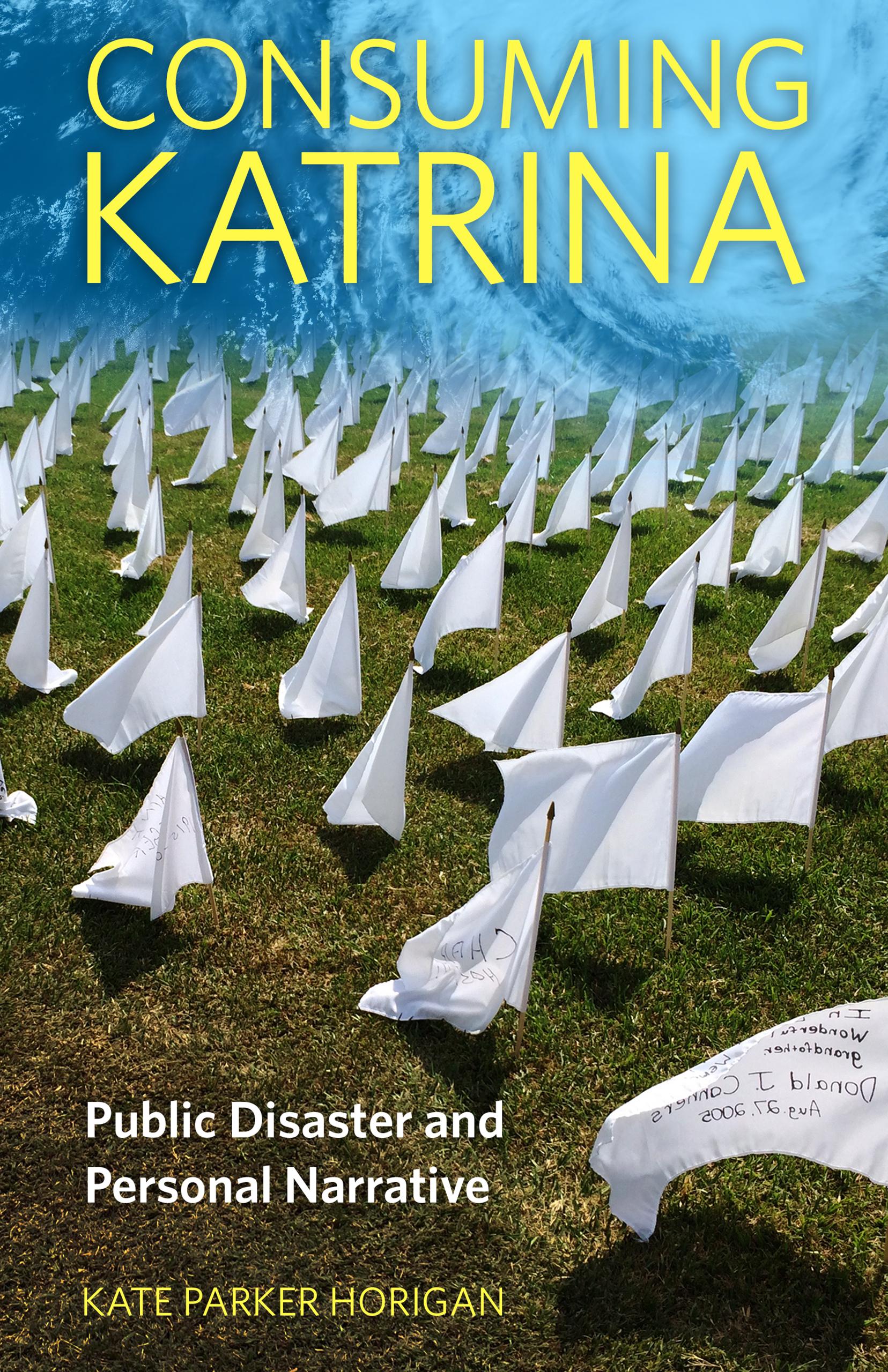
When and under what circumstances are disaster survivors able to speak for themselves in the public arena? In Consuming Katrina: Public Disaster and Personal Narrative, author Kate Parker Horigan shows how the public understands and remembers large-scale disasters like Hurricane Katrina, outlining which stories are remembered and why, as well as the impact on public memory and the survivors themselves.
Horigan discusses unique contexts in which personal narratives about the storm are shared, including interviews with survivors, Dave Eggers's Zeitoun, Josh Neufeld's A.D.: New Orleans After the Deluge, Tia Lessin and Carl Deal's Trouble the Water, and public commemoration during Hurricane Katrina's tenth anniversary in New Orleans. In each case, survivors initially present themselves in specific ways, counteracting negative stereotypes that characterize their communities. However, when adapted for public presentation, their stories get reduced back to those stereotypes. As a result, people affected by Katrina continue to be seen in limited terms, as either undeserving or incapable of managing recovery.
This project is rooted in Horigan's experiences living in New Orleans before and after Katrina, but it is also a case study illustrating an ongoing problem and an innovative solution: survivors' stories should be shared in a way that includes their own engagement with the processes of narrative production, circulation, and reception. When survivors are seen as agents in their own stories, they will be seen as agents in their own recovery. Having a better grasp on the processes of narration and memory is critical for improved disaster response because the stories that are most widely shared about disaster determine how communities recover.
Horigan discusses unique contexts in which personal narratives about the storm are shared, including interviews with survivors, Dave Eggers's Zeitoun, Josh Neufeld's A.D.: New Orleans After the Deluge, Tia Lessin and Carl Deal's Trouble the Water, and public commemoration during Hurricane Katrina's tenth anniversary in New Orleans. In each case, survivors initially present themselves in specific ways, counteracting negative stereotypes that characterize their communities. However, when adapted for public presentation, their stories get reduced back to those stereotypes. As a result, people affected by Katrina continue to be seen in limited terms, as either undeserving or incapable of managing recovery.
This project is rooted in Horigan's experiences living in New Orleans before and after Katrina, but it is also a case study illustrating an ongoing problem and an innovative solution: survivors' stories should be shared in a way that includes their own engagement with the processes of narrative production, circulation, and reception. When survivors are seen as agents in their own stories, they will be seen as agents in their own recovery. Having a better grasp on the processes of narration and memory is critical for improved disaster response because the stories that are most widely shared about disaster determine how communities recover.
Zahle einfach mit Karte, Klarna, Apple Pay oder Google Pay. Nicht zufrieden? Du hast immer ein 14-tägiges Widerrufsrecht. Lies mehr in unseren AGB. Hast du Fragen, schreib uns eine E-Mail an hello@memmo.org.
Memmo macht das Lernen einfacher – wo auch immer du bist. Bei uns findest du deine Kursbücher und smarte Lerntools an einem Ort: Zusammenfassungen, Quizzes, Podcasts und Lernkarten. Und Ted, dein Lernbuddy, beantwortet alles, was du wissen möchtest. Über 50.000 Studierende lernen bereits hier – gemacht, damit du schneller lernst und weniger Stress hast.
Das könnte dir auch gefallen
Buch kaufen0