
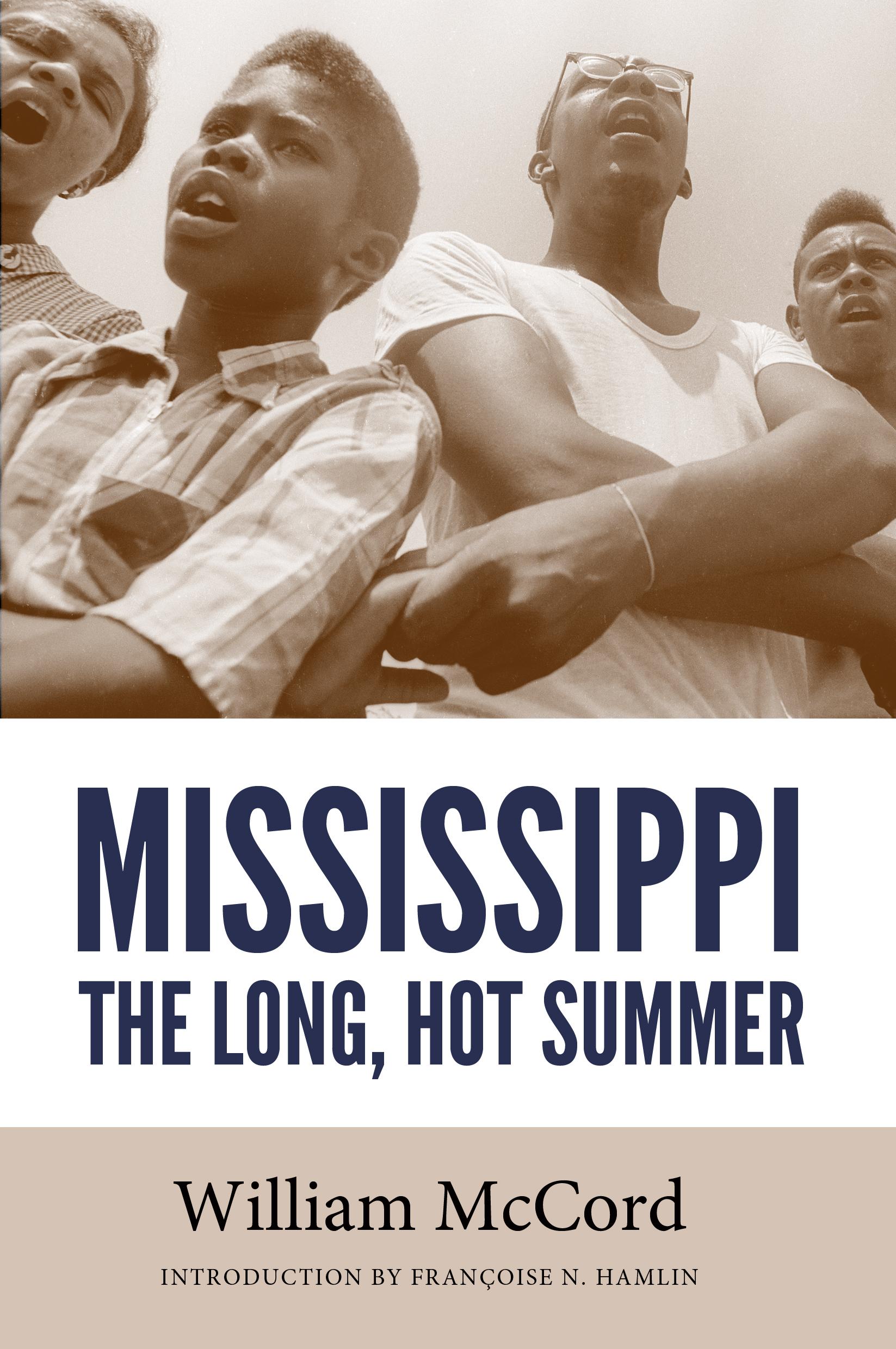
In 1964, sociologist William McCord, long interested in movements for social change in the United States, began a study of Mississippi's Freedom Summer. Stanford University, where McCord taught, had been the site of recruiting efforts for student volunteers for the Freedom Summer project by such activists as Robert Moses and Allard Lowenstein. Described by his wife as “an old-fashioned liberal,” McCord believed that he should both examine and participate in events in Mississippi. He accompanied student workers and black Mississippians to courthouses and Freedom Houses, and he attracted police attention as he studied the mechanisms of white supremacy and the black nonviolent campaign against racial segregation.
Published in 1965 by W. W. Norton, his book, Mississippi: The Long, Hot Summer, is one of the first examinations of the events of 1964 by a scholar. It provides a compelling, detailed account of Mississippi people and places, including the thousands of student workers who found in the state both opportunities and severe challenges. McCord's work sought to communicate to a broad audience the depth of repression in Mississippi. Here was evidence of the need for federal action to address what he recognized as both national and southern failures to secure civil rights for black Americans. His field work and activism in Mississippi offered a perspective that few other academics or other white Americans had shared.
Historian Françoise N. Hamlin provides a substantial introduction that sets McCord's work within the context of other narratives of Freedom Summer and explores McCord's broader career that combined distinguished scholarship with social activism.
Published in 1965 by W. W. Norton, his book, Mississippi: The Long, Hot Summer, is one of the first examinations of the events of 1964 by a scholar. It provides a compelling, detailed account of Mississippi people and places, including the thousands of student workers who found in the state both opportunities and severe challenges. McCord's work sought to communicate to a broad audience the depth of repression in Mississippi. Here was evidence of the need for federal action to address what he recognized as both national and southern failures to secure civil rights for black Americans. His field work and activism in Mississippi offered a perspective that few other academics or other white Americans had shared.
Historian Françoise N. Hamlin provides a substantial introduction that sets McCord's work within the context of other narratives of Freedom Summer and explores McCord's broader career that combined distinguished scholarship with social activism.
Zahle einfach mit Karte, Klarna, Apple Pay oder Google Pay. Nicht zufrieden? Du hast immer ein 14-tägiges Widerrufsrecht. Lies mehr in unseren AGB. Hast du Fragen, schreib uns eine E-Mail an hello@memmo.org.
Memmo macht das Lernen einfacher – wo auch immer du bist. Bei uns findest du deine Kursbücher und smarte Lerntools an einem Ort: Zusammenfassungen, Quizzes, Podcasts und Lernkarten. Und Ted, dein Lernbuddy, beantwortet alles, was du wissen möchtest. Über 50.000 Studierende lernen bereits hier – gemacht, damit du schneller lernst und weniger Stress hast.
Das könnte dir auch gefallen
Buch kaufen0