
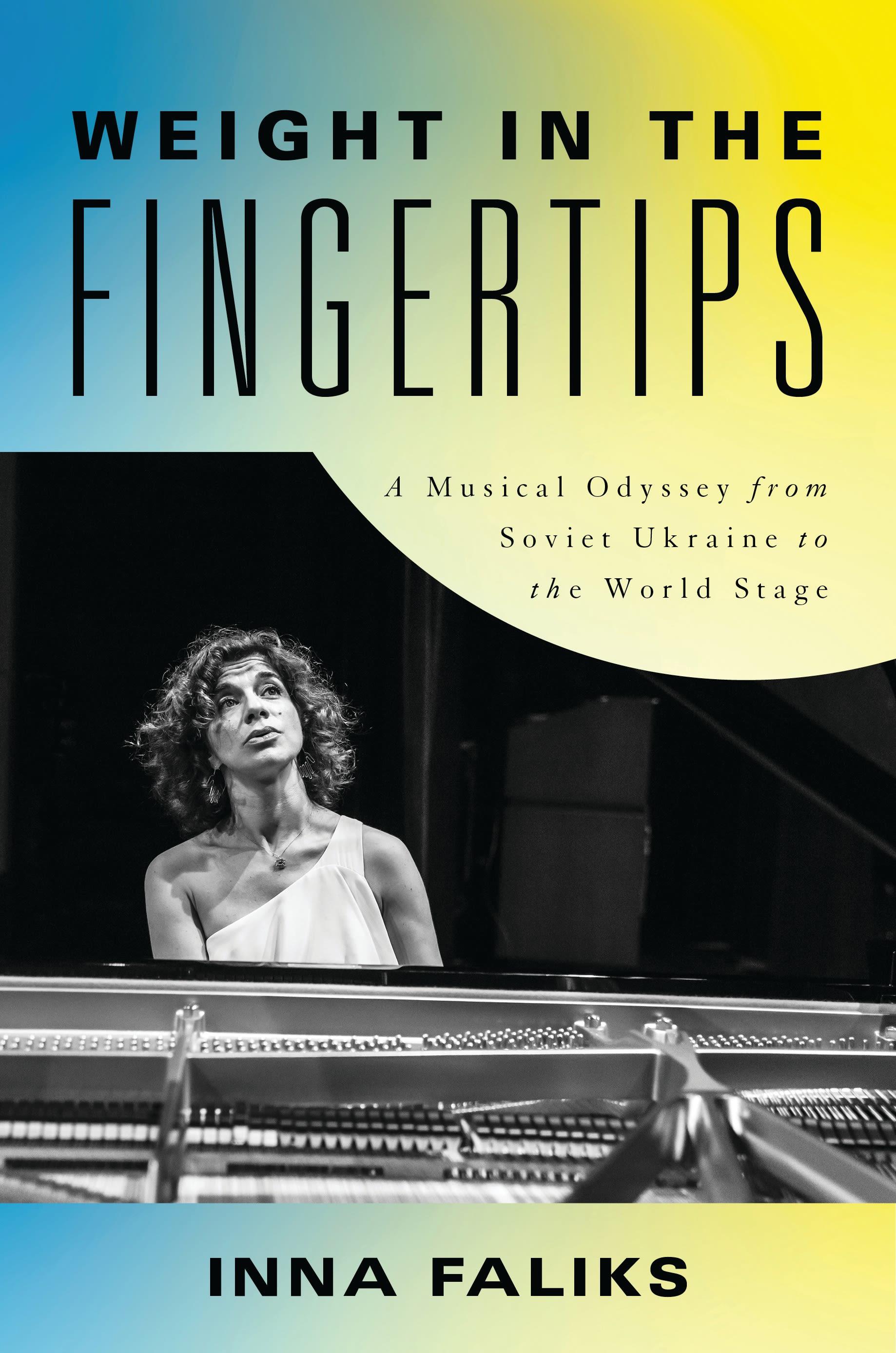
Before she knew she was Ukrainian, Soviet, or Jewish, Inna Faliks knew she was a musician. Growing up in the city of Odessa, the piano became her best friend, and she explored the brilliant, intricate puzzles of Bach’s music and learned to compose under her mother’s watchful eye. At ten, Faliks and her parents moved to Chicago as part of the tide of Jewish refugees who fled the USSR for the West in the 1980s. During the months-long immigration process, she would silently practice on kitchen tables while imagining a full set of piano keys beneath her fingertips.
In Weight in the Fingertips, Faliks gives a globe-trotting account of her upbringing as a child prodigy in a Soviet state, the perils of immigration, the struggle of assimilating as an American, years of training with teachers, and her slow and steady rise in the world of classical music. With a warm and playful style, she helps non-musicians understand the experience of becoming a world-renowned concert pianist. The places she grew up, the books she read, the poems she memorized as a child all connect to her sound at the piano, and the way she hears and shapes a musical phrase illuminate classical music and elite performance. She also explores how a person’s humanity makes their art honest and their voice unique, and how the life-long challenge of retaining that voice is fueled by a balance between being a great musician and being a human being. Throughout, Faliks provides powerful insights into the role of music in a world of conflict, change, and hope for a better tomorrow.
In Weight in the Fingertips, Faliks gives a globe-trotting account of her upbringing as a child prodigy in a Soviet state, the perils of immigration, the struggle of assimilating as an American, years of training with teachers, and her slow and steady rise in the world of classical music. With a warm and playful style, she helps non-musicians understand the experience of becoming a world-renowned concert pianist. The places she grew up, the books she read, the poems she memorized as a child all connect to her sound at the piano, and the way she hears and shapes a musical phrase illuminate classical music and elite performance. She also explores how a person’s humanity makes their art honest and their voice unique, and how the life-long challenge of retaining that voice is fueled by a balance between being a great musician and being a human being. Throughout, Faliks provides powerful insights into the role of music in a world of conflict, change, and hope for a better tomorrow.
Zahle einfach mit Karte, Klarna, Apple Pay oder Google Pay. Nicht zufrieden? Du hast immer ein 14-tägiges Widerrufsrecht. Lies mehr in unseren AGB. Hast du Fragen, schreib uns eine E-Mail an hello@memmo.org.
Memmo macht das Lernen einfacher – wo auch immer du bist. Bei uns findest du deine Kursbücher und smarte Lerntools an einem Ort: Zusammenfassungen, Quizzes, Podcasts und Lernkarten. Und Ted, dein Lernbuddy, beantwortet alles, was du wissen möchtest. Über 50.000 Studierende lernen bereits hier – gemacht, damit du schneller lernst und weniger Stress hast.