
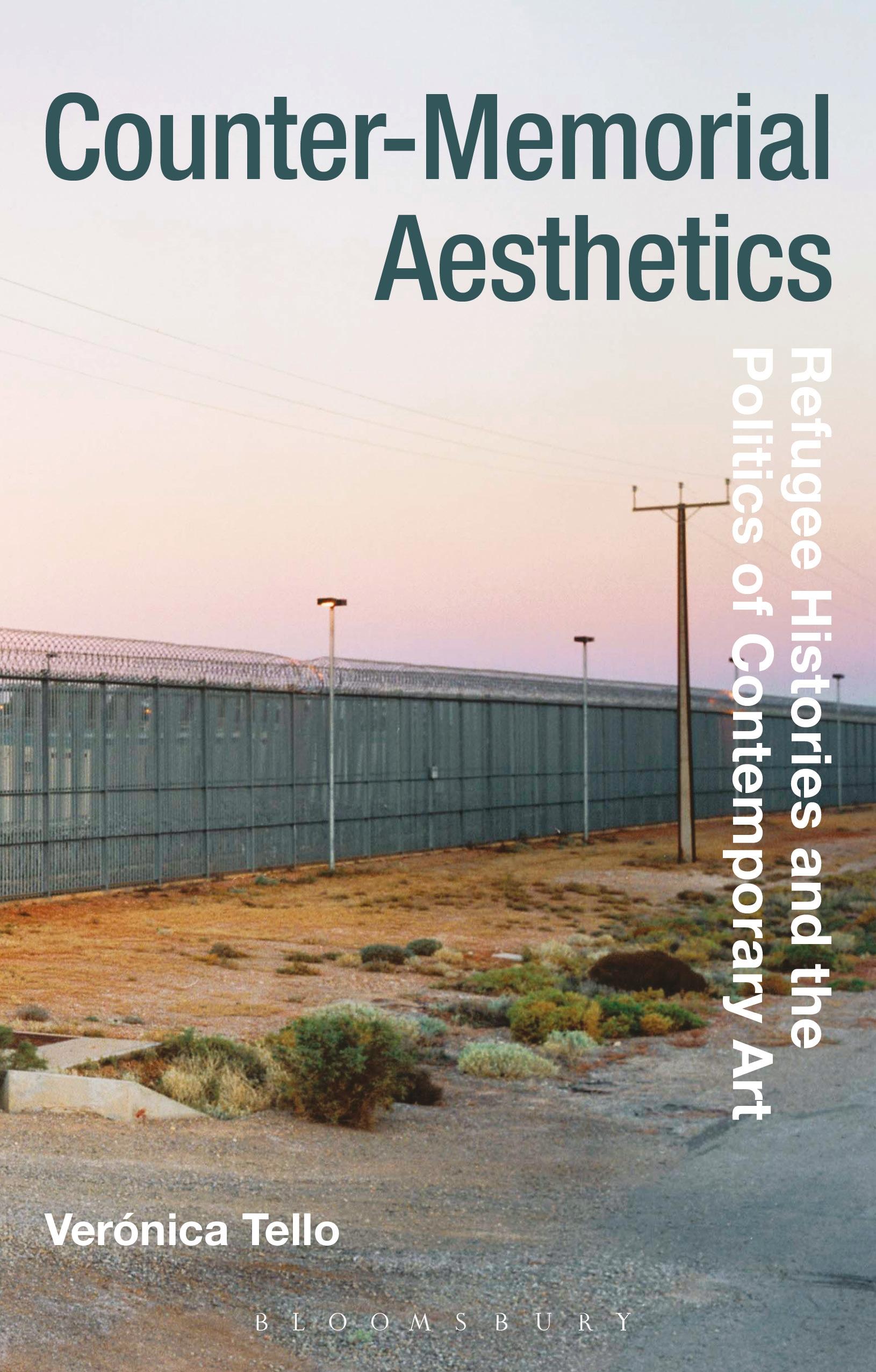
Restrictive border protection policies directed toward managing the flow of refugees coming into neoliberal democracies (and out of failing nation-states) are a defining feature of contemporary politics. In this book, Verónica Tello analyses how contemporary artists-such as Tania Bruguera, Isaac Julien, Rosemary Laing, Dinh Q. Lé, Dierk Schmidt, Hito Steyerl, Lyndell Brown and Charles Green-negotiate their diverse subject positions while addressing and taking part in the production of images associated with refugee experiences and histories. Tello argues that their practices, which manifest across a range of contexts including Cuba, the United States, Australia and Europe, represent an emergent, global paradigm of contemporary art, 'counter-memorial aesthetics'.
Counter-Memorial Aesthetics, Tello argues, is characterized by its conjunction of heterogeneous signifiers and voices of many times and places, generating an experimental, non-teleological approach to the construction of contemporary history, which also takes into account the complex, disorienting spatial affects of globalization. Spanning performance art, experimental 'history painting', aftermath photography and video installation, counter-memorial aesthetics bring to the fore, Tello argues, how contemporary refugee flows and related traumatic events critically challenge and conflict with many existing, tired if not also stubborn notions of national identity, borders, history and memory.
Building on the writings of such thinkers as Michel Foucault and Jacques Rancière, this book offers a useful concept of 'counter-memory' for the twenty-first century. It shows how counter-memorial aesthetics is not only central to the nexus of contemporary art and refugee histories but also how it can offer a way of being critically present with many other, often interrelated, global crises in the contemporary era.
Counter-Memorial Aesthetics, Tello argues, is characterized by its conjunction of heterogeneous signifiers and voices of many times and places, generating an experimental, non-teleological approach to the construction of contemporary history, which also takes into account the complex, disorienting spatial affects of globalization. Spanning performance art, experimental 'history painting', aftermath photography and video installation, counter-memorial aesthetics bring to the fore, Tello argues, how contemporary refugee flows and related traumatic events critically challenge and conflict with many existing, tired if not also stubborn notions of national identity, borders, history and memory.
Building on the writings of such thinkers as Michel Foucault and Jacques Rancière, this book offers a useful concept of 'counter-memory' for the twenty-first century. It shows how counter-memorial aesthetics is not only central to the nexus of contemporary art and refugee histories but also how it can offer a way of being critically present with many other, often interrelated, global crises in the contemporary era.
Zahle einfach mit Karte, Klarna, Apple Pay oder Google Pay. Nicht zufrieden? Du hast immer ein 14-tägiges Widerrufsrecht. Lies mehr in unseren AGB. Hast du Fragen, schreib uns eine E-Mail an hello@memmo.org.
Memmo macht das Lernen einfacher – wo auch immer du bist. Bei uns findest du deine Kursbücher und smarte Lerntools an einem Ort: Zusammenfassungen, Quizzes, Podcasts und Lernkarten. Und Ted, dein Lernbuddy, beantwortet alles, was du wissen möchtest. Über 50.000 Studierende lernen bereits hier – gemacht, damit du schneller lernst und weniger Stress hast.