
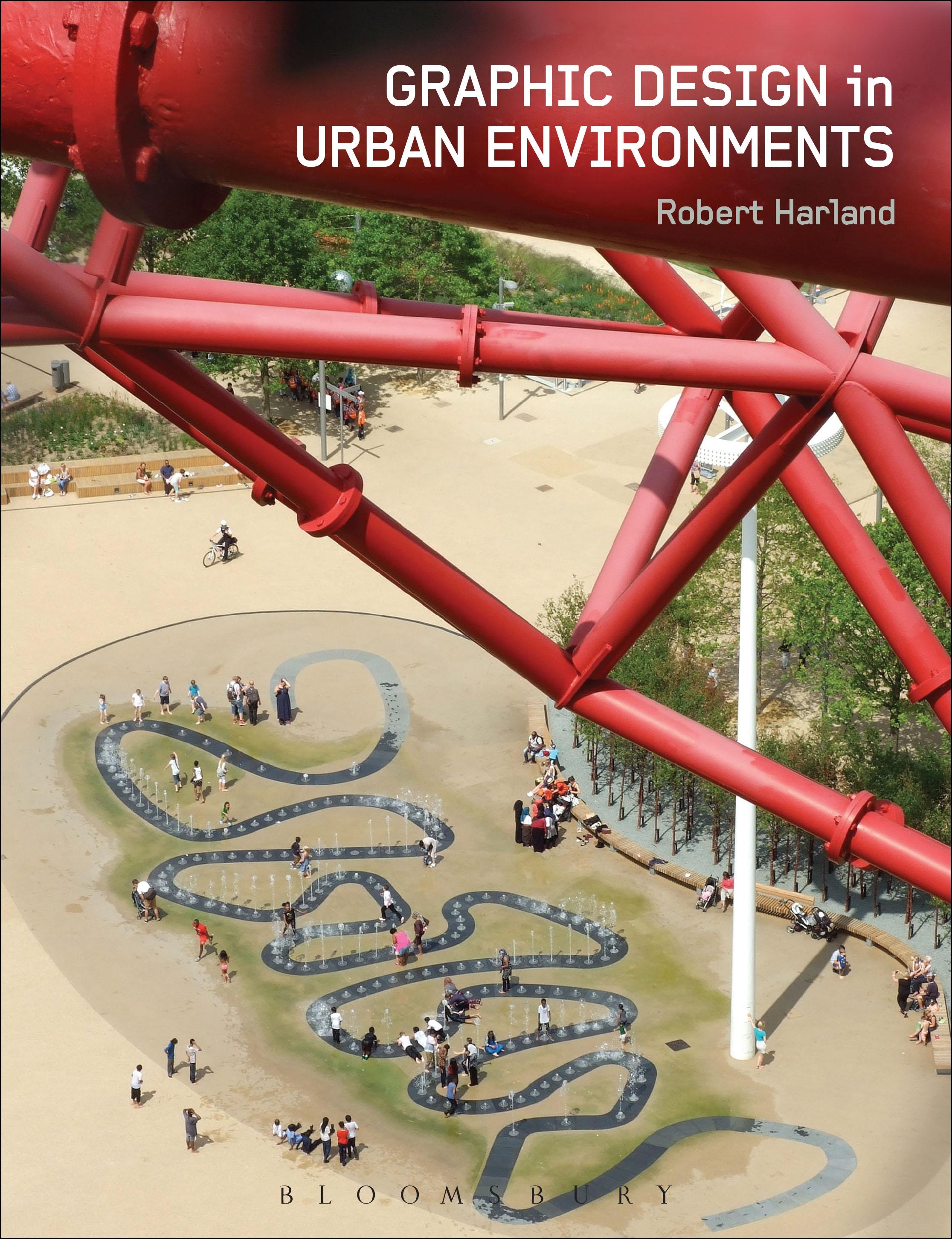
Graphic Design in Urban Environments introduces the idea of a category of designed graphic objects that significantly contribute to the functioning of urban systems. These elements, smaller than buildings, are generally understood by urban designers to comprise such phenomena as sculpture, clock towers, banners, signs, large screens, the portrayal of images on buildings through “smart screens,” and other examples of what urban designers call “urban objects.”The graphic object as it is defined here also refers to a range of familiar things invariably named in the literature as maps, street numbers, route signs, bus placards, signs, architectural communication, commercial vernacular, outdoor publicity, lettering, banners, screens, traffic and direction signs and street furniture. One can also add markings of a sports pitch, lighting, bollards, even red carpets or well dressings.
By looking at the environment, and design and deconstructing form and context relationships, the defining properties and configurational patterns that make up graphic objects are shown in this book to link the smallest graphic detail (e.g. the number 16) to larger symbolic statements (e.g. the Empire State Building). From a professional design practice perspective, a cross section through type, typographic, graphic and urban design will provide a framework for considering the design transition between alphabets, writing systems, images (in the broadest sense) and environments.
By looking at the environment, and design and deconstructing form and context relationships, the defining properties and configurational patterns that make up graphic objects are shown in this book to link the smallest graphic detail (e.g. the number 16) to larger symbolic statements (e.g. the Empire State Building). From a professional design practice perspective, a cross section through type, typographic, graphic and urban design will provide a framework for considering the design transition between alphabets, writing systems, images (in the broadest sense) and environments.
Zahle einfach mit Karte, Klarna, Apple Pay oder Google Pay. Nicht zufrieden? Du hast immer ein 14-tägiges Widerrufsrecht. Lies mehr in unseren AGB. Hast du Fragen, schreib uns eine E-Mail an hello@memmo.org.
Memmo macht das Lernen einfacher – wo auch immer du bist. Bei uns findest du deine Kursbücher und smarte Lerntools an einem Ort: Zusammenfassungen, Quizzes, Podcasts und Lernkarten. Und Ted, dein Lernbuddy, beantwortet alles, was du wissen möchtest. Über 50.000 Studierende lernen bereits hier – gemacht, damit du schneller lernst und weniger Stress hast.