
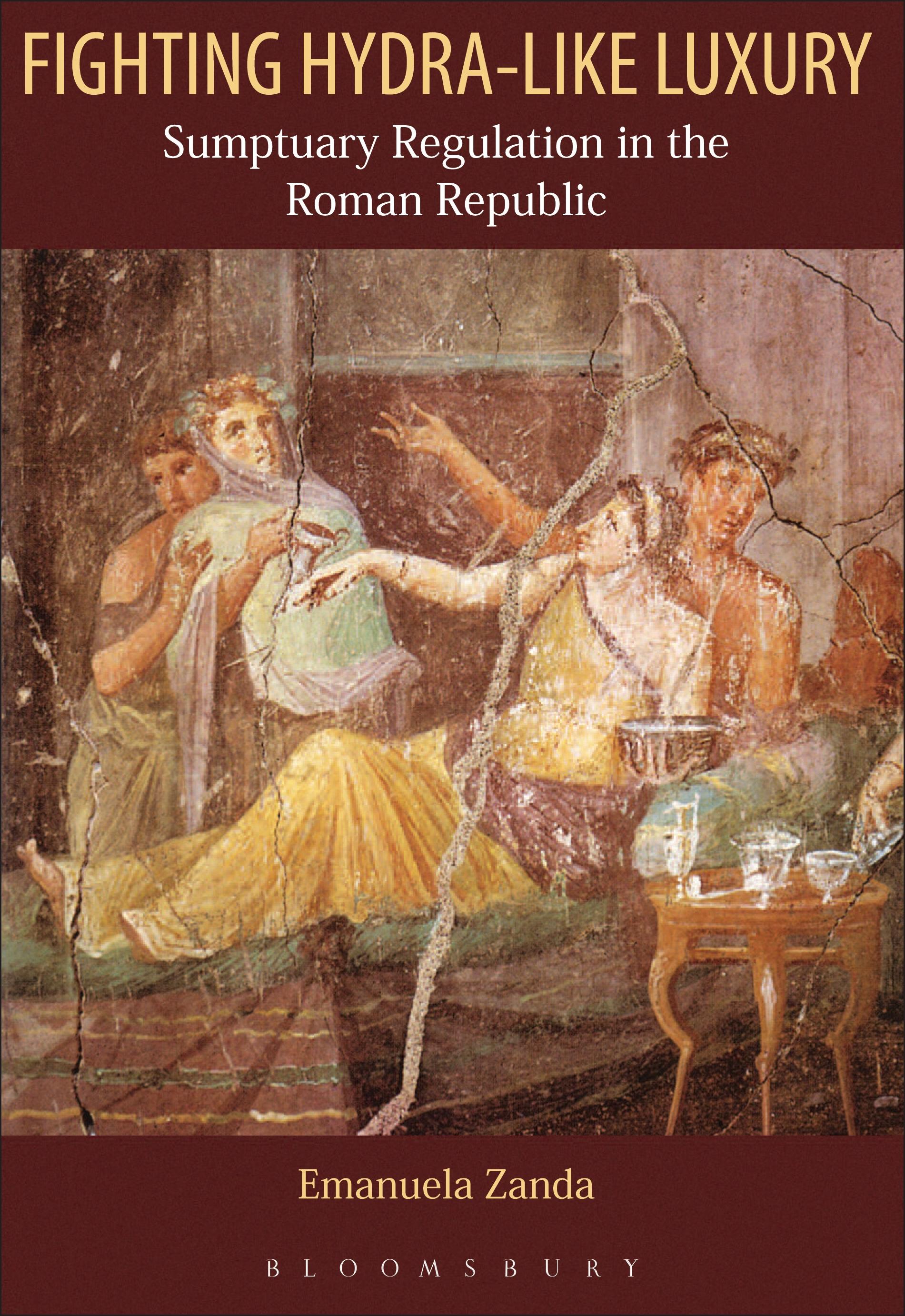
From the Old Testament to Elizabethan England, luxury has been morally condemned. In Rome, sumptuary laws (laws controlling consumption) seemed the only weapon to defeat 'hydra-like luxury', the terrible monster that was weakening even the strongest citizens.
The first Roman sumptuary law, the Lex Appia, declared that no woman could possess more than a half ounce of gold, wear a dress of different colours, or ride in a carriage in any city unless for a public ceremony. Laws listed how many different colours could be worn by members of different social classes: peasants could wear one colour, soldiers in the army could wear two, army officers could wear three, and members of the royal family could wear seven. A law passed by Emperor Aurelian stated that men couldn't wear shoes that were red, yellow, green, or white, and that only the emperor and his sons could wear red or purple shoes. A variety of other laws limited how much people could spend on parties and how many people they could invite.
In this book, Emanuela Zanda explores the purposes behind the enactment of such legislation in Rome during the Republic. She engages with the historical-literary polemic against luxury and focuses on government intervention in matters of extravagance by taking into consideration not only sumptuary laws but also other measures that dealt with self-indulgence. She addresses and answers a number of questions about what exactly the ruling class was trying to achieve, about its real motivations, and about the significance of the ideological discourse surrounding the enactment of these laws.
The first Roman sumptuary law, the Lex Appia, declared that no woman could possess more than a half ounce of gold, wear a dress of different colours, or ride in a carriage in any city unless for a public ceremony. Laws listed how many different colours could be worn by members of different social classes: peasants could wear one colour, soldiers in the army could wear two, army officers could wear three, and members of the royal family could wear seven. A law passed by Emperor Aurelian stated that men couldn't wear shoes that were red, yellow, green, or white, and that only the emperor and his sons could wear red or purple shoes. A variety of other laws limited how much people could spend on parties and how many people they could invite.
In this book, Emanuela Zanda explores the purposes behind the enactment of such legislation in Rome during the Republic. She engages with the historical-literary polemic against luxury and focuses on government intervention in matters of extravagance by taking into consideration not only sumptuary laws but also other measures that dealt with self-indulgence. She addresses and answers a number of questions about what exactly the ruling class was trying to achieve, about its real motivations, and about the significance of the ideological discourse surrounding the enactment of these laws.
Zahle einfach mit Karte, Klarna, Apple Pay oder Google Pay. Nicht zufrieden? Du hast immer ein 14-tägiges Widerrufsrecht. Lies mehr in unseren AGB. Hast du Fragen, schreib uns eine E-Mail an hello@memmo.org.
Memmo macht das Lernen einfacher – wo auch immer du bist. Bei uns findest du deine Kursbücher und smarte Lerntools an einem Ort: Zusammenfassungen, Quizzes, Podcasts und Lernkarten. Und Ted, dein Lernbuddy, beantwortet alles, was du wissen möchtest. Über 50.000 Studierende lernen bereits hier – gemacht, damit du schneller lernst und weniger Stress hast.