
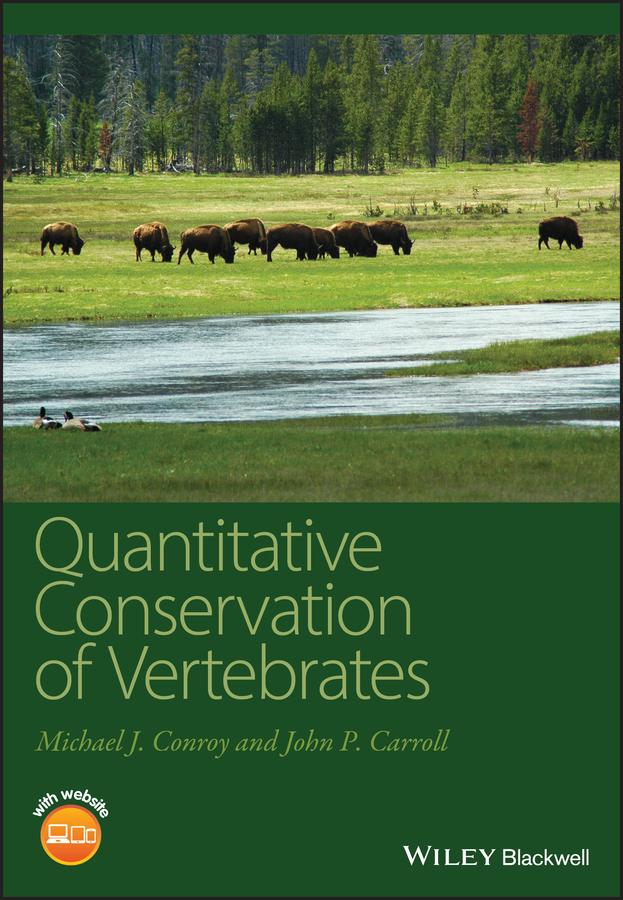
Part I provides a basic background in population and community modeling. It introduces statistical models, and familiarizes the reader with important concepts in the design of monitoring and research programs. These programs provide the essential data that guide conservation decision making. Part II covers the principal methods used to estimate abundance, occupancy, demographic parameters, and community parameters, including occupancy sampling, sample counts, distance sampling, and capture-mark-recapture (for both closed and open populations). Emphasis is placed on practical aspects of designing and implementing field studies, and the proper analysis of data. Part III introduces structured decision making and adaptive management, in which predictive models are used to inform conservation decision makers on appropriate decisions in the face of uncertainty—with the goal of reducing uncertainty through monitoring and research. A detailed case study is used to illustrate each of these themes.
Numerous worked examples and accompanying electronic material (on a website - http://www.blackwellpublishing.com/conroy - and accompanying CD) provide the details of model construction and application, and data analysis.
Zahle einfach mit Karte, Klarna, Apple Pay oder Google Pay. Nicht zufrieden? Du hast immer ein 14-tägiges Widerrufsrecht. Lies mehr in unseren AGB. Hast du Fragen, schreib uns eine E-Mail an hello@memmo.org.
Memmo macht das Lernen einfacher – wo auch immer du bist. Bei uns findest du deine Kursbücher und smarte Lerntools an einem Ort: Zusammenfassungen, Quizzes, Podcasts und Lernkarten. Und Ted, dein Lernbuddy, beantwortet alles, was du wissen möchtest. Über 50.000 Studierende lernen bereits hier – gemacht, damit du schneller lernst und weniger Stress hast.