
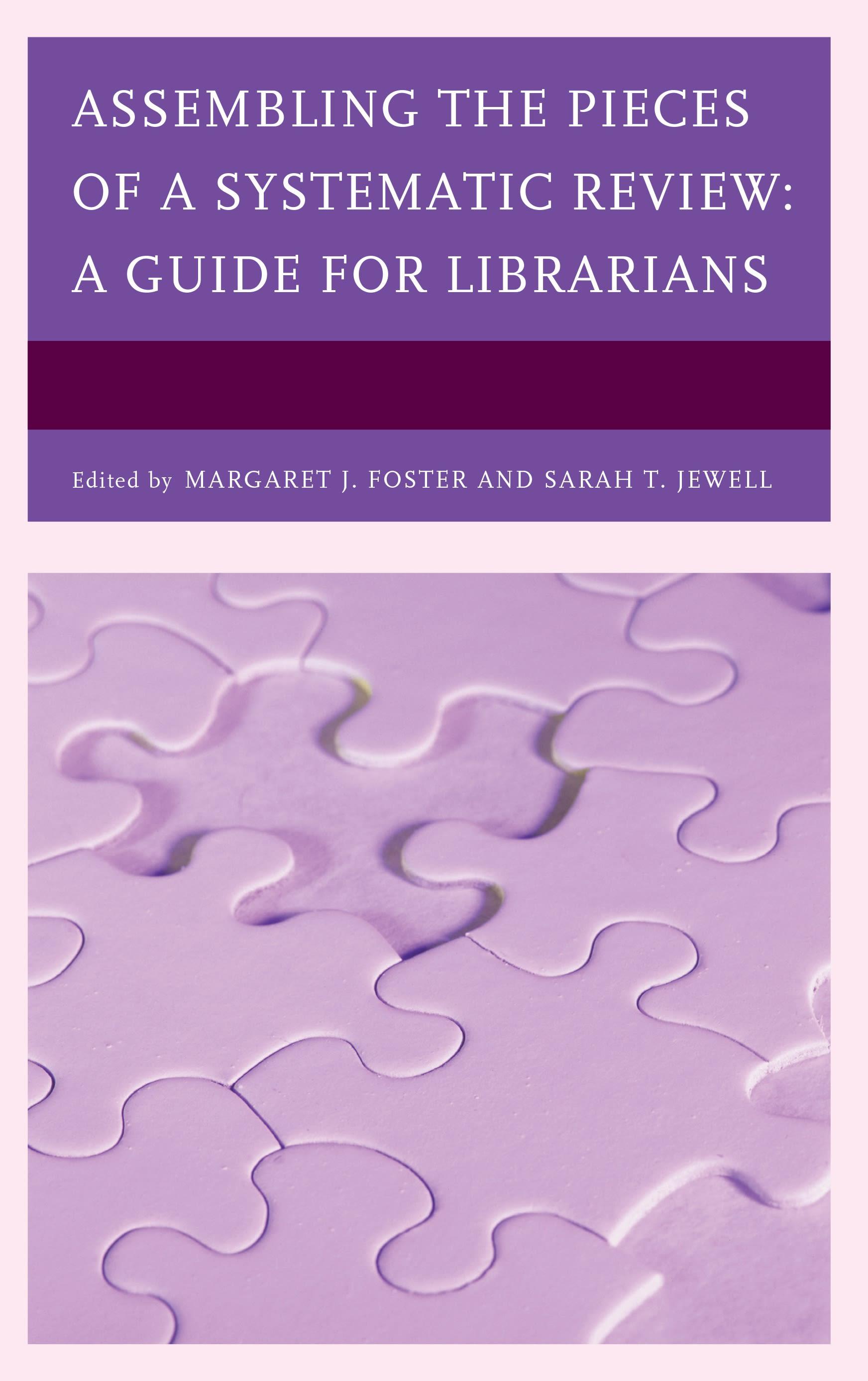
Here is a complete guide for librarians seeking to launch or refine their systematic review services.
Conducting searches for systematic reviews goes beyond expert searching and requires an understanding of the entire process of the systematic review. Just as expert searching is not fully mastered by the end of a library degree, mastering the systematic review process takes a great deal of time and practice. Attending workshops and webinars can introduce the topic, but application of the knowledge through practice is required. Running a systematic review service is complicated and requires constant updating and evaluation with new standards, more efficient methods, and improved reporting guidelines.
After a brief introduction to systematic reviews, the book guides librarians in defining and marketing their services, covering topics such as when it is appropriate to ask for co-authorship and how to reach out to stakeholders. Next, it addresses developing documentation and conducting the reference interview. Standards specific to systematic reviews, including PRISMA, Institute of Medicine, and Cochrane Collaboration, are discussed. Search strategy techniques, including choosing databases, harvesting search terms, selecting filters, and searching for grey literature are detailed. Data management and critical appraisal are covered in detail. Finally, the best practices for reporting the findings of systematic reviews are highlighted.
Experts with experience in both systematic reviews and librarianship, including the editors of the book, contributed to the chapters. Each step (or piece) of the review process (Planning the review, Identifying the studies, Evaluating studies, Collecting and combining data, Explaining the results, and Summarizing the review into a report), are covered with emphasis on information roles.
The book is for any librarian interested in conducting reviews or assisting others with reviews. It has several applications: for training librarians new to systematic reviews, for those developing a new systematic review service, for those wanting to establish protocols for a current service, and as a reference for those conducting reviews or running a service.
Participating in systematic reviews is a new frontier of librarianship, in which librarians can truly become research partners with our patrons, instead of merely providing access to resources and services.
Conducting searches for systematic reviews goes beyond expert searching and requires an understanding of the entire process of the systematic review. Just as expert searching is not fully mastered by the end of a library degree, mastering the systematic review process takes a great deal of time and practice. Attending workshops and webinars can introduce the topic, but application of the knowledge through practice is required. Running a systematic review service is complicated and requires constant updating and evaluation with new standards, more efficient methods, and improved reporting guidelines.
After a brief introduction to systematic reviews, the book guides librarians in defining and marketing their services, covering topics such as when it is appropriate to ask for co-authorship and how to reach out to stakeholders. Next, it addresses developing documentation and conducting the reference interview. Standards specific to systematic reviews, including PRISMA, Institute of Medicine, and Cochrane Collaboration, are discussed. Search strategy techniques, including choosing databases, harvesting search terms, selecting filters, and searching for grey literature are detailed. Data management and critical appraisal are covered in detail. Finally, the best practices for reporting the findings of systematic reviews are highlighted.
Experts with experience in both systematic reviews and librarianship, including the editors of the book, contributed to the chapters. Each step (or piece) of the review process (Planning the review, Identifying the studies, Evaluating studies, Collecting and combining data, Explaining the results, and Summarizing the review into a report), are covered with emphasis on information roles.
The book is for any librarian interested in conducting reviews or assisting others with reviews. It has several applications: for training librarians new to systematic reviews, for those developing a new systematic review service, for those wanting to establish protocols for a current service, and as a reference for those conducting reviews or running a service.
Participating in systematic reviews is a new frontier of librarianship, in which librarians can truly become research partners with our patrons, instead of merely providing access to resources and services.
Zahle einfach mit Karte, Klarna, Apple Pay oder Google Pay. Nicht zufrieden? Du hast immer ein 14-tägiges Widerrufsrecht. Lies mehr in unseren AGB. Hast du Fragen, schreib uns eine E-Mail an hello@memmo.org.
Memmo macht das Lernen einfacher – wo auch immer du bist. Bei uns findest du deine Kursbücher und smarte Lerntools an einem Ort: Zusammenfassungen, Quizzes, Podcasts und Lernkarten. Und Ted, dein Lernbuddy, beantwortet alles, was du wissen möchtest. Über 50.000 Studierende lernen bereits hier – gemacht, damit du schneller lernst und weniger Stress hast.