
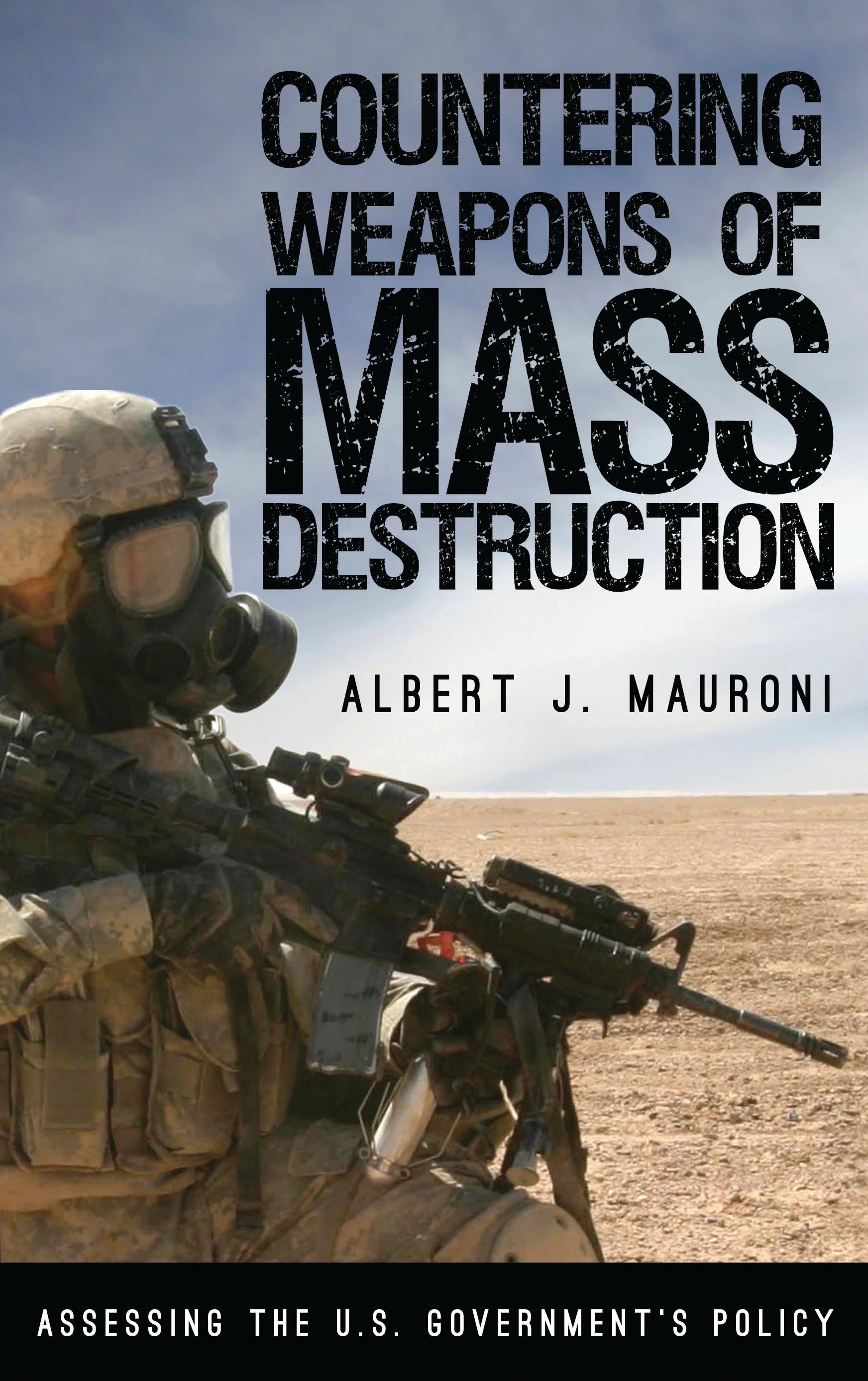
The Cold War phrase “weapons of mass destruction” continues to be used despite significant changes in international political cultures, military concepts of operation, and technology advances. Today, the term “weapons of mass destruction” (WMD) is used to address many things, from grams of ricin and barrels of industrial chemicals to megaton nuclear weapons. As a direct result of the decision to refer to all nuclear, biological, and chemical (NBC) weapons as well as biological, chemical and radiological (CBR) hazards as “WMD,” we have lost the ability to accurately develop, assess, and discuss policy concerns relating to the contemporary use of unconventional weapons on the battlefield and within the homeland.
This book uses a public policy framework to examine how the U.S. government, and in particular the U.S. military, should address the potential use of unconventional weapons in the 21st century. It defines the problem, identifies the policy actors and reviews policy options. It discusses past policy efforts before offering a critical review of current strategies and how WMD issues are integrated into the current military Joint Operating Concepts (deterrence, cooperative security, major combat operations, irregular warfare, stability, and homeland security), and proposes new national framework for countering WMD. The aim is to answer such questions as what does counterproliferation mean and whether the U.S. government is adequately prepared to protect U.S. citizens and its armed forces from adversaries developing unconventional weapons.
This book uses a public policy framework to examine how the U.S. government, and in particular the U.S. military, should address the potential use of unconventional weapons in the 21st century. It defines the problem, identifies the policy actors and reviews policy options. It discusses past policy efforts before offering a critical review of current strategies and how WMD issues are integrated into the current military Joint Operating Concepts (deterrence, cooperative security, major combat operations, irregular warfare, stability, and homeland security), and proposes new national framework for countering WMD. The aim is to answer such questions as what does counterproliferation mean and whether the U.S. government is adequately prepared to protect U.S. citizens and its armed forces from adversaries developing unconventional weapons.
Zahle einfach mit Karte, Klarna, Apple Pay oder Google Pay. Nicht zufrieden? Du hast immer ein 14-tägiges Widerrufsrecht. Lies mehr in unseren AGB. Hast du Fragen, schreib uns eine E-Mail an hello@memmo.org.
Memmo macht das Lernen einfacher – wo auch immer du bist. Bei uns findest du deine Kursbücher und smarte Lerntools an einem Ort: Zusammenfassungen, Quizzes, Podcasts und Lernkarten. Und Ted, dein Lernbuddy, beantwortet alles, was du wissen möchtest. Über 50.000 Studierende lernen bereits hier – gemacht, damit du schneller lernst und weniger Stress hast.