
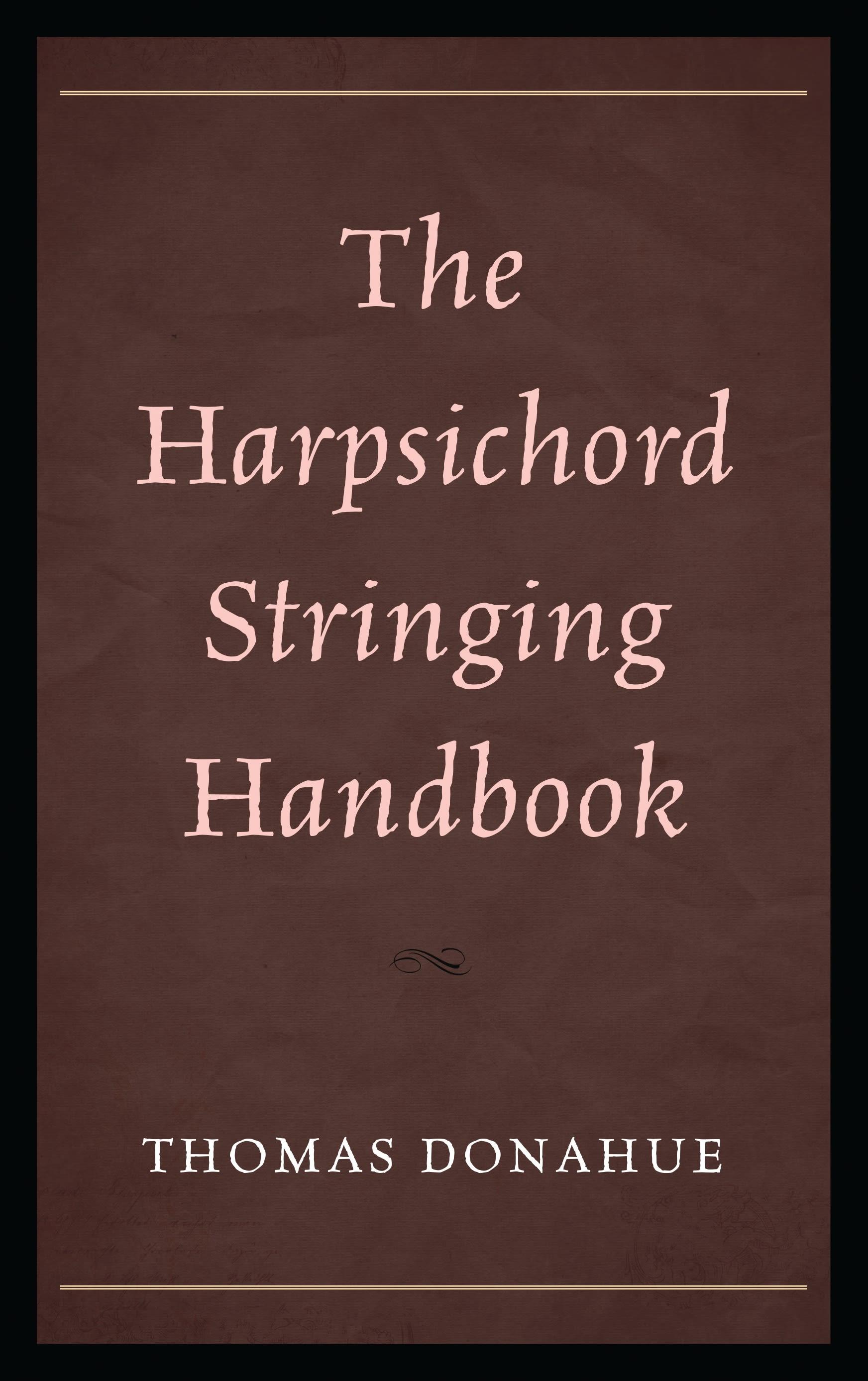
The harpsichord was the standard keyboard instrument for three centuries before the invention of the piano. It enjoyed a revival in the second half of the twentieth century, but because of the interruption in its history as a more regularly used instrument, many details about its construction are lacking. In The Harpsichord Stringing Handbook, Thomas Donahue integrates available historical evidence and modern physical principles—from both musicological and scientific literature—to provide practical quantitative information about the stringing of this instrument.
The Harpsichord Stringing Handbook covers the composition and properties of iron and brass wire, the interrelationship of frequency to string length, safety factors involved with stringing, the scaling of string lengths, the calculation of diameters, and the determination of the transition from iron to brass in mixed-strung instruments. Supplemental topics include the elasticity and plasticity of wire, inharmonicity, tension and stress, and the interpolation of string lengths. Additional material includes data on selected historical harpsichords, absolute diameters of historical gauge numbering systems, a generated list of tensile strength values for historical wire, and sizes and tensile strengths of currently available wire.
This book offers specific guidance for instrument makers, restorers, curators, technicians, musicians, kit builders, wire manufacturers, and acousticians, filling in critical details that historical treatises and surviving instruments may not clearly address.
The Harpsichord Stringing Handbook covers the composition and properties of iron and brass wire, the interrelationship of frequency to string length, safety factors involved with stringing, the scaling of string lengths, the calculation of diameters, and the determination of the transition from iron to brass in mixed-strung instruments. Supplemental topics include the elasticity and plasticity of wire, inharmonicity, tension and stress, and the interpolation of string lengths. Additional material includes data on selected historical harpsichords, absolute diameters of historical gauge numbering systems, a generated list of tensile strength values for historical wire, and sizes and tensile strengths of currently available wire.
This book offers specific guidance for instrument makers, restorers, curators, technicians, musicians, kit builders, wire manufacturers, and acousticians, filling in critical details that historical treatises and surviving instruments may not clearly address.
Zahle einfach mit Karte, Klarna, Apple Pay oder Google Pay. Nicht zufrieden? Du hast immer ein 14-tägiges Widerrufsrecht. Lies mehr in unseren AGB. Hast du Fragen, schreib uns eine E-Mail an hello@memmo.org.
Memmo macht das Lernen einfacher – wo auch immer du bist. Bei uns findest du deine Kursbücher und smarte Lerntools an einem Ort: Zusammenfassungen, Quizzes, Podcasts und Lernkarten. Und Ted, dein Lernbuddy, beantwortet alles, was du wissen möchtest. Über 50.000 Studierende lernen bereits hier – gemacht, damit du schneller lernst und weniger Stress hast.