
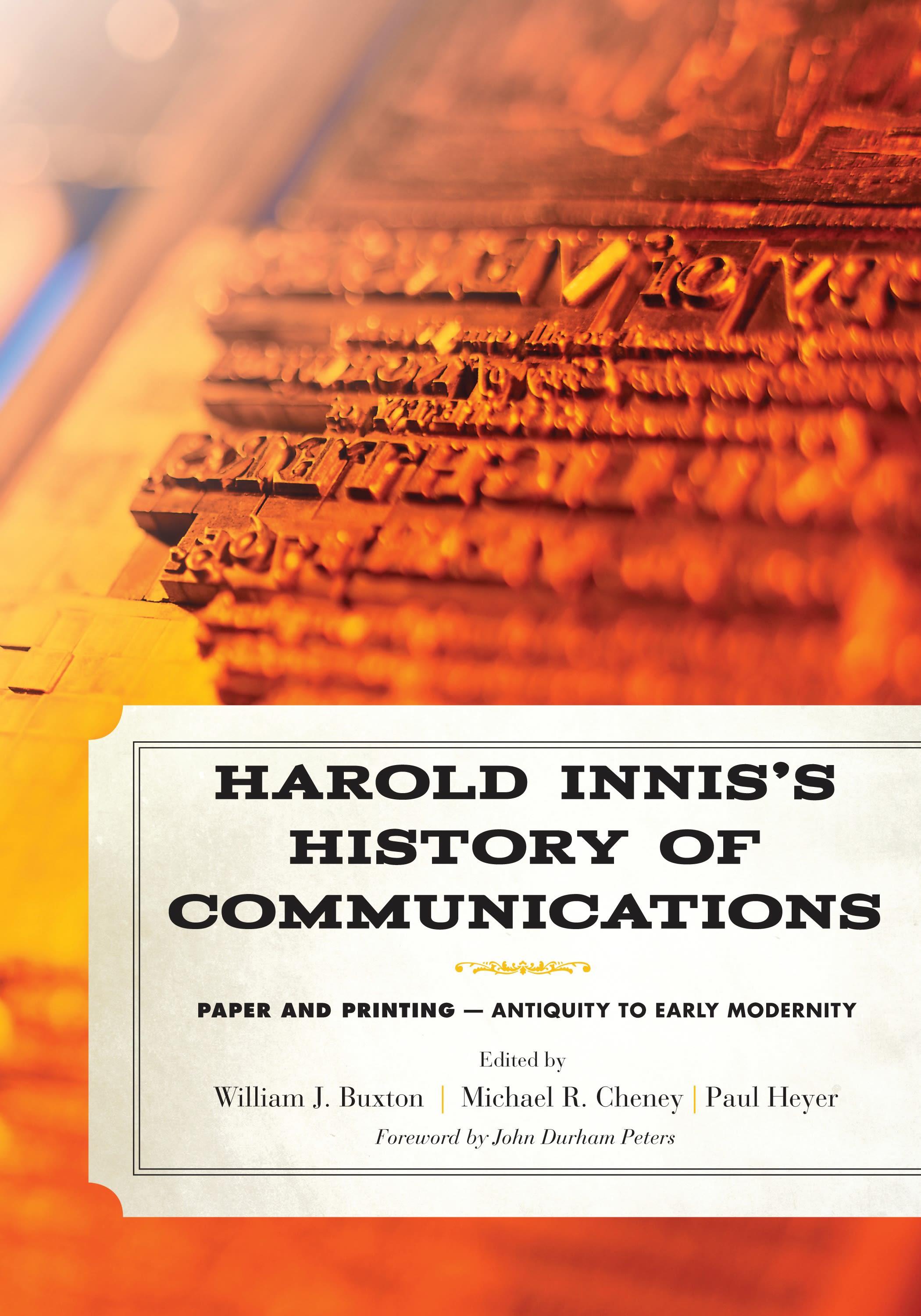
For decades, media historians have heard of Harold Innis’s unpublished manuscript exploring the history of communications—but very few have had an opportunity to see it. In this volume, editors and Innis scholars William J. Buxton, Michael R. Cheney, and Paul Heyer make widely accessible, for the first time, three core chapters from the legendary Innis manuscript.
Here, Innis (1894-1952) examines the development of paper and printing from antiquity in Asia through to 16th century Europe. He demonstrates how the paper/printing nexus intersected with a broad range of other phenomena, including administrative structures, geopolitics, militarism, public opinion, aesthetics, cultural diffusion, religion, education, reception, production processes, technology, labor relations, and commerce, as well as the lives of visionary figures.
Buxton, Cheney, and Heyer knit the chapters into a cohesive narrative and help readers navigate Innis’s observations by summarizing the heavily detailed factual material that peppered the unpublished manuscript. They provide further context for Innis’s arguments by adding annotations, references, and pertinent citations to his other writings. The end result is both a testament to Innis’s status as a canonical figure in the study of communication and a surprisingly relevant contribution to how we might think about the current sea change in all aspects of social, cultural, political, and economic life stemming from the global shift to digital communication.
Here, Innis (1894-1952) examines the development of paper and printing from antiquity in Asia through to 16th century Europe. He demonstrates how the paper/printing nexus intersected with a broad range of other phenomena, including administrative structures, geopolitics, militarism, public opinion, aesthetics, cultural diffusion, religion, education, reception, production processes, technology, labor relations, and commerce, as well as the lives of visionary figures.
Buxton, Cheney, and Heyer knit the chapters into a cohesive narrative and help readers navigate Innis’s observations by summarizing the heavily detailed factual material that peppered the unpublished manuscript. They provide further context for Innis’s arguments by adding annotations, references, and pertinent citations to his other writings. The end result is both a testament to Innis’s status as a canonical figure in the study of communication and a surprisingly relevant contribution to how we might think about the current sea change in all aspects of social, cultural, political, and economic life stemming from the global shift to digital communication.
Zahle einfach mit Karte, Klarna, Apple Pay oder Google Pay. Nicht zufrieden? Du hast immer ein 14-tägiges Widerrufsrecht. Lies mehr in unseren AGB. Hast du Fragen, schreib uns eine E-Mail an hello@memmo.org.
Memmo macht das Lernen einfacher – wo auch immer du bist. Bei uns findest du deine Kursbücher und smarte Lerntools an einem Ort: Zusammenfassungen, Quizzes, Podcasts und Lernkarten. Und Ted, dein Lernbuddy, beantwortet alles, was du wissen möchtest. Über 50.000 Studierende lernen bereits hier – gemacht, damit du schneller lernst und weniger Stress hast.