
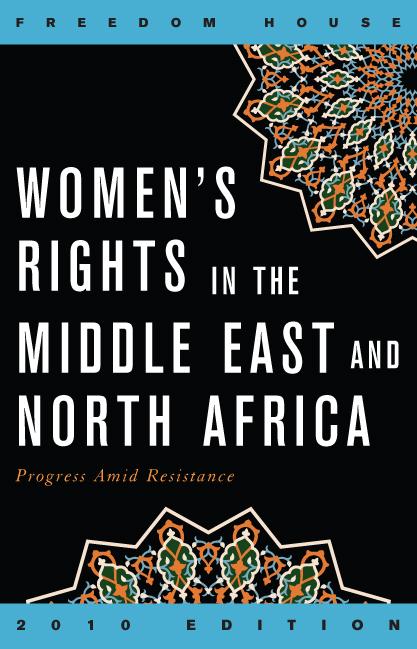
Freedom House's innovative publication Women's Rights in the Middle East and North Africa: Progress Amid Resistance analyzes the status of women in the region, with a special focus on the gains and setbacks for women's rights since the first edition was released in 2005. The study presents a comparative evaluation of conditions for women in 17 countries and one territory: Algeria, Bahrain, Egypt, Iran, Iraq, Jordan, Kuwait, Lebanon, Libya, Morocco, Oman, Palestine (Palestinian Authority and Israeli-Occupied Territories), Qatar, Saudi Arabia, Syria, Tunisia, United Arab Emirates, and Yemen. The publication identifies the causes and consequences of gender inequality in the Middle East, and provides concrete recommendations for national and international policymakers and implementers.
Freedom House is an independent nongovernmental organization that supports democratic change, monitors freedom, and advocates for democracy and human rights.
The project has been embraced as a resource not only by international players like the United Nations and the World Bank, but also by regional women's rights organizations, individual activists, scholars, and governments worldwide. Women's rights in each country are assessed in five key areas: (1) Nondiscrimination and Access to Justice; (2) Autonomy, Security, and Freedom of the Person; (3) Economic Rights and Equal Opportunity; (4) Political Rights and Civic Voice; and (5) Social and Cultural Rights. The methodology is based on the Universal Declaration of Human Rights, and the study results are presented through a set of numerical scores and analytical narrative reports.
Freedom House is an independent nongovernmental organization that supports democratic change, monitors freedom, and advocates for democracy and human rights.
The project has been embraced as a resource not only by international players like the United Nations and the World Bank, but also by regional women's rights organizations, individual activists, scholars, and governments worldwide. Women's rights in each country are assessed in five key areas: (1) Nondiscrimination and Access to Justice; (2) Autonomy, Security, and Freedom of the Person; (3) Economic Rights and Equal Opportunity; (4) Political Rights and Civic Voice; and (5) Social and Cultural Rights. The methodology is based on the Universal Declaration of Human Rights, and the study results are presented through a set of numerical scores and analytical narrative reports.
Zahle einfach mit Karte, Klarna, Apple Pay oder Google Pay. Nicht zufrieden? Du hast immer ein 14-tägiges Widerrufsrecht. Lies mehr in unseren AGB. Hast du Fragen, schreib uns eine E-Mail an hello@memmo.org.
Memmo macht das Lernen einfacher – wo auch immer du bist. Bei uns findest du deine Kursbücher und smarte Lerntools an einem Ort: Zusammenfassungen, Quizzes, Podcasts und Lernkarten. Und Ted, dein Lernbuddy, beantwortet alles, was du wissen möchtest. Über 50.000 Studierende lernen bereits hier – gemacht, damit du schneller lernst und weniger Stress hast.