
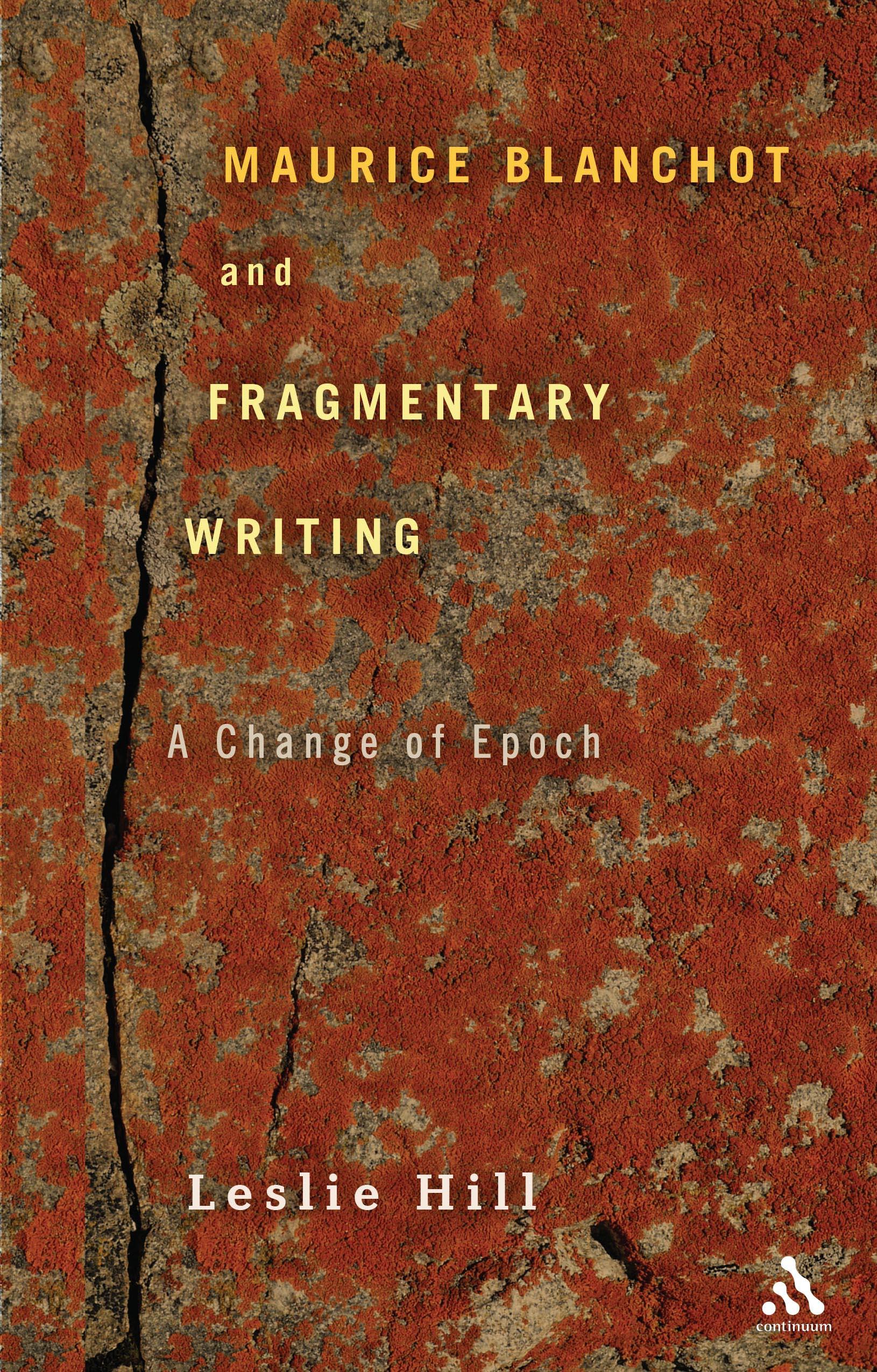
Writing in fragments is often held to be one of the most distinctive signature effects of Romantic, modern, and postmodern literature. But what is the fragment, and what may be said to be its literary, philosophical, and political significance? Few writers have explored these questions with such probing radicality and rigorous tenacity as the French writer and thinker Maurice Blanchot.
For the first time in any language, this book explores in detail Blanchot's own writing in fragments in order to understand the stakes of the fragmentary within philosophical and literary modernity. It attends in detail to each of Blanchot's fragmentary works (Awaiting Forgetting, The Step Not Beyond, and The Writing of the Disaster) and reconstructs Blanchot's radical critical engagement with the philosophical and literary tradition, in particular with Hegel, Nietzsche, Heidegger, Heraclitus, Levinas, Derrida, Nancy, Mallarmé, Char, and others, and assesses Blanchot's account of politics, Jewish thought, and the Shoah, with a view to understanding the stakes of fragmentary writing in Blanchot and within philosophical and literary modernity in general.
For the first time in any language, this book explores in detail Blanchot's own writing in fragments in order to understand the stakes of the fragmentary within philosophical and literary modernity. It attends in detail to each of Blanchot's fragmentary works (Awaiting Forgetting, The Step Not Beyond, and The Writing of the Disaster) and reconstructs Blanchot's radical critical engagement with the philosophical and literary tradition, in particular with Hegel, Nietzsche, Heidegger, Heraclitus, Levinas, Derrida, Nancy, Mallarmé, Char, and others, and assesses Blanchot's account of politics, Jewish thought, and the Shoah, with a view to understanding the stakes of fragmentary writing in Blanchot and within philosophical and literary modernity in general.
Zahle einfach mit Karte, Klarna, Apple Pay oder Google Pay. Nicht zufrieden? Du hast immer ein 14-tägiges Widerrufsrecht. Lies mehr in unseren AGB. Hast du Fragen, schreib uns eine E-Mail an hello@memmo.org.
Memmo macht das Lernen einfacher – wo auch immer du bist. Bei uns findest du deine Kursbücher und smarte Lerntools an einem Ort: Zusammenfassungen, Quizzes, Podcasts und Lernkarten. Und Ted, dein Lernbuddy, beantwortet alles, was du wissen möchtest. Über 50.000 Studierende lernen bereits hier – gemacht, damit du schneller lernst und weniger Stress hast.